Formations and roles · Analysis
4-4-2 vs 4-3-3: The Battle for the Spare Man
What really happens when three central midfielders meet two? Move through four tactical scenes, then test the idea against Liverpool, City, Atlético and Barcelona.
By 01 Owen
· Updated 25 Sep 2026 · 5 min read
TACTICAL FILM ROOM · INTERACTIVE EXPLAINER
Twenty players. One moving problem.
Follow the ball through four schematic moments. Blue defends in a 4-4-2; coral builds in a 4-3-3. The positions illustrate a principle, not footage or tracking data from a real match.
The route to No. 6 is screened
Three coral midfielders face two blue midfielders, but a blue striker stands between the centre-back and No. 6. Red marks the unavailable pass.
Read the four scene descriptions even if you pause the motion. Positions are deliberately simplified; the match examples below are sourced separately.
Three central midfielders against two sounds like a solved equation. It is not. The extra player matters only if the team in possession can find him, turn him and use the space his reception creates. A 4-4-2 can deny that pass with its two forwards and a narrow midfield four; a 4-3-3 can redraw the triangle until one defender has to make an uncomfortable choice. The moving board above is a schematic teaching sequence, not a reconstruction of any of the matches discussed below.
The short answer: what beats what?
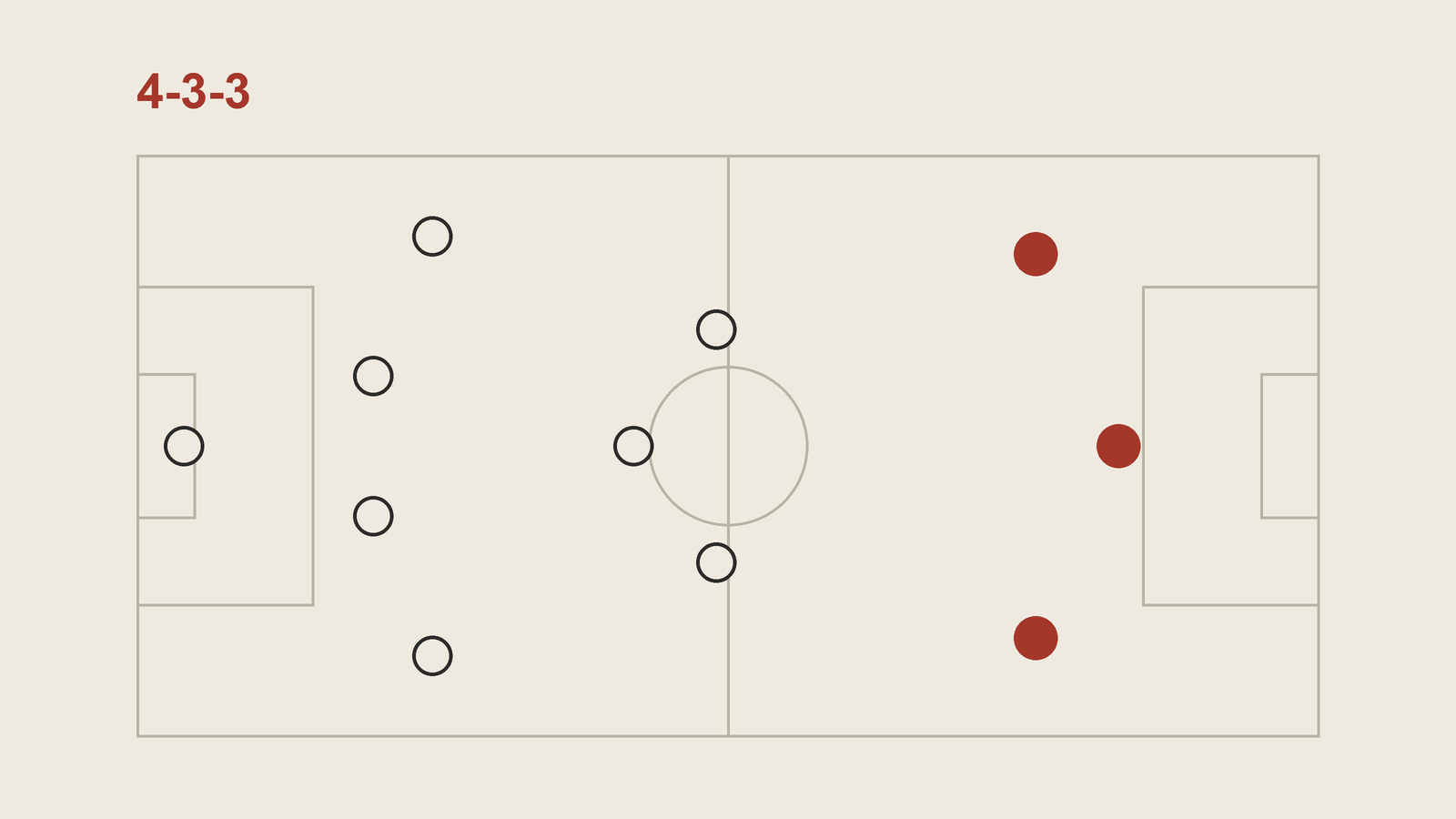
A 4-3-3 can use its third central midfielder when the deepest player changes angle during build-up play and becomes reachable behind the first line. A 4-4-2 can answer by screening that pass, narrowing its midfield four and pressing the ball wide. Neither formation wins this matchup on its own; access to the free player and the timing of the defensive shift decide each possession.
First, find the spare player
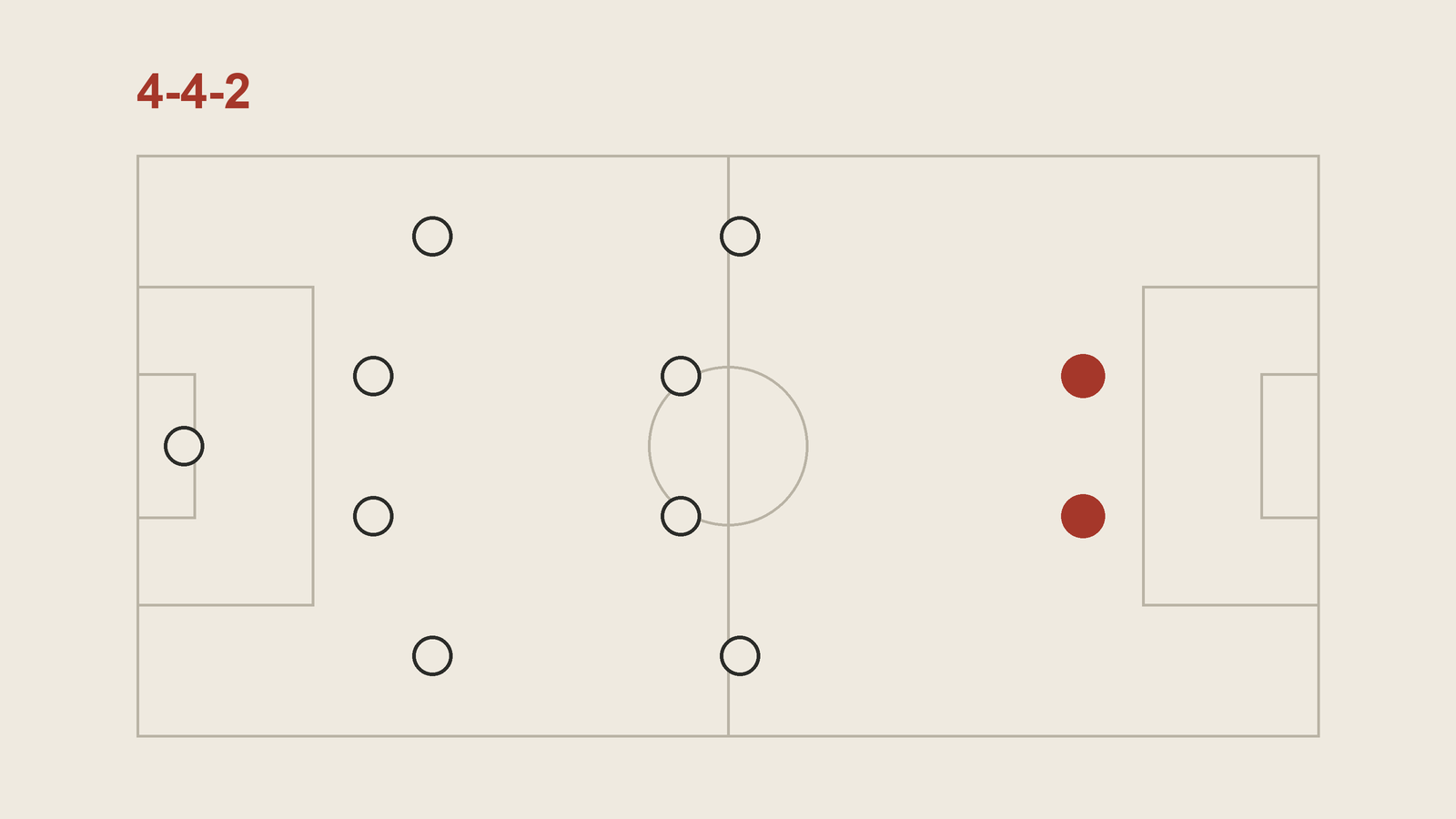
In a flat 4-4-2, the central pair can stand opposite two of a 4-3-3's three midfielders. That leaves the third without a direct central opponent. The obvious answer is to pass into him, but the defending forwards may screen the route from the centre-backs. A spare player behind a blocked passing lane is not yet an advantage. On the board, red shows the screened pass in scene one. In scene two, the deepest midfielder changes his angle while the nearby number eight occupies a defender. The cream pass becomes available only because those movements happen together.
This is the principle behind José Mourinho's early Chelsea midfield. Claude Makélélé sat behind two other midfielders in a 4-3-3, giving Chelsea a triangle against the flat pairs common in England at the time. The Premier League's account describes the extra central option; it is an explanation of a recurring structure, not proof that Chelsea won every individual match because of the formation. The practical question is whether that third player is accessible, not whether he appears on the teamsheet.
A match where the movement made the numbers count
Liverpool's 2–0 win over Manchester City on 1 December 2024 gives a more specific example. Liverpool began in a 4-3-3 shape; City defended in a 4-4-2. According to the Premier League's tactical review, Alexis Mac Allister dropped to draw out City's central pair, Luis Díaz came short into the space that opened, and Dominik Szoboszlai moved beyond him. The centre-forward's drop mattered as much as the nominal third midfielder. City had to decide whether a midfielder should follow, whether a centre-back should step out, or whether Díaz could turn.
The review also notes that City's adjustment after the interval gave them more possession and better access to wide areas. That matters to the claim here: Liverpool's first-half advantage was produced by timing, roles and available space. It was not a permanent property of the numbers 4-3-3.
How the 4-4-2 can answer
The defending side has several responses, each with a cost. One forward can shift across to screen the opposition's deepest midfielder, but that leaves the other centre-back under less pressure. A wide midfielder can tuck inside, but the far-side pass may then be open. Or the two forwards can screen central passes while the four midfielders stay narrow and invite the ball outside. The last option is a wide pressing trap: the nearest wide midfielder and full-back close the receiver against the touchline while the central pair protect the pass back inside.
FIFA's guide to defending as a unit stresses horizontal and vertical compactness, moving together and pressing when the ball goes wide. The third and fourth board scenes show those choices. They also show the trade-off: solving one passing lane can release a different player or create room behind the first press. Neither shape has a free solution.
A result that resists the simple equation
Atlético Madrid beat Barcelona 1–0 on 9 April 2014, advancing 2–1 on aggregate in the Champions League quarter-final. UEFA's season technical report describes Atlético's 4-4-2 with two screening midfielders, compact defensive work and quick vertical attacks; it describes Barcelona's 4-3-3 with a single screening midfielder. UEFA's match report records both Atlético's early chances and Barcelona's later openings. The result alone cannot isolate the effect of the formations. It does show why counting three against two does not predict who controls the dangerous spaces or wins the match.
Atlético's two forwards could threaten the first pass, the midfield line could protect the centre, and the side could break quickly when it recovered the ball. Barcelona could still create chances. A compact block is a way to manage a numerical disadvantage, not a guarantee that every attack is stopped.
What to watch in a real game
Forget the formation graphic for a minute. When a 4-3-3 builds against a 4-4-2, ask four questions: Can the deepest midfielder receive? Who follows a dropping forward? Can the defender on the ball play into the space that movement opens? What happens if the ball goes wide? The answers can change during one possession. Use the tactics board to move the players and test the alternatives yourself.
The central lesson is conditional: a 4-3-3 can create a spare midfielder, while a disciplined 4-4-2 can hide him behind a blocked lane, compress the centre or turn the duel into a wide trap. The better team is the one that repeatedly turns its shape into a useful passing option or a useful defensive choice.
Sources and further reading
- Liverpool 2-0 Manchester City: Why Slot's tactics got the better of Guardiola — Premier League
- Game Changers: Claude Makélélé — Premier League
- 2013/14 UEFA Champions League technical report — UEFA
- Koke takes Atlético through at Barcelona's expense — UEFA
- Team organisation out of possession — FIFA Training Centre