Glossary · Analysis
The Cues That Tell a Whole Team to Press at Once
Pressing triggers are pre-agreed cues, like a bad touch or a back pass, that tell a team to press together. Here's how they work and what the stats miss.
By 01 Owen
· Updated 19 Sep 2026 · 5 min read
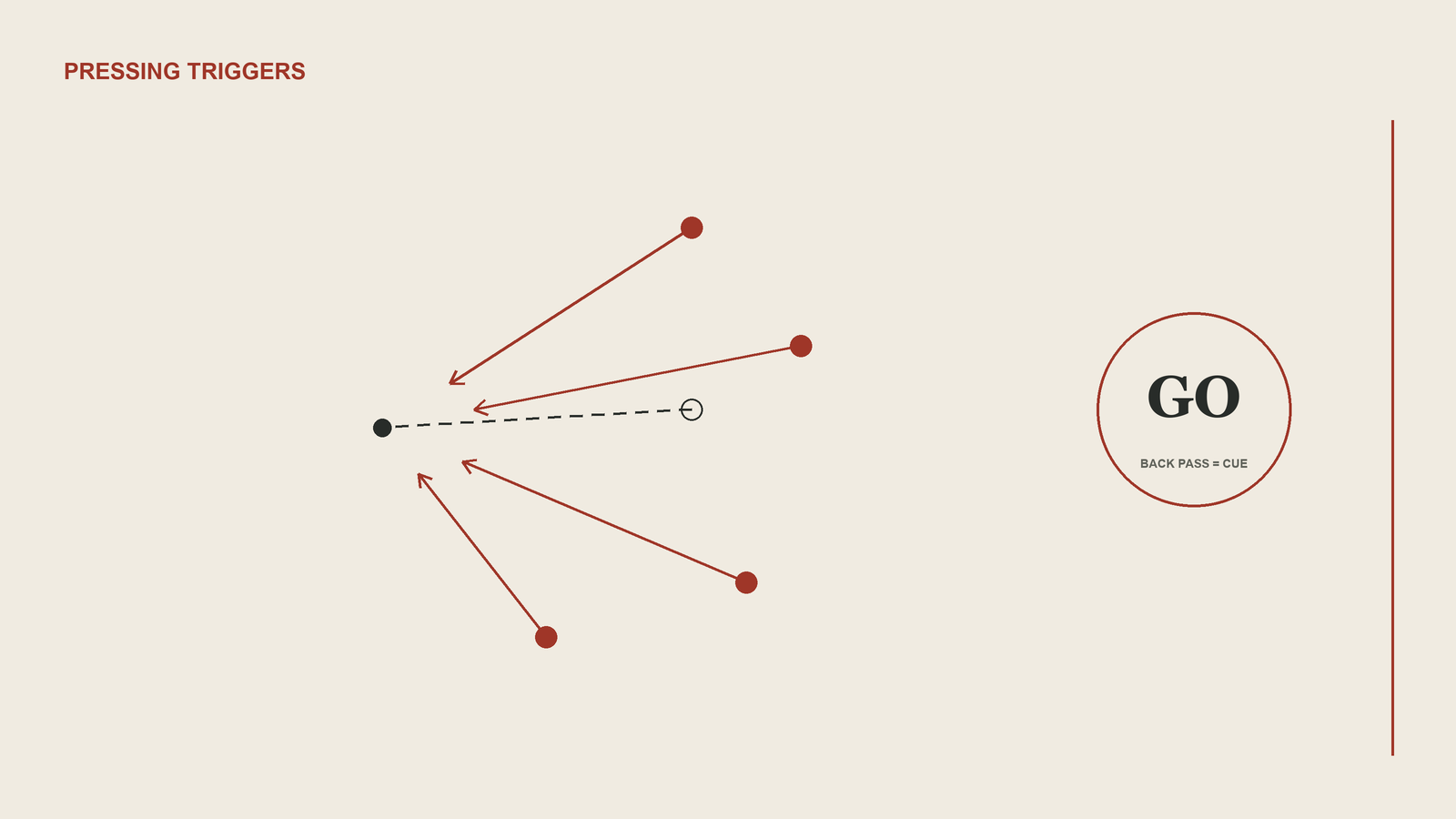
Pressing triggers are pre-agreed cues, such as a bad touch, a backward pass, a pass to the touchline or a player receiving with his back to goal, that tell the whole team to press together at the same moment. The word that matters in that sentence is "together". Any player can run at the ball. A press only works when the runner knows that the people behind him are stepping up to cut the passing lanes at the same time, and the trigger is the shared signal that makes that possible.
Most coaches teach some version of the same handful. A backward pass is the most common, because the receiver is usually facing his own goal and cannot see the press arriving until he turns. A heavy or bouncing first touch buys the pressing team the half second it needs to close the gap. A pass to a full-back near the touchline is another, since the line itself works as an extra defender and the receiver has only half a pitch of options. A slow, underhit pass gives the same window. Some teams also use specific players as triggers: let the good centre-back have the ball, jump when it reaches the weaker one or the goalkeeper.
Coaches' Voice describes it in almost exactly those terms: players must learn to recognise cues such as a backward, slow or inaccurate pass or a goalkeeper receiving under pressure as triggers to press hard and high together. The trigger is not the press itself. It is the moment the press is allowed to start.
This is why coordination matters more than intensity. A team that sprints at everything looks ferocious early and stretched later, because every charge that is not backed up opens a gap behind it. A team that presses only on triggers can look passive for long stretches, letting the opposition pass sideways in front of a compact shape, then move as one unit the instant the cue appears. The second team usually covers less ground and wins the ball in better positions.
The analytics side of this is where it gets awkward, because the public numbers see the outcome of a press but not the reason for it. PPDA counts how many opposition passes a team allows before it makes a defensive action in the attacking two thirds of the pitch. A low PPDA suggests the team is getting to the ball quickly. It does not say whether those actions came from a coordinated trap or from four players chasing at random and getting lucky. Pressure and regain counts go one step closer, because a pressure event records a player closing down an opponent within a few seconds of him receiving the ball, and a regain records whether the team got the ball back shortly afterwards. That shows where a team presses and how often it wins the ball, which is genuinely useful.
What neither metric captures is the trigger. The data knows a pressure happened after a backward pass; it does not know the team was waiting for that backward pass. You can infer it by checking which events tend to precede a team's pressures and regains, but that is analysis you do on top of the numbers, not something they hand you. The same is true of gegenpressing, where the trigger is the moment of losing the ball itself. A counter-press and a trigger-based high press look similar in an event feed but are different decisions on the pitch.
A concrete example is the goalkeeper back pass. The pressing team holds its line while the opposition centre-backs pass to each other. The moment one of them plays the ball back to the keeper, the striker curves his run so that his body blocks the return pass to the centre-back he came from, forcing the keeper to play to the other side or go long. The winger on that side is already moving towards the full-back before the pass is made, the nearest midfielder steps onto the pivot, and the back line pushes up behind them. Nobody needs to shout. The back pass was the instruction.
Triggers do not guarantee anything. A well-drilled possession team knows what the cues are and uses them as bait: the back pass invites the press, the keeper plays through it, and the pressing team is suddenly playing against a team that has just removed four of its players from the game with one pass. Triggers also assume the whole team recognises the cue at the same time, a training-ground habit that breaks down when players are tired, when substitutes have not learned the pattern, or when the opponent varies its build-up so the cue never quite appears. A press that never fires is not a press. It is a mid-block with ambitions.
When should you press in football?
When the cue you have agreed on appears, and only then, if the team is set up to go with you. The cue is usually a moment of vulnerability: a backward pass, a poor touch, a pass into a tight area, a receiver facing his own goal. Pressing outside those moments tends to cost more than it wins, because a single runner against a composed player in space is easy to play through and leaves a hole behind him. Whether to press high or in a mid-block is a question of where the triggers are set, not whether to use them. Even deep-defending teams have triggers; they are just further back.
Sources and further reading
- In Focus: High press — The Coaches' Voice (accessed 18 Sep 2026)
- Pressing Trigger — Football Paradise (accessed 18 Sep 2026)
- 8v8 attack v. defence: Pressing the goal kick — FIFA Training Centre (accessed 18 Sep 2026)