Glossary · Analysis
Build-Up Play Is a Plan for Beating the Press, Not a Preference for Short Passing
Build-up play is how a team moves the ball from goalkeeper and defenders into midfield against a press. Here's how it's shaped, measured and misread.
By 01 Owen
· Updated 19 Sep 2026 · 4 min read
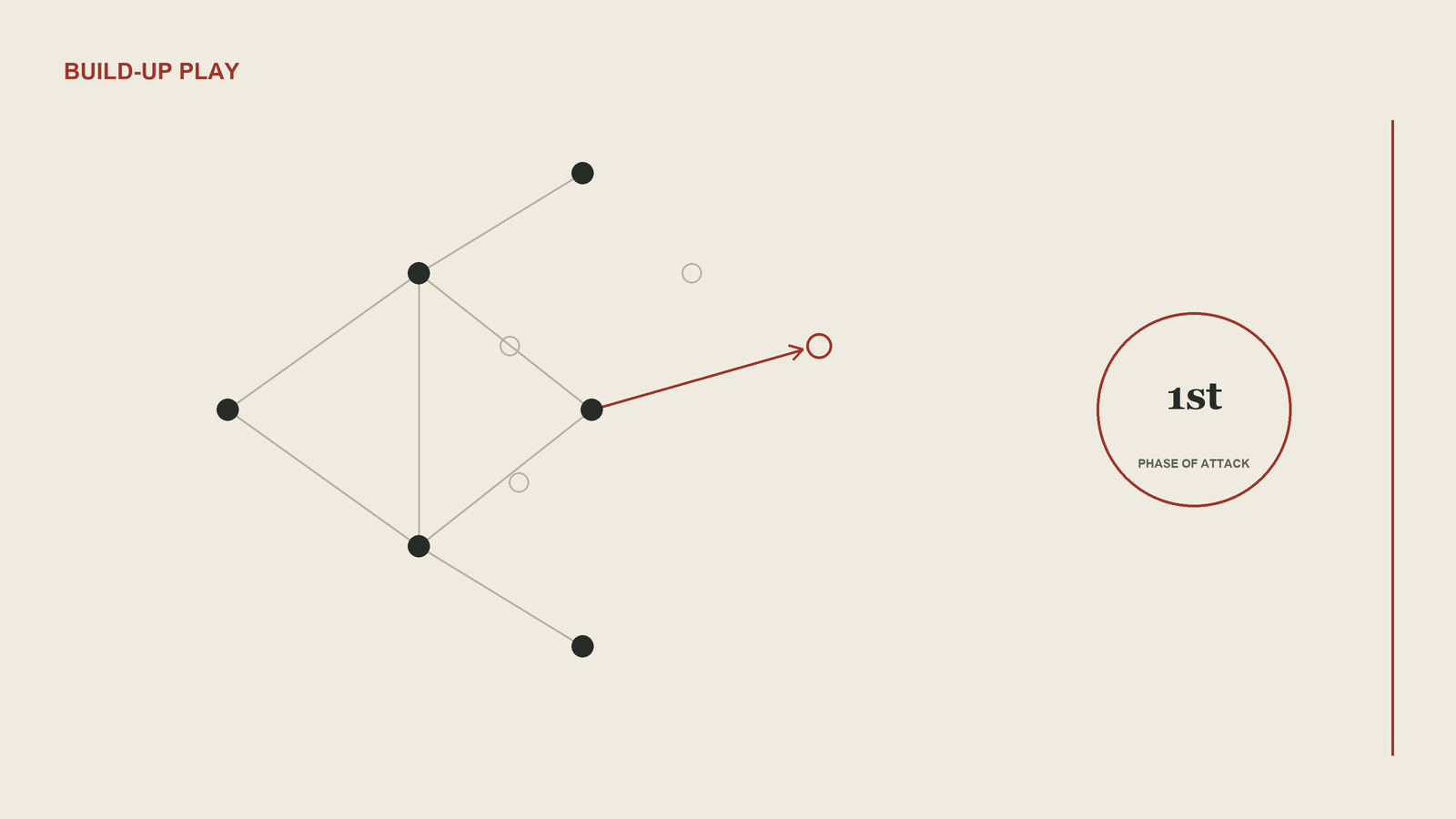
Build-up play is the structured way a team moves the ball from its goalkeeper and defenders into midfield against an opponent trying to stop it. That last clause is the important one. Passing the ball around the back four while the opposition sits in a mid-block is circulation, not build-up. Build-up starts the moment a team has the ball deep in its own half and someone on the other side is pressing to win it back, and it ends when the ball reaches a player facing forward in the middle third with the first line of pressure behind him. "Playing out from the back" describes the same phase, usually with the emphasis on refusing to clear the ball long.
The whole problem is arithmetic. If the opponent presses with a front three against a back four, the team in possession has a spare man. If the press adds a midfielder to make it four against four, the spare man disappears and someone has to create him again. That is why the goalkeeper has become the first piece of most build-up structures: he is the one player the pressing team almost never marks, so a defence that uses him as an extra passer always starts with a numerical advantage, however small. Coaches' Voice frames the modern goalkeeper's job in possession exactly this way, as the player who makes an overload in the team's own half possible before anyone else has moved.
From there the shapes vary, and it is worth resisting the idea that every team builds the same way. A back four can split wide with a holding midfielder dropping between the centre-backs to form a temporary back three. A back three can stay as it is and push the wing-backs high, using the width to stretch a front line that would rather stay compact. Some teams invert a full-back into midfield next to the pivot so the build-up shape becomes a three at the back with two in front of it, which gives the ball-carrier two short options and keeps a defensive rest structure in place if possession is lost. Manchester City under Pep Guardiola used John Stones this way through the run-in of their treble season, stepping out of the defensive line to become a second midfielder when City had the ball. None of these is the correct answer. Each is a response to what the opponent's press takes away.
That is the trade-off analysts spend most of their time on. A team that presses high commits players forward and leaves space behind them, so a build-up that survives the press arrives in midfield facing a thinner defence. A team that presses less aggressively concedes the first pass but keeps more bodies between the ball and its goal. PPDA is the standard way to put a number on the pressing side of that bargain, and reading a team's PPDA alongside its opponent's build-up success tells you whether the risk either side is taking is paying off.
Measuring the possession side is harder, because build-up is a sequence rather than a single event. The usual approach is to count the actions that actually move the ball out of the first third: progressive passes and carries starting in a team's own half, the number of passes a team needs to escape its defensive third, and how often a possession that starts with the goalkeeper ends with a deep completion or a shot. Some providers go further and cluster build-up sequences by their starting position and path, so a coach can see an opponent's preferred routes out rather than a single average. None of this is as standardised as expected goals. Two analysts can define the end of the build-up phase differently and get different numbers from the same match.
What build-up numbers do not tell you is whether the team is any good at attacking. Possession is not progress. A side can complete every pass in its own half, escape the press cleanly, and then have nothing to do with the ball once it arrives in the middle third. Equally, a team can build up badly on paper, going long from every goal kick, and still be effective if it wins the second balls and plays fast from there. Build-up is a phase, not a philosophy, and the metrics describe the phase. Whether escaping the press turns into chances is a question for the progressive actions and deep completions that follow, not for the build-up count itself.
Why is playing out from the back so popular?
Because the alternative hands the ball back. A long clearance from a goal kick or a pressed centre-back turns into a contest in the air that either side can win, so a team that goes long has roughly given up its own possession to gamble on the next one. Building through the press keeps the ball and, if the press is beaten, leaves the opponent with fewer players between the ball and goal than it started with. The cost is the occasional turnover in a dangerous area, which is why teams that play this way invest so much in the goalkeeper's passing and in rest-defence shapes that can cope when it goes wrong.
Sources and further reading
- What is build-up play in football? — zone14 (accessed 18 Sep 2026)
- What Is Build-Up Phase In Football? Tactical Theory — Total Football Analysis (accessed 18 Sep 2026)
- The modern goalkeeper: football tactics explained — The Coaches' Voice (accessed 18 Sep 2026)