Formations and roles · Analysis
Three in Midfield, Three Up Front, and Why It Took Over
The 4-3-3 lines up four defenders, three midfielders and three forwards. How the single pivot, the two number eights and the wingers work, and where it breaks.
By 01 Owen
· Updated 22 Sep 2026 · 4 min read
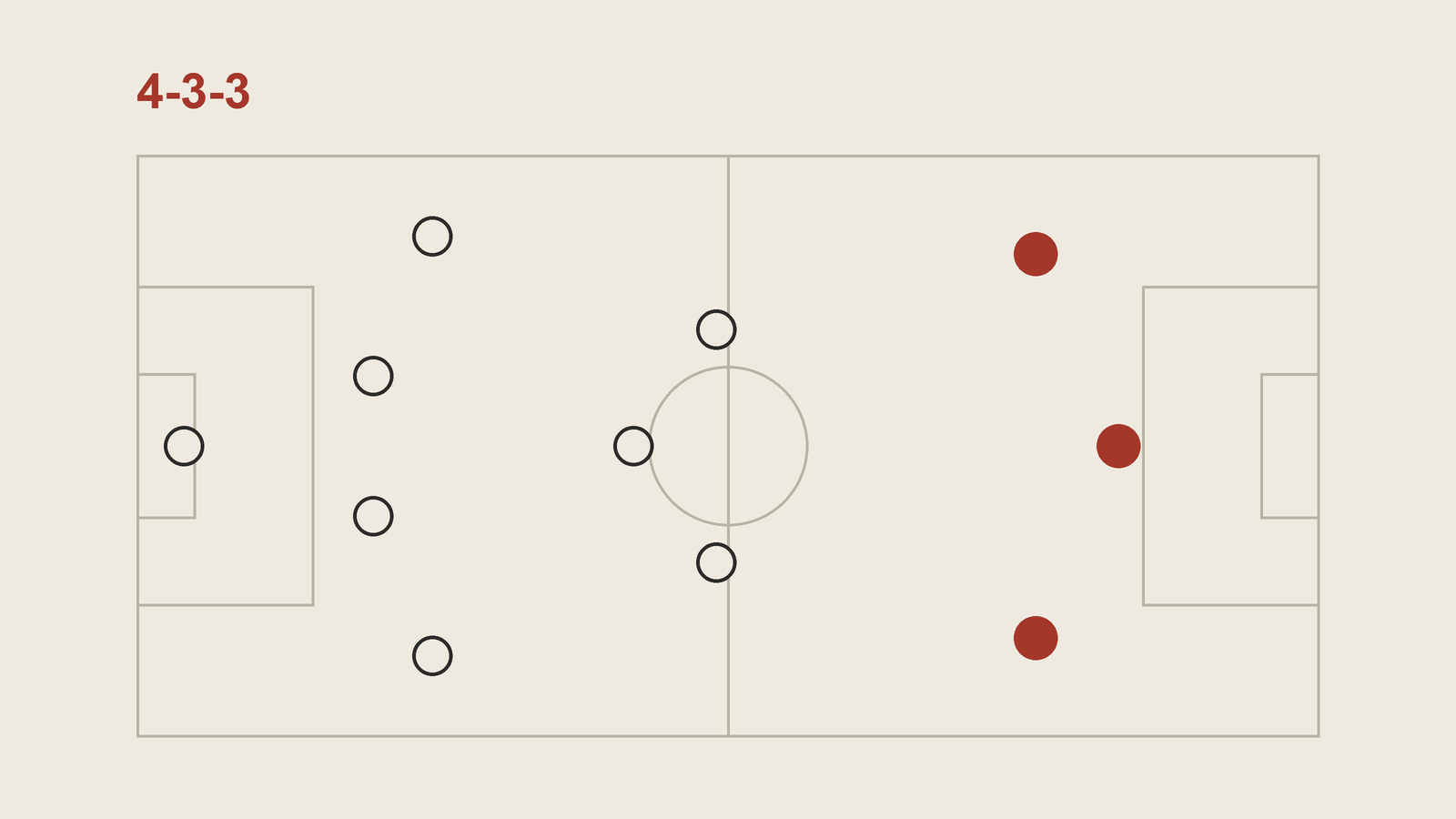
The 4-3-3 is a formation with four defenders, three central midfielders and three forwards: two wingers either side of a centre-forward. Its midfield triangle can provide an extra passing option against a central pair, although a dropping opponent can cancel that advantage. The formation alone does not determine how attacking a team will be.
The shape grew out of the 4-2-4. Brazil won the World Cups of 1958 and 1962 with a nominal four up front, but the left winger Mário Zagallo kept dropping into midfield, and what the team actually played was close to a 4-3-3. Rinus Michels made it the base of Ajax and the Netherlands in the 1970s, where the constant position-swapping became known as Total Football. Pep Guardiola's Barcelona between 2008 and 2012, and Jürgen Klopp's Liverpool, who won the Champions League in 2019 and the Premier League in 2020, are the modern reference points. They used the same numbers for very different football, which is the first thing to understand about any formation: it names starting positions, not a style.
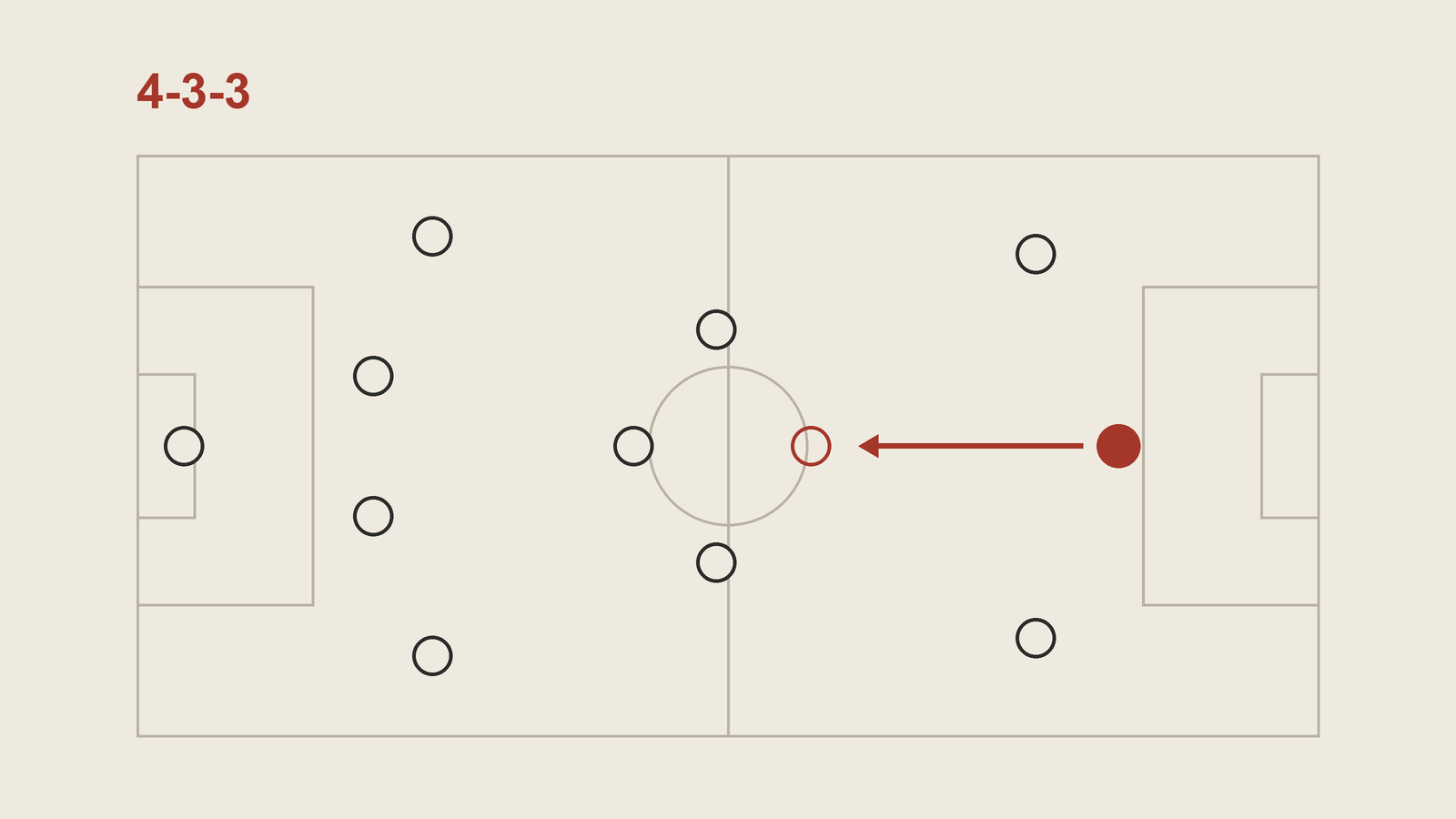
The midfield three is usually one deeper player and two in front of him. The deep one, the single pivot or number six, screens the centre-backs and offers the first pass in build-up play. The two number eights play ahead and to either side, in or near the half-spaces. One of them is often a runner who arrives in the box and the other a passer, and in Italy the wider-drifting version of the role has its own name, the mezzala. This triangle can also be flipped, with two holding players and one number ten, at which point the shape is really a 4-2-3-1.
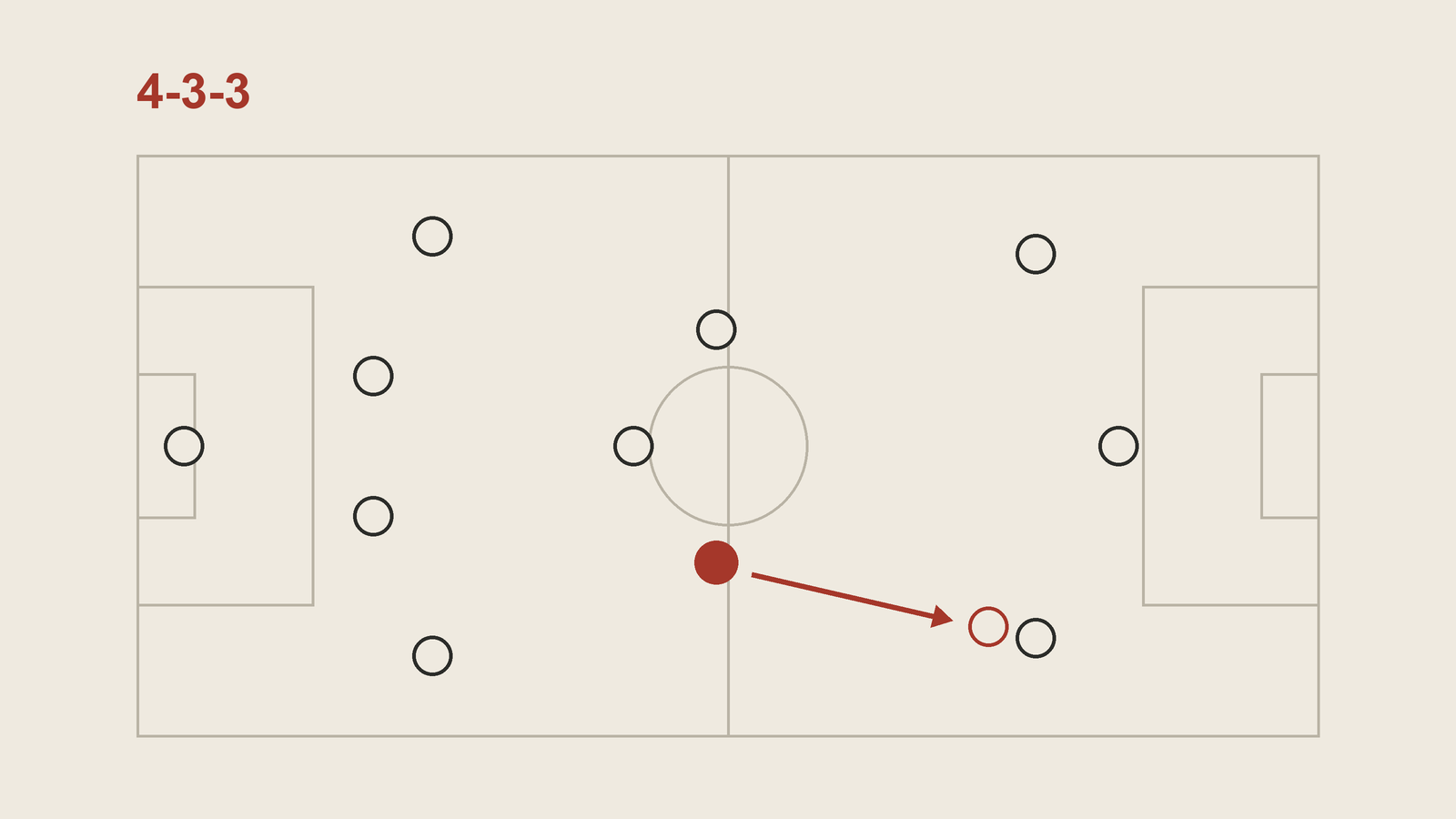
The front three decides what kind of 4-3-3 it is. At Barcelona the wingers stayed high and wide to stretch the back four, which opened room for the midfielders and for a false nine dropping off the front. At Liverpool it was the other way round: Mohamed Salah and Sadio Mané played narrow, close to goal, and the width came from the full-backs, Trent Alexander-Arnold and Andy Robertson, who ended up among the team's main creators. Either way the principle is that five lanes across the pitch are occupied, the two wings, the two half-spaces and the centre, so the defending line is stretched to its full width.
Without the ball the 4-3-3 presses well. The front three can steer the build-up toward one side while screening other passes. They cannot individually cover four defenders and a goalkeeper at once, so pressure depends on coordinated runs and support from midfield. Many sides do not defend in the shape they attack in, though. The wingers drop alongside the midfield and the block becomes a 4-5-1 or a 4-1-4-1, which protects the flanks at the price of leaving the striker alone.
The weaknesses come from the same place as the strengths. A single pivot has a lot of grass either side of him, and opponents who get a number ten or an inverted winger into those pockets can turn and run at the centre-backs. When the full-backs push on, the space behind them is open to transitions, so the pivot and the two centre-backs have to hold a sound rest defence. And the lone centre-forward is outnumbered by design. If the wingers and eights do not arrive around him, a 4-3-3 can have a lot of the ball and very little presence in the box.
That is also why the numbers on their own tell you little. Watch where the full-backs stand when the team has the ball, which midfielder drops between the centre-backs, and whether the wingers are wide or inside. Two teams that both announce a 4-3-3 can look nothing alike after the first pass. You can set up a 4-3-3 on the tactics board and move the pieces to see how quickly it becomes a 2-3-5 in attack or a 4-5-1 in defence.
Is the 4-3-3 an attacking formation?
It can be, but the forwards are not the reason. What the shape gives you is an extra player in central midfield and natural width high up the pitch, which helps a team keep the ball and pin the opponent back. Plenty of sides use the same 4-3-3 to defend deep and counter through fast wingers. The formation sets the starting positions; the instructions decide whether it attacks.
Sources and further reading
- The 4-3-3: football tactics explained — The Coaches' Voice
- Formation (association football) — Wikipedia
- Total Football — Wikipedia