Glossary · Analysis
The Few Seconds After the Ball Changes Hands
Transitions are the seconds after possession changes hands. Here's why attacking and defensive transitions produce so many chances, and how teams plan for both.
By 01 Owen
· Updated 19 Sep 2026 · 5 min read
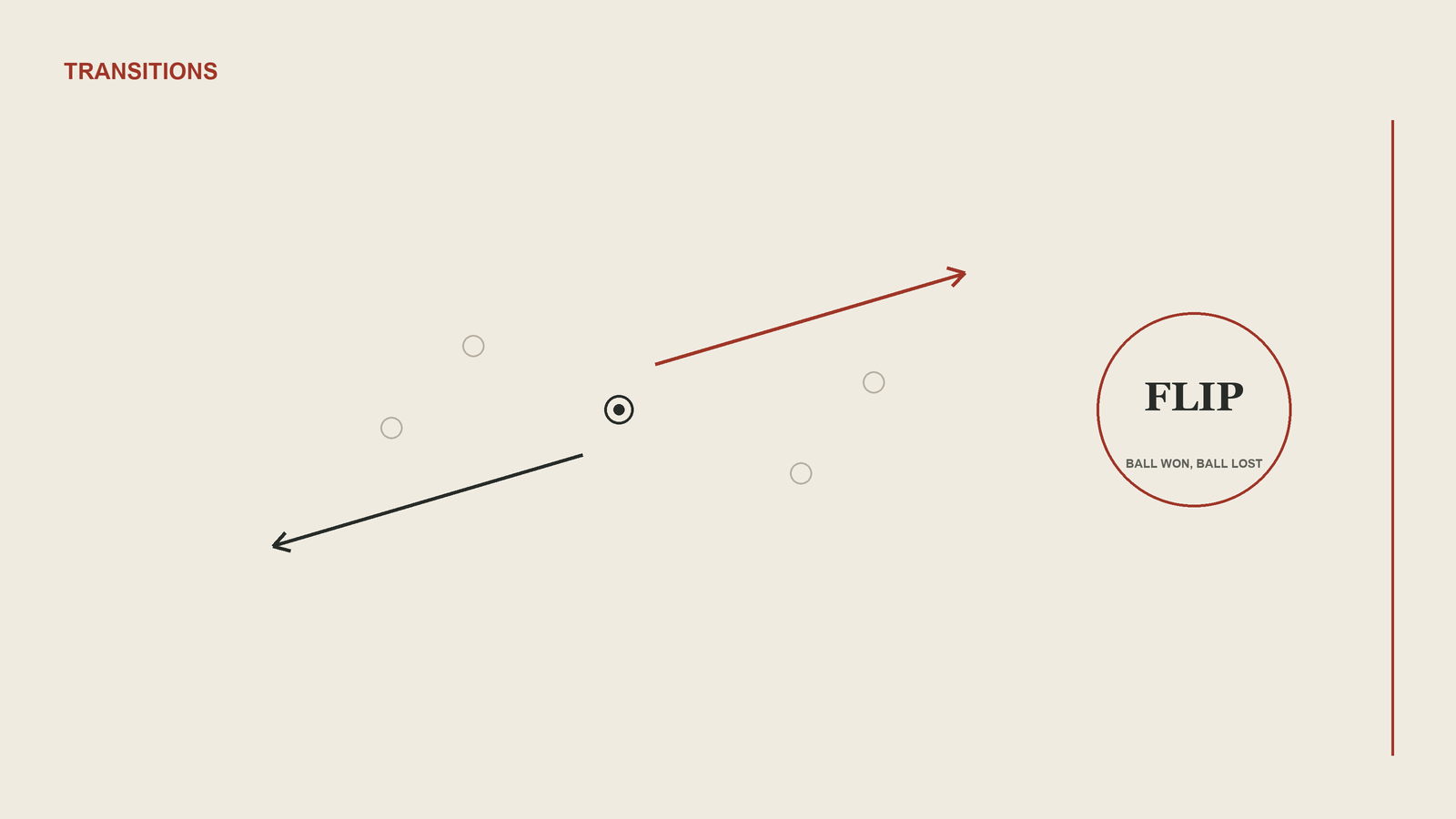
A transition is the short window immediately after possession changes hands, in either direction, when neither team is yet in the shape it wants to be in. The team that has just won the ball is in an attacking transition. The team that has just lost it is in a defensive transition. Both are usually over within a few seconds, and both are decided by what players do before anyone has time to think.
The term comes from the habit of dividing a match into four phases: in possession, out of possession, and the two transitions that connect them. The framing is common coaching shorthand, and it exists because the transition phases behave so differently from the settled ones. In possession or out of it, everyone knows their job and their position. The moment the ball is turned over, both organised pictures fall apart at once, and for a few seconds the pitch is full of players standing where the previous phase left them.
That is why transitions produce more than their fair share of chances. A settled defence is compact, has its lines in place, and can be attacked only by patiently moving it around. A defence caught in transition has full-backs high up the pitch, midfielders who were just supporting an attack, and centre-backs facing their own goal as they turn. How much of a team's danger comes from these moments depends on the league, the season and how the analyst defines a transition, but coaches from opposite ends of the tactical spectrum agree that the seconds after a turnover are some of the most decisive in any match, which is why teams built around a low block and teams built around possession both spend training time on them.
Planning for a defensive transition comes down to one choice, made in advance. A team can go straight after the ball, committing the nearest players to win it back before the opponent has settled. That is gegenpressing, and it works because the player who has just won the ball is often the least well-oriented person on the pitch. Or a team can drop, sprinting back behind the ball into its block and accepting that the opponent keeps possession for now. Thomas Tuchel's Chelsea in 2021 were a clear example of the second approach: the priority was numbers behind the ball, not immediate recovery. Counterpressing needs fitness and a high starting position; dropping needs discipline and a willingness to concede territory.
The attacking transition mirrors it. A team that has just won the ball can play forward immediately, before the opponent reorganises, which is the counter-attack in its purest form. Or it can slow the game down, keep the ball, and turn the transition into a settled possession phase. The first option rewards verticality: forward passes, forward runs, and a willingness to risk losing the ball again in exchange for a chance while the defence is still scattered. The second is safer but gives up the moment of disorganisation that made winning the ball valuable in the first place. Leicester City's title-winning side of 2015-16 chose the first option almost every time. N'Golo Kanté won the ball in midfield, Riyad Mahrez or Danny Drinkwater played it forward at once, and Jamie Vardy ran into the space behind a defence that had pushed up to attack.
Measuring any of this is harder than describing it. Most public data records events, not phases, so an analyst has to define a transition out of the event stream: a possession sequence that starts with a turnover in open play, perhaps limited to the first several seconds or the first few passes, and then count what happened. Shots and expected goals from those sequences give a rough picture of counter-attacking output. The number of times the ball is regained within a short window of losing it says something about counterpressing. Tracking data does better, because it can show how quickly a team recovers its shape, but tracking data is rarely public. Every version depends on a threshold someone chose, so two analysts can disagree about a team's transition numbers without either being wrong.
The term also has limits. A transition is a phase, not a style. A team can be excellent in transition while playing very little of its football there, and a team that lives on the counter can still be poor at the specific moment of the turnover. Nor does the word say where on the pitch the turnover happened, which matters enormously: a ball won on the halfway line and a ball won in the opposition penalty area are both attacking transitions, but they present completely different problems. Transition describes when. It does not describe how, where, or how well.
Why are transitions so important in football?
Because they are the only moments when both teams are out of shape at once. A settled attack against a settled defence is a slow negotiation for small advantages. When the ball is turned over, that negotiation stops. Players are positioned for a phase that has just ended, closed passing lanes are briefly open, and defenders are facing the wrong way. The team that reacts first, by winning the ball straight back or by playing forward before the opponent recovers, gets a chance at a defence it would otherwise have to work very hard to break down. That is why coaches with very different philosophies give transition its own training time.
Sources and further reading
- Attacking transitions: football tactics explained — The Coaches' Voice (accessed 18 Sep 2026)
- Defensive transitions: football tactics explained — The Coaches' Voice (accessed 18 Sep 2026)