Glossary · Essay
Low Block: Why Some Teams Would Rather Defend Their Own Box Than Press
Not every team wants the ball high up the pitch. A low block gives up territory on purpose, packing numbers near goal and forcing the opponent to solve a crowded box.

By 01 Owen
· Updated 6 Oct 2026 · 6 min read
Not every team that concedes possession is losing the tactical argument. A low block is a deliberate choice to defend deep, often with all ten outfield players behind the ball inside their own half, giving up territory and the ball itself in exchange for compressing the space an opponent has to work with near the only goal that matters.
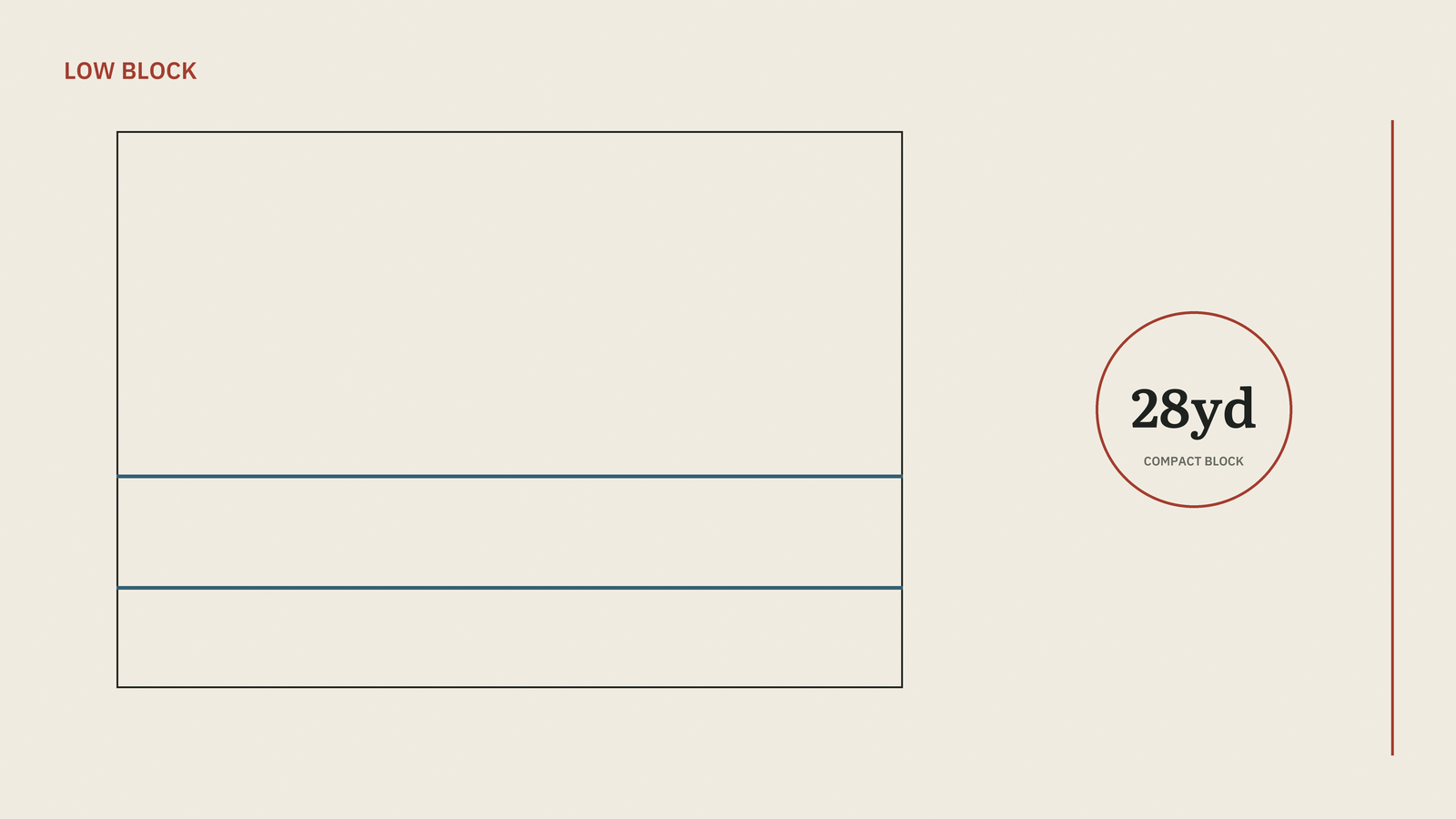
The shape usually looks like two or three banks stacked close together: a front line that screens central passing lanes without pressing high, a compact midfield line a short distance behind it, and a defensive line sitting deep enough that in-behind runs lose most of their value, since there's little room left to run into before reaching the goalkeeper. The distances between those lines are the entire point. A well-drilled low block keeps perhaps twenty-five or thirty yards between its front and back lines rather than the fifty or sixty yards a high-pressing team might concede, which means any pass that beats one line immediately runs into the next one instead of finding space to exploit.
When defending deep makes sense
This is a rational choice under specific conditions, not simply a fallback for weaker teams, though it's often caricatured that way. A side that's technically or physically overmatched gains more from making the pitch small and crowded than it would from contesting territory it's unlikely to win anyway; every yard of the pitch an opponent is allowed to have for free in front of a packed box is a yard that costs the defense nothing, since a team still has to solve the compressed space in front of goal regardless of how much of the rest of the pitch it dominates. It's also a common choice for a team protecting a lead late in a match, or for a side that has identified specific weaknesses, a lack of a genuine creative outlet against a settled defense, say, that it wants to test an opponent against for ninety minutes.
The statistical price of a low block
The cost shows up in exactly the numbers you'd expect. A team sitting in a low block will typically post low possession shares and a low, passive PPDA relative to its opponent, since it isn't contesting the ball in the middle third at all, and its own attacking output tends to depend heavily on quick transitions the moment it does win the ball back, rather than sustained buildup, because sustained buildup requires exactly the space a low block has spent the whole game refusing to have. Field tilt numbers for a low-block team are almost always lopsided against them, which is expected and not itself a sign the approach is failing; the entire strategy accepts a lopsided territorial share as the price of a compact defensive picture.
How a low block breaks down
The failure mode is equally specific. A low block breaks down when the compression itself is undone, most commonly through switches of play that force the whole shape to shift sideways faster than it can, since a block that's tight against a central attack can be stretched thin the moment the ball moves to the far side and the defense has to cover the same width with the same compact spacing. Set pieces are the other classic weak point, since a low block by definition concentrates bodies in exactly the penalty area where a well-delivered corner or free kick does its damage, and a team that's spent ninety minutes in a deep, tightly packed shape is defending set pieces from a standing start rather than from an organized, rehearsed setup.
It's the mirror image of gegenpressing, and a team's PPDA reading while sitting in a low block is usually about as passive as the stat gets.
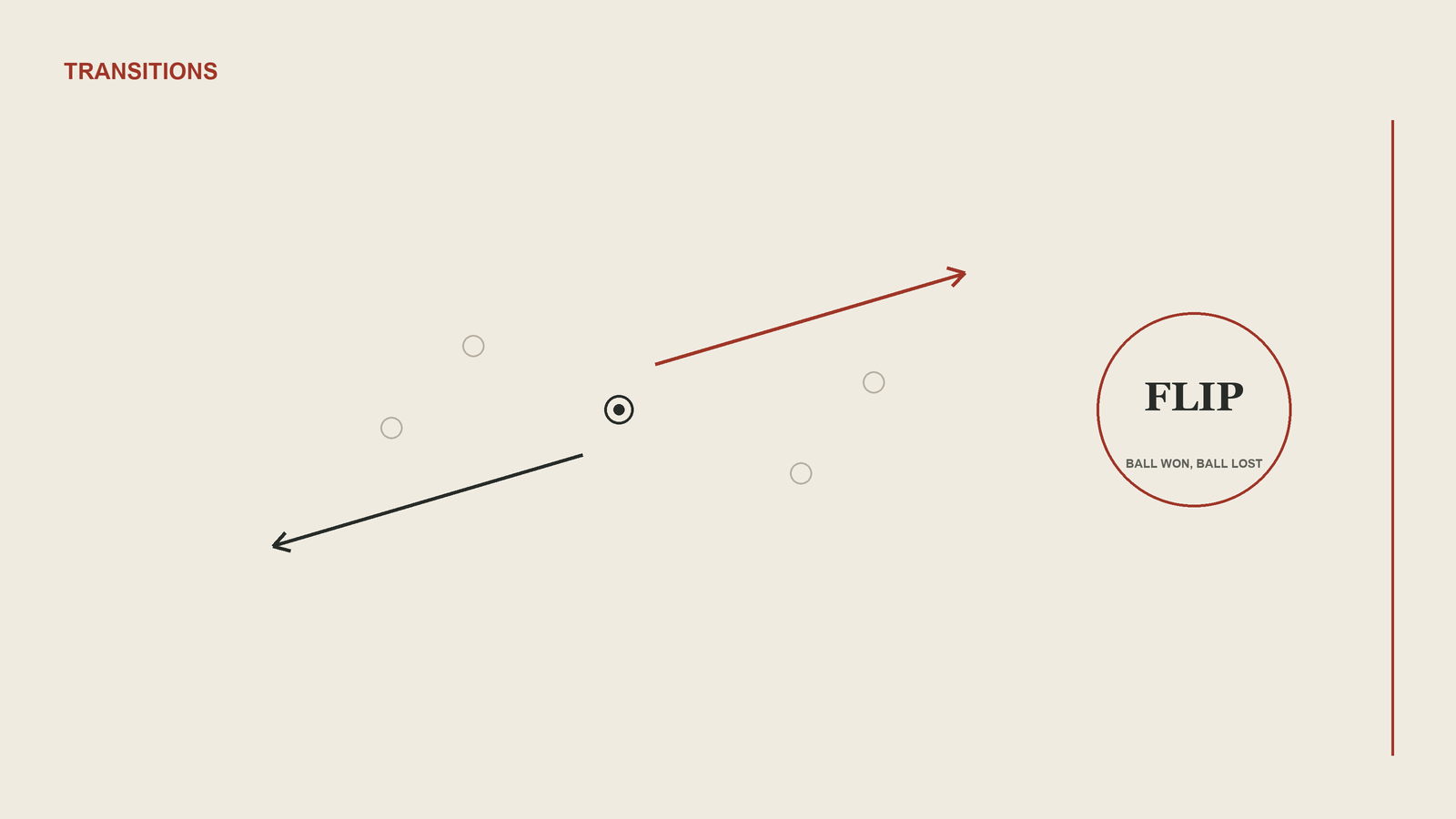
A low block is only half a plan; the other half is what happens when the ball is won. Its attacking threat lives in transitions, and the opponent's protection against that threat is their rest defence, which is what a counter-attacking side is really trying to beat.
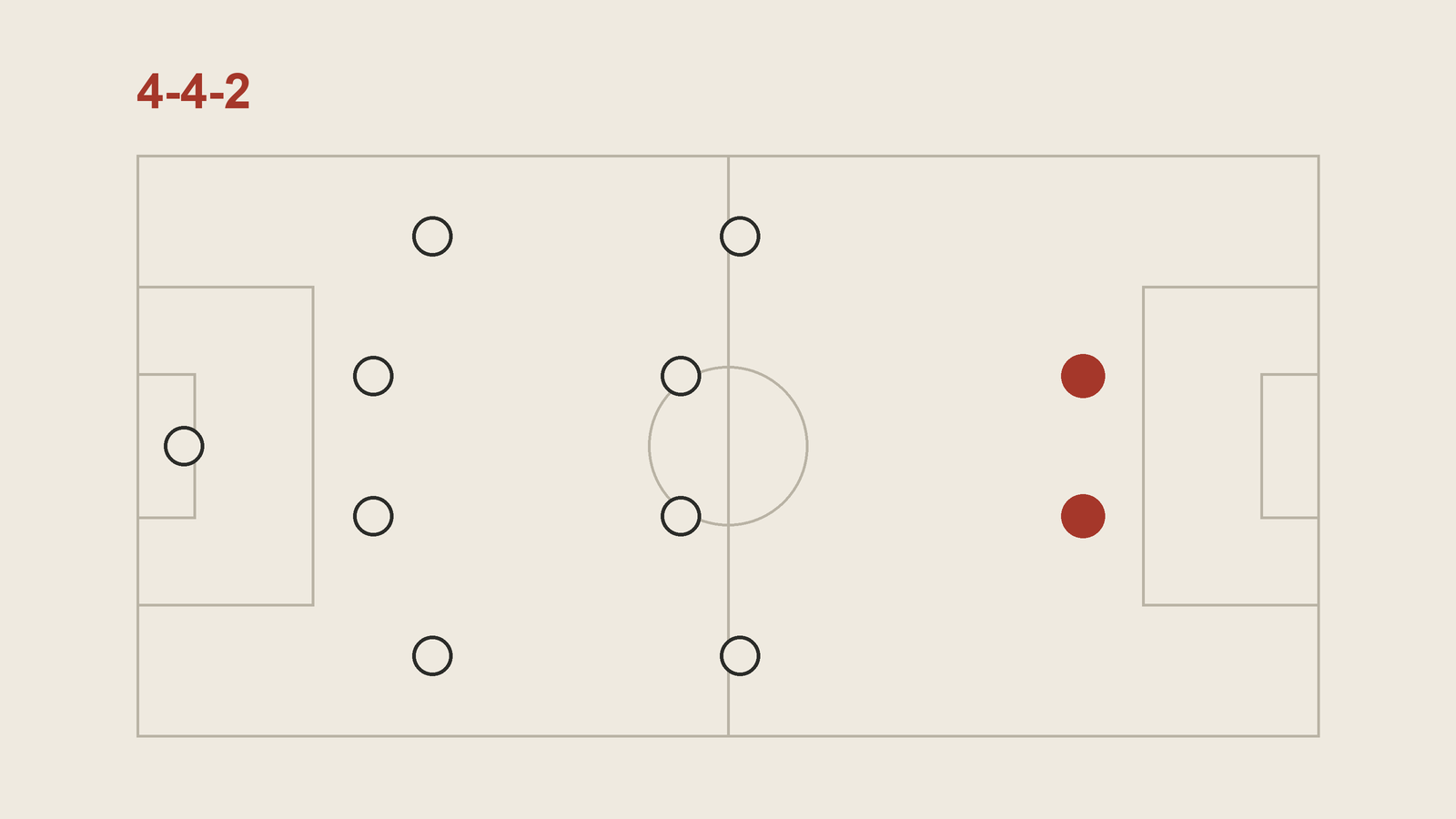
A 4-4-2 can form two compact lines of four. In a system with three centre-backs, the wing-backs can instead return to form a line of five.
A low block is sometimes called catenaccio, but the classic Italian catenaccio was a specific structure, with man-markers, a free sweeper and planned counter-attacks, not simply a deep defence.
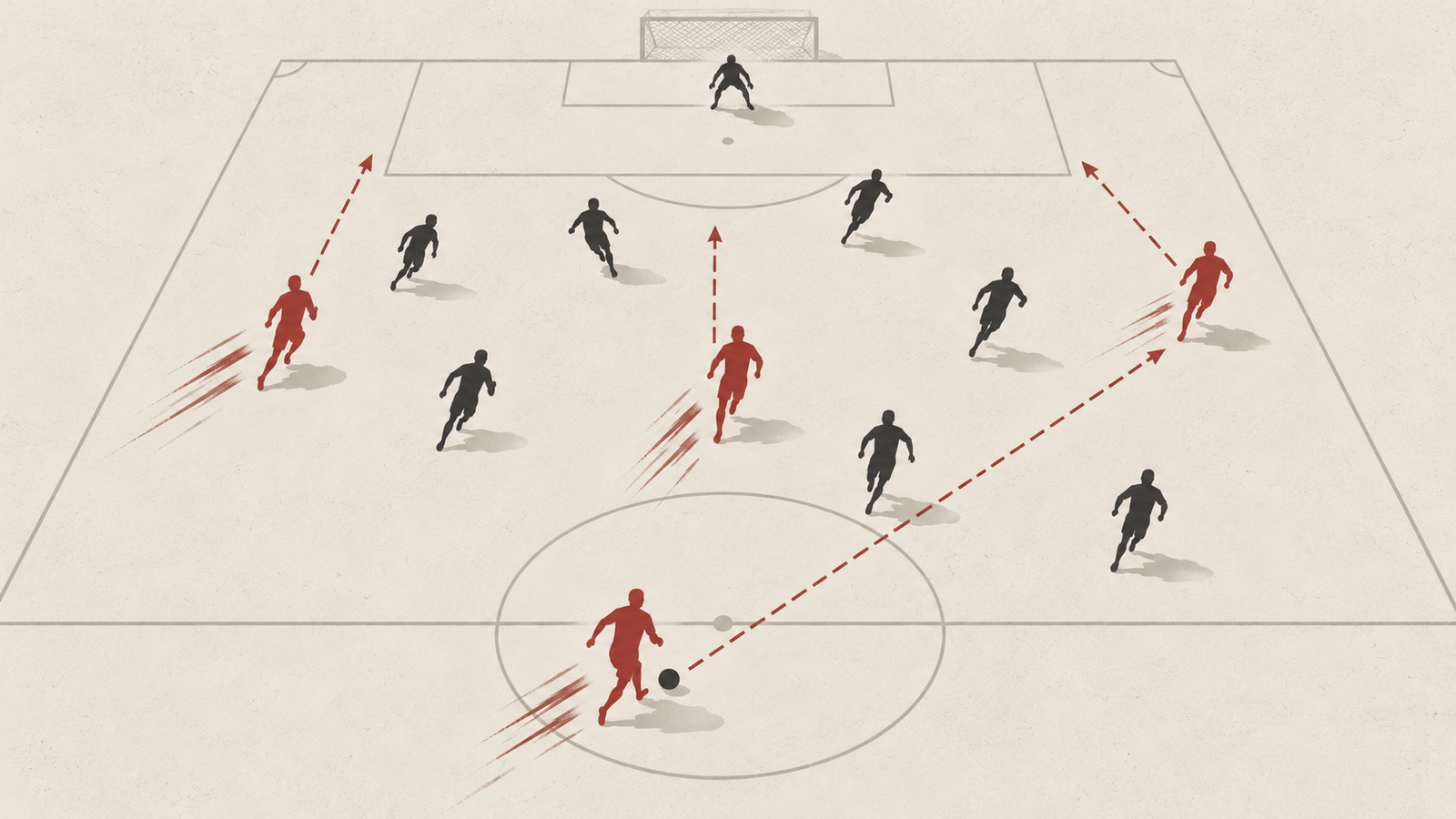
Teams sit in a low block to attack the space behind the opponent: winning the ball deep and breaking forward quickly is the heart of counter-attacking football.
One of the deepest shapes for a low block is the 5-4-1: five defenders and four midfielders form two compact lines, with nine players behind the ball and one striker left up front.
What's the difference between a low block and a mid-block?
The distinction is mainly about where the front line of pressure sits, not how compact the team is overall. A low block typically starts screening passing lanes from close to its own penalty area, conceding the middle third of the pitch almost entirely; a mid-block sets its first line of pressure closer to the halfway line, contesting the middle third more actively while still declining to press high up the pitch. Both prioritize compactness between the lines over winning the ball early, but a mid-block is a slightly more assertive version of the same basic idea.
How compact is a low block?
A well-drilled low block keeps perhaps twenty-five or thirty yards between its front and back lines, rather than the fifty or sixty yards a high-pressing team might concede. Its two or three banks sit close together, so any pass that beats one line immediately runs into the next one. The defensive line sits deep enough that runs in behind lose most of their value.
How do you break down a low block?
A low block breaks down when its compression is undone, most often through switches of play that force the whole shape to shift sideways faster than it can. Set pieces are the other classic weak point, because a low block packs bodies into the penalty area where a good corner or free kick does damage, and it defends them from a standing start.
Why do teams choose to play a low block?
A low block is a rational choice, not just a fallback for weaker teams. A side that is technically or physically overmatched gains more from making the pitch small and crowded than from contesting territory it is unlikely to win. It is also common for protecting a lead late in a match or for testing an opponent that lacks a creative outlet against a settled defence.
Sources and further reading
- Pressing — Spielverlagerung glossary (accessed 18 Sep 2026)
- Association football tactics — Wikipedia (accessed 18 Sep 2026)