Glossary · Analysis
The Shape You Keep While You Attack
Rest defence is the shape a team keeps behind the ball while it attacks. Here's how 2+1 and 3+2 structures work, how it pairs with counterpressing, and what data shows.
By 01 Owen
· Updated 19 Sep 2026 · 5 min read
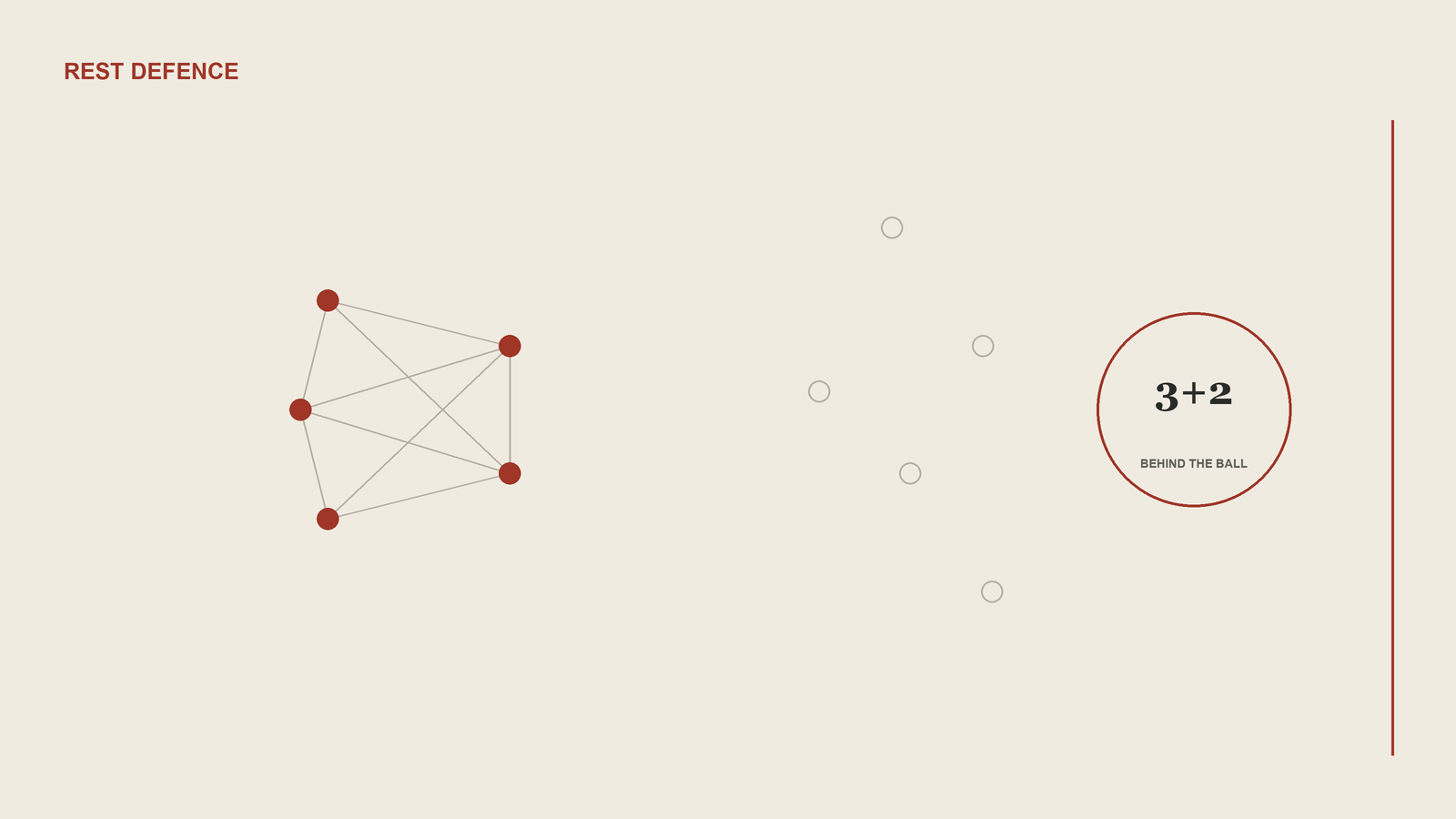
Rest defence is the shape and the number of players a team keeps behind the ball while it is attacking, so that it is already organised for the moment possession is lost. The term is a straight translation of the German Restverteidigung, where "rest" means what remains: the players not directly involved in the attack, and what they are doing while their teammates try to score. Every team has one whether it has planned it or not. The difference shows up a few seconds after a misplaced pass.
The logic is simple. The more players a team commits forward, the more space it leaves behind. If the ball is lost with eight players ahead of it, the two who remain are defending a whole half against whoever the opponent left up. Rest defence answers that problem in advance. The team decides before the attack starts who stays, where they stand and how far apart they are, so that a turnover meets a structure rather than a scramble.
The structures are described by how many players sit in each line behind the ball. A 2+1 keeps the two centre-backs and one holding midfielder back, about the lightest cover a top team accepts in open play. A 3+2 puts three in the last line and two in front, often built by a full-back tucking inside next to the centre-backs while a second midfielder drops beside the pivot. A 2+3 is the same five arranged the other way. The Coaches' Voice glossary frames the whole thing as five players attacking and five behind the ball, shifting to six and four when a team is chasing a goal. Those labels are shorthand, not a rulebook. The shape flexes constantly, because the players behind the ball also have to recycle possession and switch play.
That dual job is what makes it hard to coach. Stand too deep and narrow and the attack loses its passing options, so the opponent can defend the front five in comfort. Stand too high and wide and the first forward pass after a turnover goes straight through the middle. A 2023 study by Forcher and colleagues in the Journal of Sports Science and Medicine, combining expert interviews with Bundesliga tracking data, found that the speed of ball recovery was the strongest single factor in whether a rest defence succeeded, ahead of depth, compactness and numerical advantage. The shape matters mostly because of what it lets you do in the first few seconds.
That is why rest defence and gegenpressing are two halves of one plan rather than rival ideas. Counterpressing is the action: players near the ball swarm the new holder immediately. Rest defence is the insurance behind it. If the first wave fails, the opponent's escape pass should land in a zone where the remaining defenders already outnumber the runners. An aggressive counterpress with a careless rest defence gets beaten by one line-breaking pass. A careful rest defence with no counterpress just retreats and defends every transition at its own box.
The clearest recent example is Pep Guardiola's Manchester City with an inverted full-back. From the 2022-23 season, John Stones stepped from right-back into midfield beside Rodri when City had the ball, leaving three across the last line and two in front. That 3+2 block was widely credited with how rarely City were caught on the break in their treble season. Spain at the Tokyo Olympics built a similar four-player box from the centre-backs, a midfielder and a tucked-in full-back, which the FIFA Training Centre analysed in detail.
In the data, rest defence is mostly visible through what it prevents. The obvious counts are shots and expected goals conceded from fast breaks, or from possessions that start with a turnover in the opponent's half and reach the box within a handful of seconds. A dominant possession side that concedes a large share of its xG on the counter usually has a rest-defence problem. Pressures and regains show the other half: how quickly and how high the ball comes back after it is lost. Tracking data adds what event data cannot: how many defenders were actually behind the ball at the turnover, and how far apart.
What the concept does not tell you is how good a team is at defending in general. It only covers the transition moment. A side sitting in a low block for eighty minutes barely needs one, because it rarely has enough players forward to be caught. Nor do the labels say anything about quality. Two slow centre-backs in a textbook 3+2 can still be beaten by one quick runner. The numbers describe an intention; the players inside it decide whether it works.
How do you defend while attacking?
You decide before the attack who is not going to join it. In practice that means the centre-backs, at least one holding midfielder and usually one more player, either a full-back tucking inside or a second midfielder, holding positions that are close enough together to cover the central lanes and close enough to the attack to keep offering a pass. The turnover itself is the trigger for everyone else: players near the ball press it immediately, and the rest defence steps up to squeeze the space behind the press. Get the distances right and a lost ball becomes a chance to win it back higher, not a foot race towards your own goal.
Sources and further reading
- What is rest defence? Football tactics explained — The Coaches' Voice (accessed 18 Sep 2026)
- MOFT - Rest defence — FIFA Training Centre (accessed 18 Sep 2026)
- The Success Factors of Rest Defense in Soccer - A Mixed-Methods Approach of Expert Interviews, Tracking Data, and Machine Learning — Journal of Sports Science and Medicine (via PMC) (accessed 18 Sep 2026)