Glossary · Analysis
The Pass That Takes a Whole Defensive Line Out of the Game
A line-breaking pass travels through or beyond a line of opposition players. Here's how analysts detect it, why coaches prize it, and what the count leaves out.

By 01 Owen
· Updated 19 Sep 2026 · 5 min read
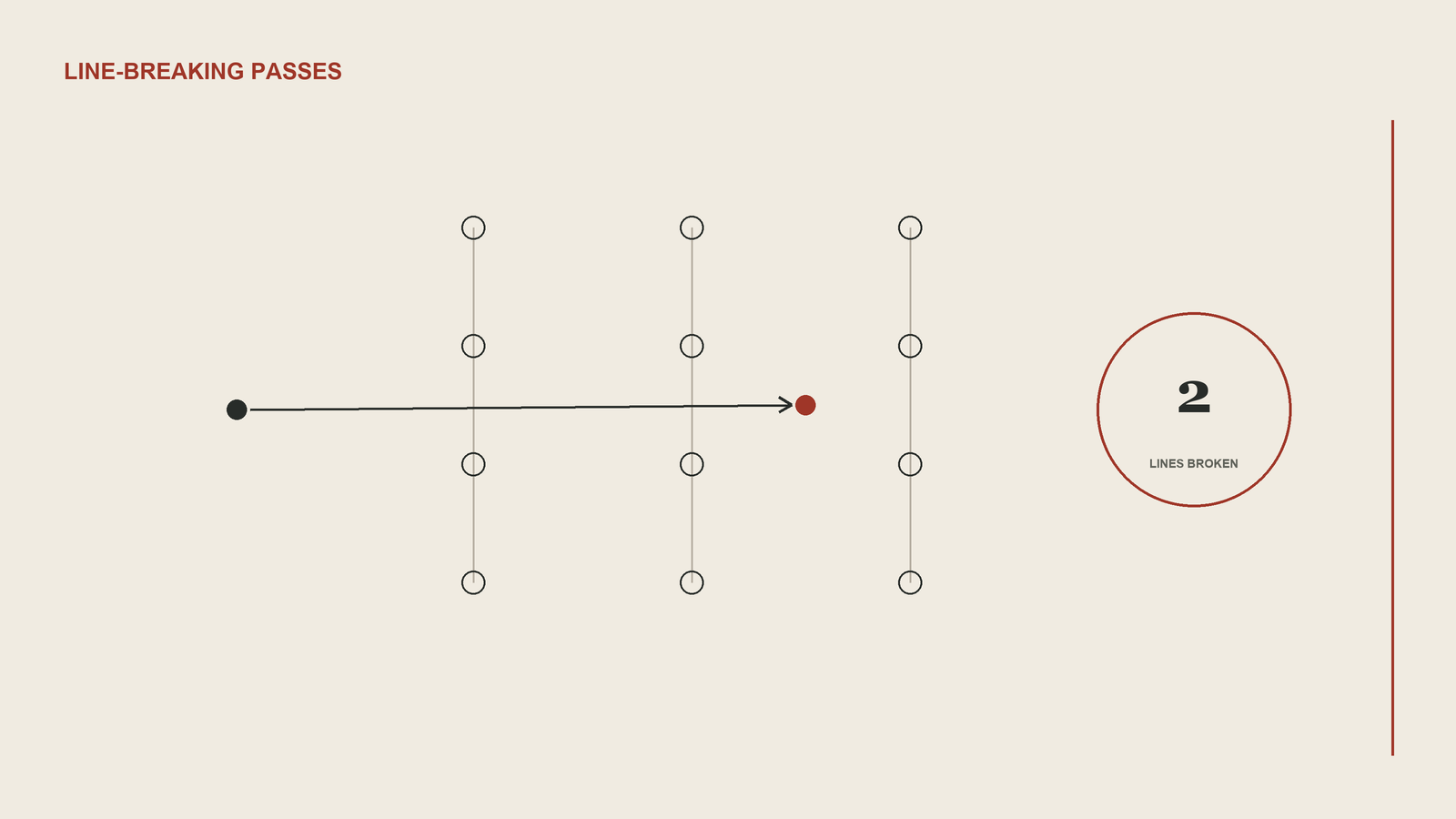
A line-breaking pass is a pass that travels through or beyond a line of opposition players and is received on the far side of it. Most teams defend in two or three horizontal bands: a front line of forwards, a midfield line, and a back line. A pass that starts in front of one of those bands and ends behind it has broken that line. A pass that moves the ball twenty metres forward but stays in front of the same midfield line has not, however good it looks.
Coaches have taught the idea for decades as "playing through the thirds". What changed is that data providers started counting it. Stats Perform, working with tracking data from the Belgian Pro League, defines a line-breaking pass as one that geometrically crosses an opposition line, moves the ball at least ten metres forward, starts at least five metres from the point where it crosses, and ends at least two metres beyond the deepest player in that line. StatsBomb's version, built on its 360 data, asks that the pass end at least ten percent closer to goal than it started and either pass between two nearby defenders or go behind the line altogether. Both are trying to separate a genuine penetration from a pass that skims the edge of a block.
Both definitions need to know where the defenders were at the moment of the pass, which is why the metric only became practical once tracking or freeze-frame data existed. Plain event data records where a pass started and ended, not who it went past. That is also why line-breaking counts live mostly inside clubs and provider platforms rather than on free stats sites.
Coaches care because the moment after a line is broken is the moment a defence is most exposed. The players in the line that was just bypassed are now facing the wrong way, or at least behind the ball, and the receiver usually has time and a forward-facing picture. Think of the standard scene from a Manchester City match under Pep Guardiola: a centre-back holds the ball, the opposition's front two screen the passing lane to Rodri, and the pass is delayed and delayed until a gap opens and the ball is fired between them into his feet. The opponent's first line has been removed from the play, and the next pass can be aimed at the space between their midfield and defence. Positional play is largely a system for manufacturing these gaps on purpose.
The evidence that this matters is fairly direct. In the Belgian Pro League study, the median probability of a goal following a line-breaking pass came out at roughly double that of a non-line-breaking pass, and failed attempts did not meaningfully raise the risk of conceding. That second finding undercuts the common instinct that a risky vertical pass is a liability. On this evidence, the risk is mostly worth taking.
The metric sits naturally next to progressive passes and carries, but they are not the same thing. A progressive pass is defined by distance toward goal, with no reference to where the opponents stood. A pass can be progressive without breaking a line, and, less often, can break a line while barely counting as progressive, for instance a short pass squeezed between two pressing forwards. A team's verticality tells you how directly it plays, which raises the chance of breaking lines but does not guarantee it. And expected threat values the destination of a pass, not its route, so a pass into a dangerous zone earns credit whether it went past six defenders or none. Line-breaking is the only one of these that explicitly measures the opponent.
That is also its weakness. A line is only worth breaking if it was a real line, and the count treats a well-organised block and a stretched, scrambling one identically. Breaking the front line of a team that is defending in a low block with everyone behind the ball is easy and nearly worthless. Breaking the last line of a high defence is rare and often decisive. The raw number flattens that difference unless it is split by which line was broken and where. It also says nothing about what the receiver did next, which is where most of the value is realised, and it cannot see a pass that was on but never played.
Read a line-breaking count as a description of how willing and able a team is to play through an opponent rather than around it. It complements the distance-based metrics. It does not, on its own, say how well the team attacked.
How impactful are line-breaking passes?
Considerably more than an average pass, as far as the public evidence goes. Stats Perform's analysis of a full Belgian Pro League season found that the median probability of a goal following a line-breaking pass was roughly twice that of other passes, and StatsBomb's on-ball value model consistently grades line-breaking passes higher than passes of similar length that do not cross a line. The impact is not uniform, though. Breaking a midfield line near halfway is common and modestly useful. Breaking the last defensive line inside the final third is rare and often leads straight to a shot, which is why the best analyses report the count by line and by zone rather than as one total.
Sources and further reading
- How Impactful Are Line-Breaking Passes? — Stats Perform (accessed 18 Sep 2026)
- StatsBomb 360: Exploring Line Breaking Passes — StatsBomb (accessed 18 Sep 2026)
- In Focus: Breaking lines — The Coaches' Voice (accessed 18 Sep 2026)