Glossary · Essay
What Expected Goals Actually Measures (and What It Doesn't)
Every shot carries a probability of becoming a goal. Expected goals puts a number on that probability, and gets misread more often than almost any other stat in the modern game.

By 01 Owen
· Updated 7 Oct 2026 · 6 min read
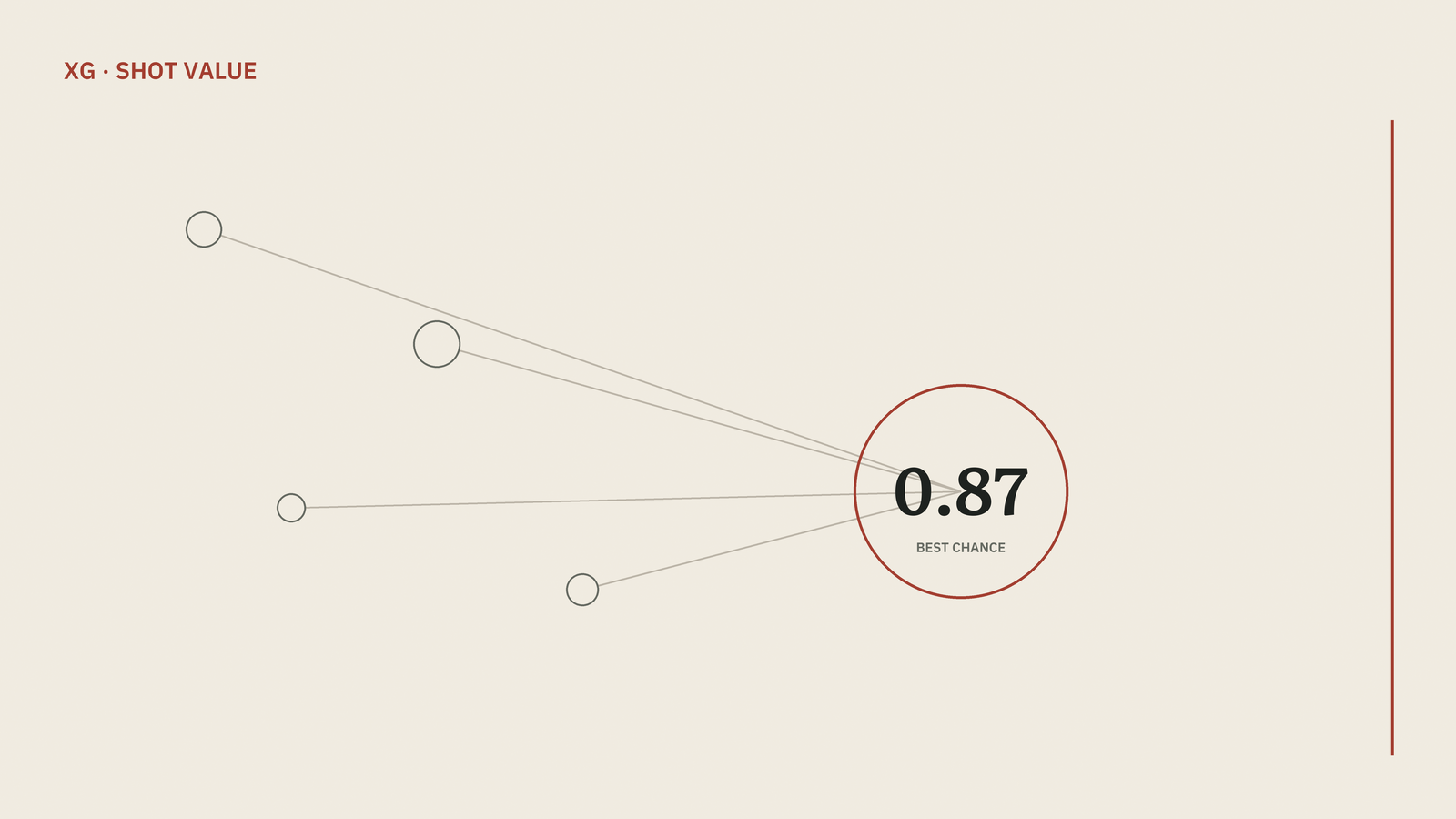
Every shot in football carries a probability of becoming a goal, and that probability is what expected goals, or xG, tries to put a number on. A tap-in from two yards with an open goal might carry an xG of 0.9. A speculative strike from thirty yards, hit from a tight angle with a defender closing in, might be worth 0.03. Add up every shot a team or player takes over a match, a season, or a career, and you get a total that says roughly how many goals that shot quality should have produced.
The model behind the number looks at thousands of historical shots and asks a simple question for each new one: of all the shots taken from this distance, this angle, under this kind of pressure, with this type of assist, how many went in? Distance and angle to goal do most of the work. Whether the shot was a header or hit with the foot matters. Whether the ball arrived from a cutback, a cross, or a through ball changes the number. Defensive pressure, the goalkeeper's position, and whether it was a one-on-one all shift it further, depending on how detailed the model is.
What xG does not predict
What xG is not is a prediction for that specific shot. Erling Haaland does not convert 0.9 xG chances 90 percent of the time because he is Erling Haaland; the model does not know who is taking the shot. It knows what the shot looked like geometrically. This is the most common misreading of the stat, and it is worth sitting with, because it explains most of the arguments people have about it.
It also explains why some players consistently score more than their xG suggests they should. A striker who repeatedly beats their expected total over several seasons is probably doing something the model can't see: exceptional placement, unusual composure, or simply being good enough at finishing that average conversion rates don't apply to him. One good month proves very little. Multiple seasons of overperformance start to look like a real skill rather than variance.
Why xG works best over many matches
The number is most useful in the aggregate, over a run of matches rather than a single game. A team can lose 1-0 while producing 2.4 xG to their opponent's 0.3, and that tells you something a 1-0 scoreline alone cannot: that the process was sound even though the result wasn't. Managers get sacked on the back of results that xG suggests were unlucky, and other managers survive results that xG suggests were flattering. Neither observation changes the final table, but both change how you should read the next few matches.
A description, not a verdict
Where the stat gets misused is when people treat it as a verdict rather than a description. "Team A deserved to win because their xG was higher" skips past everything that actually happened on the pitch: a goalkeeper having the game of his life, a team parking a bus and hitting on the counter, a red card that reshaped the second half. xG describes shot quality. It does not describe game plans, and it does not know that a team was playing with ten men for the last twenty minutes unless you adjust for it, which most public models don't.
Limits of the underlying data
There are also real limits to the underlying data. Different providers build their models on different shot samples and different input variables, which is why you'll see two websites disagree on the same match's xG total. Neither is lying; they're just weighting distance, assist type, and pressure differently. None of them account well for a shot taken a split second after a defender got a foot in the way, or a knockdown that arrived at an awkward height. The model reads geometry. It doesn't watch the game.
Used carefully, xG is one of the better tools for separating what a team did from what the scoreline says happened. Used carelessly, it becomes just another number people quote to win an argument they've already decided the outcome of.
For strikers who take a lot of penalties, the more useful number is non-penalty expected goals, which strips the guaranteed value of the spot kick out of the total. And none of this says anything about the goalkeeper on the other end of the shot, which is what post-shot xG is built to measure instead.
xG is also the raw material for other measures. Divide it by shots and you get shot quality, run the two teams' totals through a simulation and you get expected points, and compare either with results-based Elo ratings to see where performance and results disagree.
xG is the standard way to judge a striker: a forward who keeps getting high-xG chances is moving well even in a run without goals, while one who scores far above his xG may be finishing brilliantly or riding his luck.
Is xG a reliable predictor of match results?
Not on its own, and not for a single match. xG measures the quality of chances created and conceded, not who wins. A team can post a commanding 2.8-to-0.7 xG advantage and still lose to a stoppage-time set piece, because a single match is too small a sample for shot quality to reliably convert into a result. Over a run of matches, though, xG differential correlates much more closely with points than most other single stats available to the public, which is why analysts treat a persistent gap between a team's xG and its actual results as a signal worth investigating rather than dismissing as noise.
How is xG calculated?
An xG model looks at thousands of historical shots and asks, for each new one, how many shots from that distance, angle, pressure and type of assist went in. Distance and angle do most of the work. Header or foot matters, as does whether the ball came from a cutback, cross or through ball, and detailed models add pressure and the goalkeeper's position.
Can a player consistently beat his xG?
Yes, though it takes time to show. A striker who beats his expected goals total over several seasons is probably doing something the model cannot see, such as exceptional placement or unusual composure. The model does not know who is shooting. One good month proves very little, but multiple seasons of overperformance start to look like a real skill.
Why do different websites show different xG for the same match?
Different providers build their xG models on different shot samples and input variables, weighting distance, assist type and pressure differently. That is why two websites can disagree on the same match without either being wrong. None of them handles well a shot taken just after a defender got a foot in, or a knockdown at an awkward height.
Sources and further reading
- What are Expected Goals (xG)? — Hudl Statsbomb (accessed 18 Sep 2026)
- What Is Expected Goals (xG)? — Opta Analyst (accessed 18 Sep 2026)
- Expected goals — Wikipedia (accessed 18 Sep 2026)