Glossary · Essay
npxG: Why Analysts Strip the Penalties Out of a Striker's Numbers
Penalties inflate a striker's expected goals in a way that has nothing to do with open play. Non-penalty xG strips them out for a cleaner read on real chance creation.

By 01 Owen
· Updated 9 Oct 2026 · 5 min read

A penalty is worth roughly 0.76 expected goals almost regardless of who's taking it or which goalkeeper is facing it, because the model is built from thousands of penalties taken from the same spot, at the same distance, against a keeper who has to guess. That consistency is exactly why penalties distort a player's xG total if you don't separate them out. Two strikers can finish a season with identical expected-goals totals, one of them built almost entirely from open-play chances and the other inflated by five converted penalties, and a plain xG comparison would call them equally threatening from open play when they clearly aren't.
Non-penalty expected goals, npxG, is the fix: take the same shot-quality model used for xG and simply exclude penalty kicks from the calculation. What's left is a cleaner picture of how much danger a player or team creates through actual buildup play, movement, and finishing from open play and set pieces other than the spot kick.
Comparing strikers fairly
The gap between a player's npxG and their actual non-penalty goals tells the same overperformance story that xG does, just without a penalty taker's free conversions muddying the comparison. It's especially useful for comparing strikers who play for teams with different penalty-taking arrangements. A striker who doesn't take penalties for his club will always look artificially less prolific on raw goal counts next to a teammate who does, even if the non-taker is creating more dangerous chances from open play. npxG per ninety minutes is the number that corrects for that and lets you compare the two fairly.
Judging whether a team's attack is sustainable
It's also useful at team level for judging whether a side's attacking output is sustainable. A team that's scored a lot of goals partly because they've won and converted an unusually high number of penalties in a short stretch, more than their underlying play would suggest, is a candidate for regression once the penalty count normalizes, and npxG is one of the clearer ways to see that coming before it shows up in the results.
Why recruiters lean on npxG
Recruitment departments lean on npxG per ninety specifically because it travels better across leagues than raw goal totals do. A striker scoring seventeen goals in a mid-table league and a striker scoring seventeen goals in a title-chasing side aren't necessarily creating the same quality of chance; league quality, teammate quality, and yes, penalty allocation all shape the raw number. npxG per ninety strips out at least one of those variables, which is part of why it shows up so often in recruitment reports even though it's one of the simpler adjustments in the analytics toolkit.
Not a verdict on penalty takers
The stat isn't a verdict on penalty takers, and it shouldn't be read as suggesting penalties don't matter or don't take skill; converting them consistently under pressure over a full season is its own real skill, and missing them costs points just like missing any other high-value chance. The point of npxG isn't to dismiss penalties. It's to keep them from being counted twice: once as a converted goal, and again as evidence of open-play attacking quality they didn't actually demonstrate. Kept separate, both numbers, penalties and non-penalty output, tell you something a combined total blurs together.
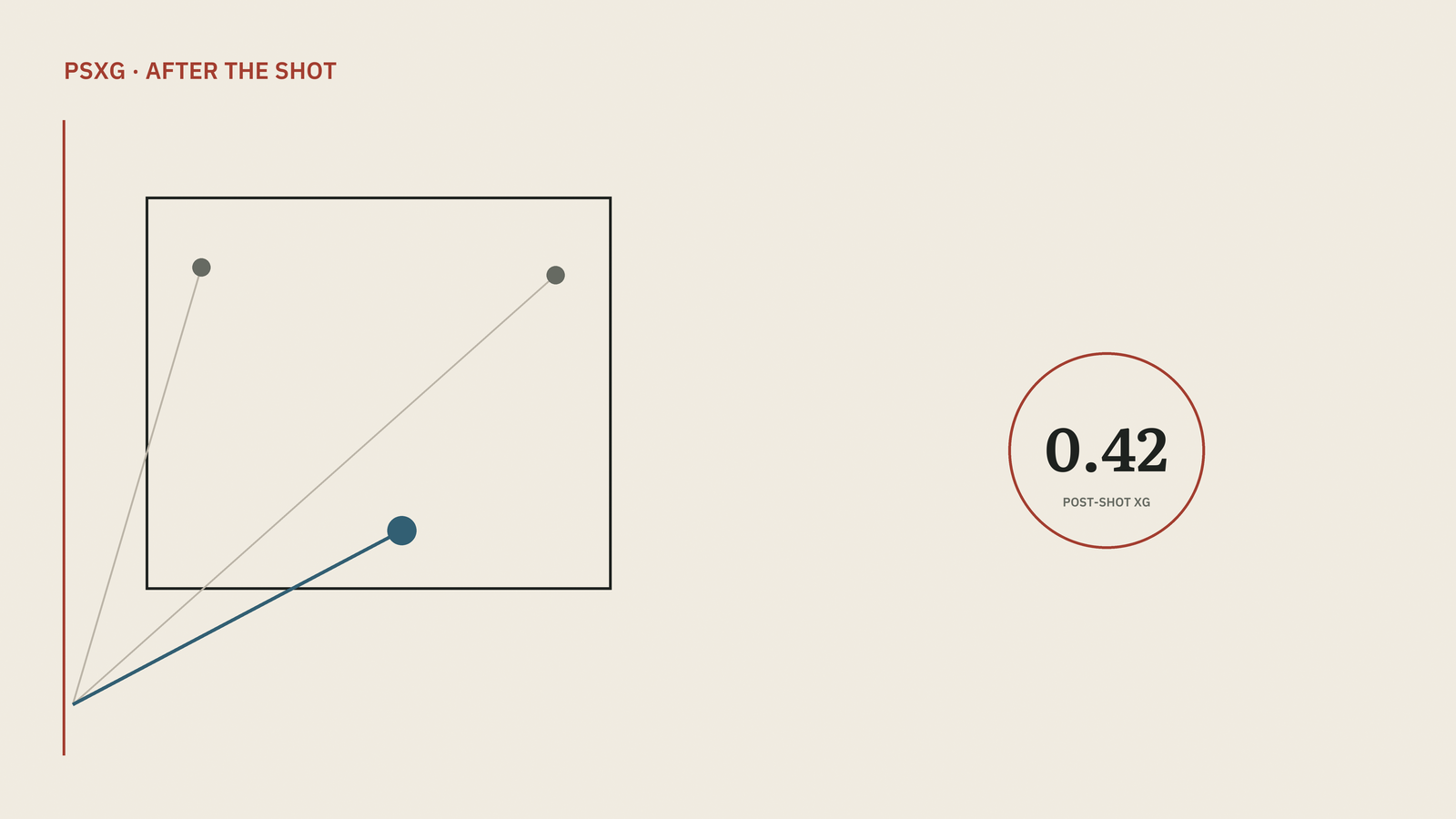
It's the natural companion to expected goals itself, and if you're judging the goalkeeper rather than the striker, the equivalent adjustment on the other end of the shot is post-shot xG.
Once penalties are out, the natural next question is how good the remaining shots were. That is shot quality: npxG divided by the number of non-penalty shots.
How big is the usual gap between a player's xG and npxG?
It depends entirely on how many penalties a player takes, which is exactly the variable npxG exists to isolate. A designated penalty taker converting four or five spot kicks in a season can see roughly three to four goals' worth of xG stripped out once penalties are removed, since each penalty carries a near-fixed value around 0.76 xG; a player who never takes penalties will show an identical xG and npxG total. The gap itself isn't a quality signal. It's simply a bookkeeping question of who's on penalty duty.
How much xG is a penalty worth?
A penalty is worth roughly 0.76 expected goals almost regardless of who takes it or which goalkeeper faces it, because the model is built from thousands of penalties taken from the same spot at the same distance. That fixed value is why penalties distort a player's xG total, and why npxG removes them to show open-play threat more clearly.
Why do recruitment departments use npxG per ninety minutes?
Recruitment departments use npxG per ninety minutes because it travels better across leagues than raw goal totals. League quality, teammate quality and penalty allocation all shape how many goals a striker scores. Stripping out penalties removes at least one of those variables, which is why npxG appears so often in recruitment reports despite being a simple adjustment.
Does npxG mean penalties do not matter?
No. npxG is not a verdict on penalty takers, and converting penalties consistently under pressure over a season is a real skill. The point of npxG is to stop penalties being counted twice, once as goals and again as evidence of open-play quality they did not demonstrate. Kept separate, penalties and non-penalty output each tell you something.
Sources and further reading
- What are Expected Goals (xG)? — Hudl Statsbomb (accessed 18 Sep 2026)
- Opta Football Stats Definitions — Opta Analyst (accessed 18 Sep 2026)