Glossary · Essay
PSxG: Grading Goalkeepers by the Shots They Should Have Let In
Pre-shot xG can't see where the ball actually went. Post-shot xG grades a shot after it's struck, making it the clearest public way to rate a goalkeeper's shot-stopping.

By 01 Owen
· Updated 9 Oct 2026 · 5 min read
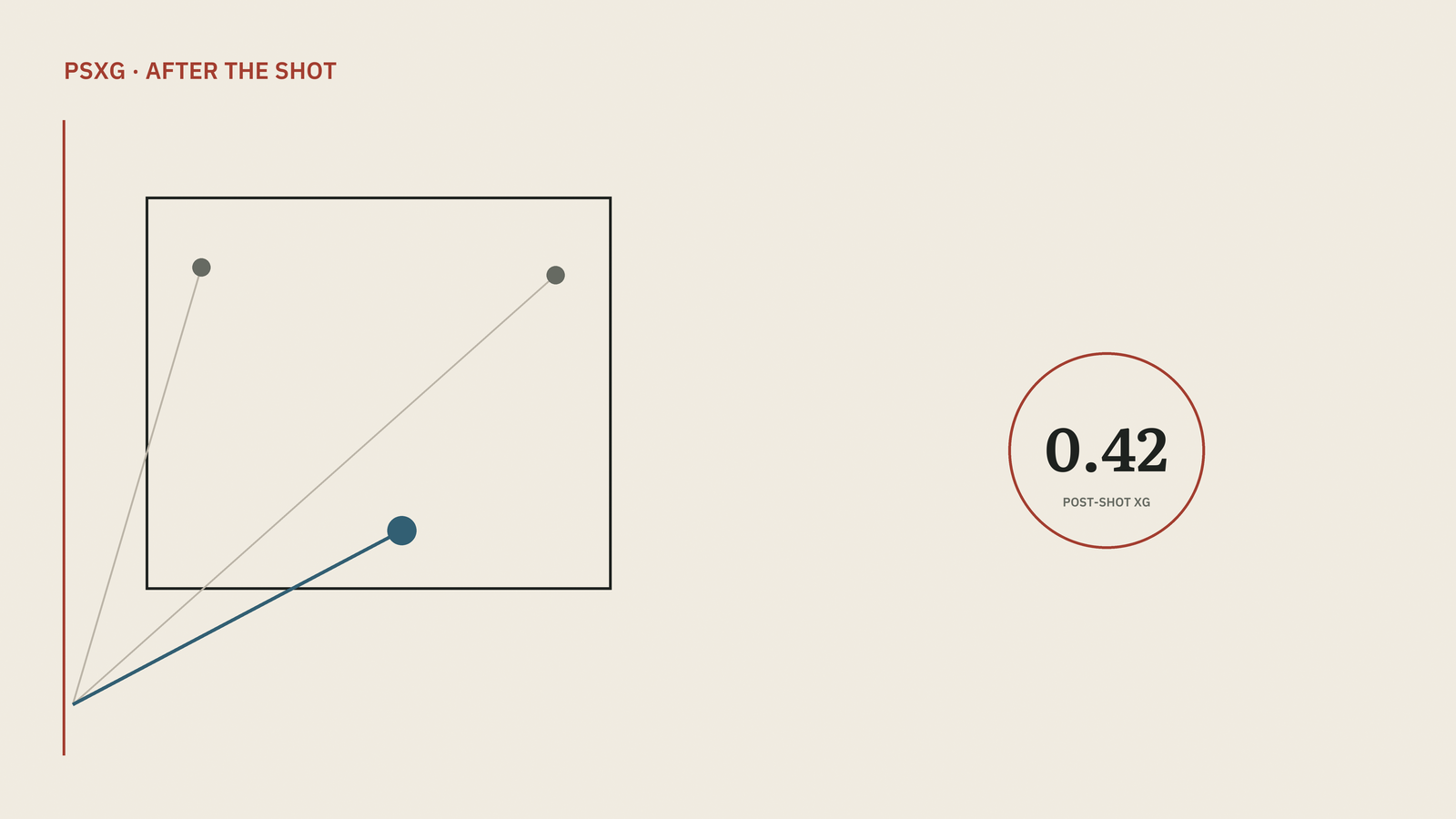
Regular expected goals is calculated before the shot is taken, from where the ball is on the pitch, the angle to goal, and how the chance arrived. That makes it a good measure of the chance a player was given, but a poor measure of a goalkeeper's performance, because it has no idea where the shot actually went. A player can be gifted a huge chance worth 0.6 xG and scuff it tamely into the keeper's arms, or the same chance can be lashed into the top corner. Pre-shot xG treats both attempts identically. The goalkeeper's job in each is completely different.
Post-shot expected goals, PSxG, fixes that by recalculating the shot's danger after it's been struck, using where the ball actually crossed the goal line, or would have if uninterrupted, along with its speed. A shot placed in the corner, inches from the post, generates a high PSxG regardless of how far out it was taken from, because keepers save shots hit straight at them far more often than shots placed into the corners. A tame effort straight down the middle keeps a low PSxG even if the pre-shot chance quality was excellent, because any goalkeeper at this level saves that shot most of the time.
Rating shot-stopping with PSxG
Comparing PSxG to goals actually conceded is the cleanest widely available way to rate shot-stopping. A keeper who faces shots totaling 30 PSxG across a season and concedes only 24 goals has prevented roughly six goals above what an average keeper would be expected to stop, given the placement and power of what was fired at him. A keeper conceding 35 goals from 28 PSxG is doing the opposite, letting in shots that, on placement alone, an average keeper saves more often than not.
Why save percentage misleads
This matters because raw save percentage and goals-against totals both get distorted by the defense in front of the keeper. A back line that concedes a lot of low-quality, straight-at-the-keeper shots inflates a keeper's save percentage without him doing anything special. A back line that keeps conceding one-on-ones and shots into the far corner will drag a good keeper's save percentage down through no fault of his own. PSxG minus goals conceded controls for shot placement in a way raw saves can't, which is why it's become the standard public reference point for keeper performance, even though it still isn't a complete picture.
What happens before the shot
What it doesn't capture is everything that happens before the shot: positioning that cuts down the angle before the ball is even struck, command of the box on crosses, distribution that starts attacks, and the sweeper-keeper work of clearing danger outside the box entirely, which prevents a shot from happening at all and therefore never shows up in a PSxG number. A goalkeeper who consistently forces shots wide through good angle play will look ordinary on PSxG minus goals conceded simply because he's facing fewer high-value chances in the first place, which is a different kind of good goalkeeping that this particular number was never built to reward.
Why the sample size matters
It also needs a reasonable sample before it means much. A handful of matches can swing wildly on one or two exceptional saves or one or two soft goals, the same variance problem that affects every shot-based metric over a small window. Over a full season, though, PSxG minus goals conceded does a better job than almost any other public stat of separating keepers who are genuinely shot-stopping well from keepers who are simply facing easier shots.
It picks up exactly where expected goals leaves off, once the shot has actually been struck, and it pairs well with non-penalty xG when judging the attacker on the other end of the same shot.
PSxG minus goals conceded vs. save percentage: which is the better goalkeeper stat?
PSxG minus goals conceded is generally considered the stronger public metric, specifically because it accounts for where and how hard a shot was struck before judging whether the save was routine or exceptional, while raw save percentage treats every save identically regardless of difficulty. A keeper facing mostly tame, straight-at-them shots will post an inflated save percentage without doing anything special, whereas PSxG minus goals conceded corrects for that by weighing placement and power first. Neither is complete on its own, but between the two, PSxG-based numbers are the more honest read on shot-stopping specifically.
What is the difference between xG and PSxG?
Regular xG is calculated before the shot, from location, angle and how the chance arrived, so it measures the chance a player was given. PSxG recalculates the danger after the shot is struck, using where the ball crossed or would have crossed the goal line and its speed. A shot placed near the post has a high PSxG, while a tame effort down the middle stays low.
How do you use PSxG to rate a goalkeeper?
Compare the PSxG of the shots a goalkeeper faced with the goals he actually conceded. A keeper who faces shots totalling 30 PSxG in a season and concedes only 24 goals has prevented roughly six goals more than an average keeper would. A keeper conceding 35 goals from 28 PSxG is letting in shots an average keeper usually saves.
What does PSxG not measure?
PSxG ignores everything that happens before the shot: positioning that narrows the angle, command of the box on crosses, distribution and sweeper-keeper clearances that stop a shot happening at all. A goalkeeper who forces shots wide through good angle play can look ordinary on PSxG minus goals conceded because he faces fewer dangerous chances in the first place.
Sources and further reading
- A New Way to Measure Keepers' Shot Stopping: Post-Shot Expected Goals — Hudl Statsbomb (accessed 18 Sep 2026)
- Opta Football Stats Definitions — Opta Analyst (accessed 18 Sep 2026)