Glossary · Essay
Elo Ratings: The Chess Rating System That Took Over Football
Football didn't invent a way to rate team strength between matches. It borrowed one from chess, and it's turned out to travel remarkably well.

By 01 Owen
· Updated 7 Oct 2026 · 5 min read
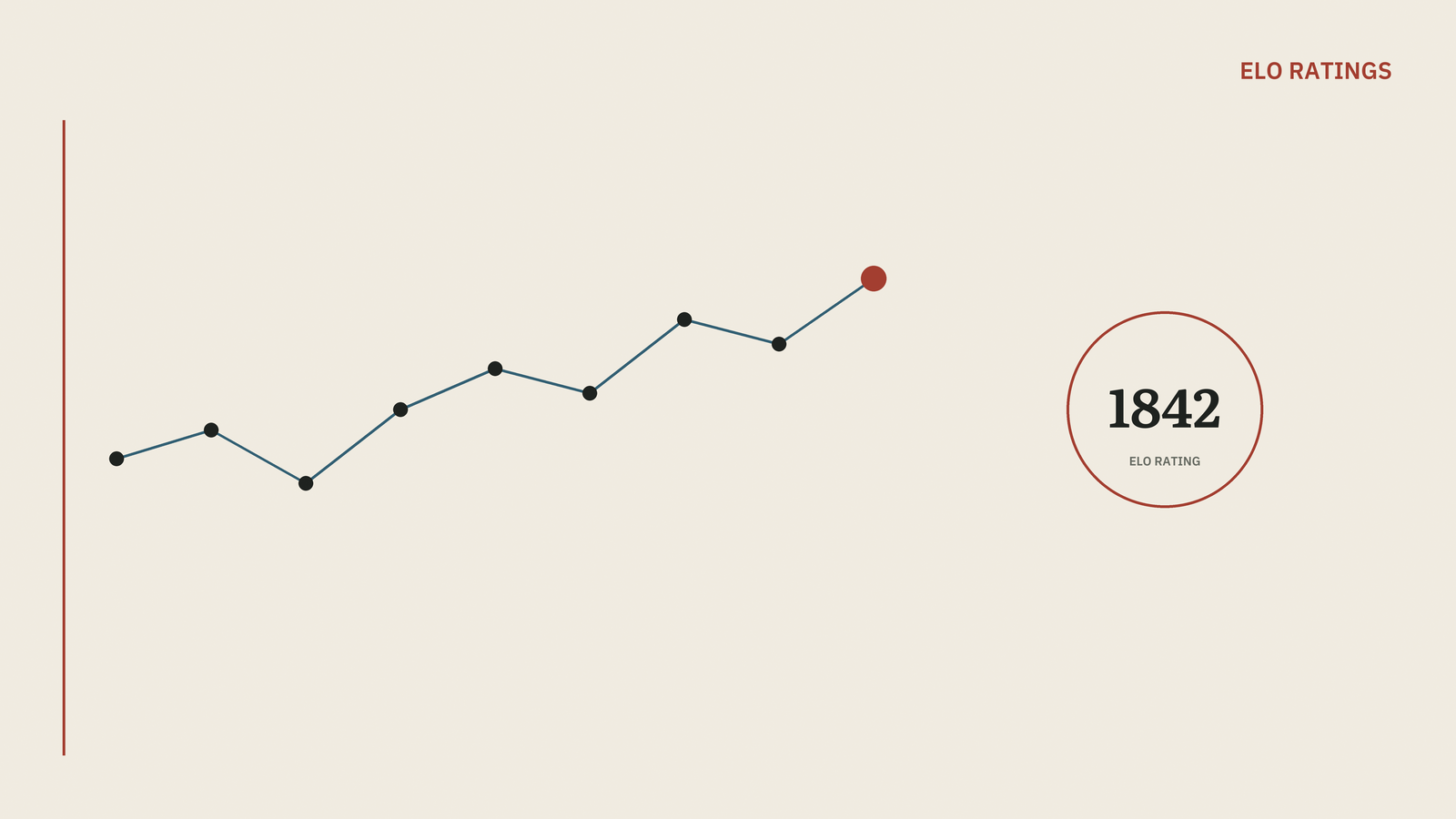
Football didn't invent a system for rating how strong a team is relative to everyone else it might play. It borrowed one, more or less wholesale, from chess, where Arpad Elo built the original rating system in the 1960s to solve the same underlying problem: ranking competitors who don't all play each other, using results that happened at different times against opponents of very different strength.
The mechanics are simple enough to run by hand, even though nobody actually does anymore. Every team starts with a rating. After each match, both teams' ratings update based on the actual result compared to what the pre-match rating difference predicted. Beat a much stronger opponent and your rating jumps sharply, since the model was surprised; beat a much weaker one and it barely moves, since that result was already expected. Lose to a team you were heavily favored against and your rating drops hard, in proportion to how unlikely that result was supposed to be. The system is entirely self-correcting over time: a team's rating is really just an ongoing record of how often its results have matched or defied expectations, continuously revised match by match rather than reset each season.
How football adapts the chess model
Football's version, most visibly maintained by independent projects like the World Football Elo Ratings site rather than any official governing body, adds a few sport-specific adjustments chess never needed: a weighting for the size of the margin of victory, since a 4-0 win says more about relative strength than a 1-0 win does, a weighting for the importance of the competition, since a World Cup match generally moves ratings more than a routine friendly, and often a home-advantage adjustment, since playing away is a genuinely harder task the model needs to account for before judging a result.
The advantage over points-based rankings
The appeal of Elo, compared to something like a rigid FIFA ranking based on points-per-competition formulas, is that it has no artificial cliffs or category boundaries. A team's rating simply reflects the accumulated weight of everything it has done against everyone it has played, weighted by how surprising each result was at the time, which tends to produce rankings that pass a basic smell test even for teams that don't play in the competitions a more bureaucratic points system happens to reward heavily. It's also genuinely predictive in a way simple win-loss records aren't, since the whole system is built around estimating win probabilities for future matchups, not just describing the past.
What Elo ratings cannot see
It has real limits too. Elo has no memory of personnel changes, injuries, managerial appointments, or anything else that might make a team meaningfully different from the version of itself that earned its current rating six months ago; it only knows results, and a team that has quietly rebuilt its entire squad still carries the accumulated rating of the team that existed before the rebuild, adjusting only gradually as new results come in. It's also just one model among several competing approaches, some incorporate individual player quality, market values, or more detailed performance data rather than results alone, and different Elo implementations can disagree with each other meaningfully depending on how they weight margin of victory, competition importance, and how much they let ratings move per match.
Using Elo sensibly
Used sensibly, Elo is one of the more honest ways to ask a simple question, how good is this team right now compared to everyone else, based purely on what has actually happened on the pitch. Used as the final word on a debate about which team is really the best in the world, it runs into the same problem every single-number ranking system does: it flattens a genuinely complicated question into one figure, and a lot gets lost in that flattening.
Where expected points asks how a single match should have gone, Elo asks the same underlying question about a team's whole history, updated one match at a time.
Is Elo more accurate than the official FIFA world rankings?
Elo tends to be viewed as the more honest predictive tool among analysts, mainly because it has no artificial floors, category boundaries, or fixed point values per competition the way FIFA's points-based system does, and it's built specifically to estimate win probabilities rather than just rank teams by accumulated points. That said, 'more accurate' depends on what you're testing it against. Elo has generally outperformed FIFA rankings in retrospective studies of predicting match outcomes, but neither system incorporates injuries, squad changes, or current form the way a betting market's live odds do.
How do Elo ratings work in football?
Every team starts with an Elo rating, and after each match both ratings update based on the result compared with what the pre-match difference predicted. Beating a much stronger opponent moves a rating sharply, beating a weaker one barely moves it. The system corrects itself over time and is revised match by match rather than reset each season.
Who publishes football Elo ratings?
Football Elo ratings are most visibly maintained by independent projects such as the World Football Elo Ratings site, not by an official governing body. Their versions add adjustments chess never needed: a weighting for the margin of victory, a weighting for the importance of the competition, and often a home-advantage adjustment. Different implementations can disagree depending on those weightings.
What are the limitations of Elo ratings?
Elo ratings only know results. They have no memory of injuries, personnel changes or managerial appointments, so a team that has rebuilt its squad still carries the old rating and adjusts only gradually. Elo is also one model among several, and like any single-number ranking it flattens a complicated question about who is best into one figure.
Sources and further reading
- World Football Elo Ratings: about the system — eloratings.net (accessed 18 Sep 2026)
- ClubElo: the rating system — ClubElo (accessed 18 Sep 2026)
- Elo rating system — Wikipedia (accessed 18 Sep 2026)