Playing styles · Analysis
Offside trap: the offside rule in plain words and how defences use it
The offside rule in plain words: when a player is offside under Law 11, when it is an offence, and how defences step up together to use it. History and risks.
By 01 Owen
· Updated 3 Oct 2026 · 6 min read
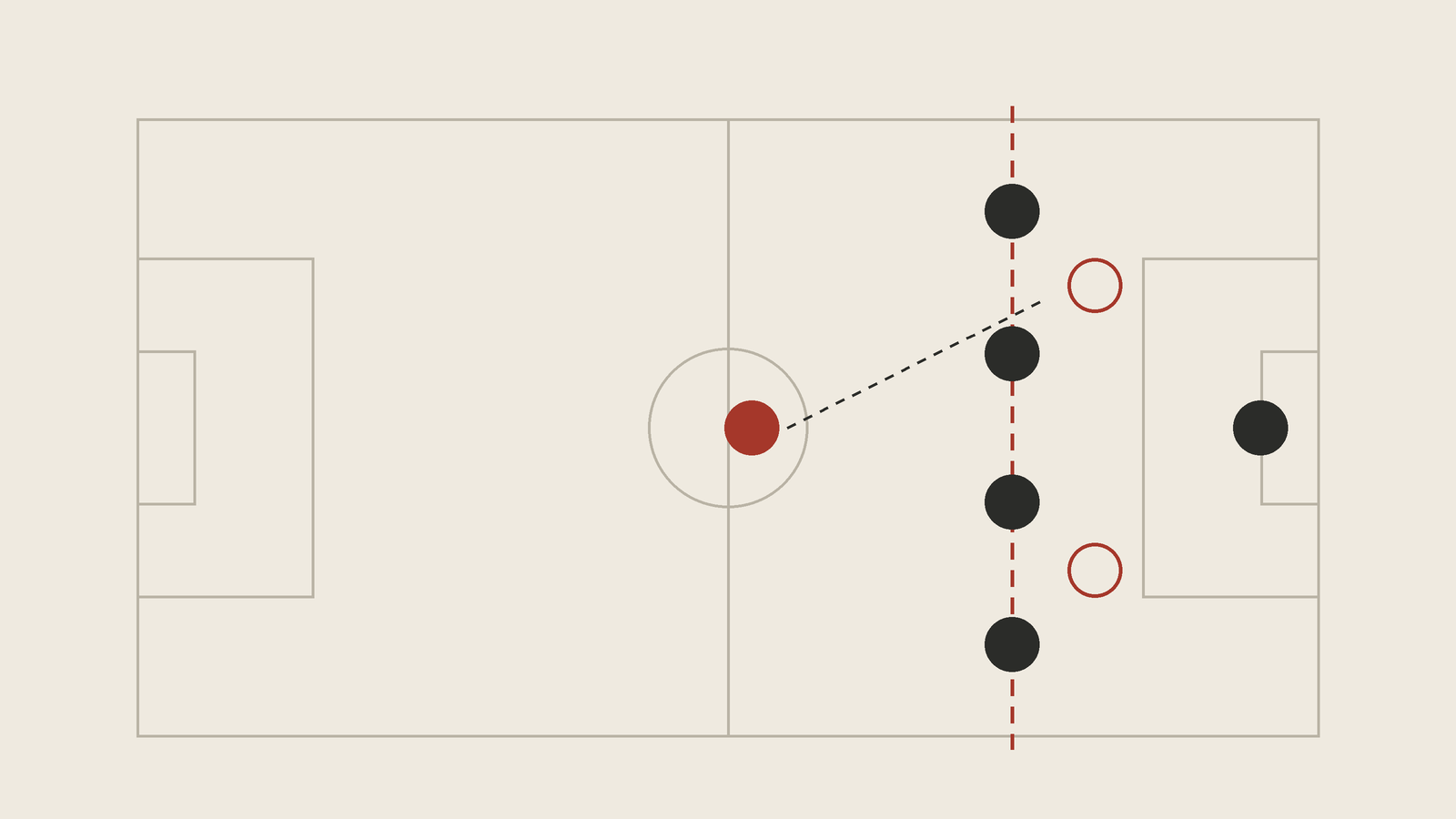
A player is offside when he is ahead of the ball and the second-last opponent in the opponent's half as a team-mate passes, and then takes part in play. The offside trap uses that rule: the back line steps up together to leave attackers in an offside position.
Precisely, Law 11 compares the attacker with both the ball and the second-last opponent at the moment a team-mate plays or touches the ball; only then, and only if he gets involved, is it an offence.
The rule shapes how every team attacks and defends. Without it, forwards could wait next to the goalkeeper; with it, the defence's line decides how much space there is behind and how high the whole team can play.
The offside rule in plain words
The rule is Law 11 of the Laws of the Game, written by the International Football Association Board (IFAB). Its key points:
- The position: a player is in an offside position if any part of his head, body or feet is in the opponent's half and nearer to the opponent's goal line than both the ball and the second-last opponent.
- Arms and hands do not count: IFAB states that the hands and arms of all players, including goalkeepers, are not considered when judging the position.
- Level is onside: a player level with the second-last opponent, or with the last two opponents, is not in an offside position.
- Your own half is safe: a player in his own half cannot be offside.
Being in an offside position is not an offence on its own. It becomes one only when, at the moment a team-mate plays or touches the ball, the player gets involved in active play: by playing or touching the ball, by interfering with an opponent (blocking his line of vision, challenging him for the ball or making an obvious action that affects his ability to play it), or by gaining an advantage from a rebound off the post, the crossbar, a match official or an opponent.
There are also exceptions. A player cannot be offside when he receives the ball directly from a goal kick, a throw-in or a corner kick. And if an opponent deliberately plays the ball, rather than deflecting it or making a save, a player in an offside position who receives it is not penalised. The sanction for an offside offence is an indirect free kick to the defending team.
How the rule changed
Wikipedia traces the law's history in steps. The Football Association's first laws of 1863 were very strict. In 1866 the FA allowed a player to play the ball as long as at least three opponents were between him and the goal. In 1925, after a trial match at Highbury, the number was reduced from three to two, which increased goalscoring and led coaches to new formations, most famously the WM, with a centre-half dropping back into defence, as described in the guide to the centre-back.
In 1990 IFAB declared that an attacker level with the second-last defender is onside, giving the benefit to the attacker. In 2005 it clarified that only the head, body and feet count, because there is no advantage in having only the arms in front.
The offside trap
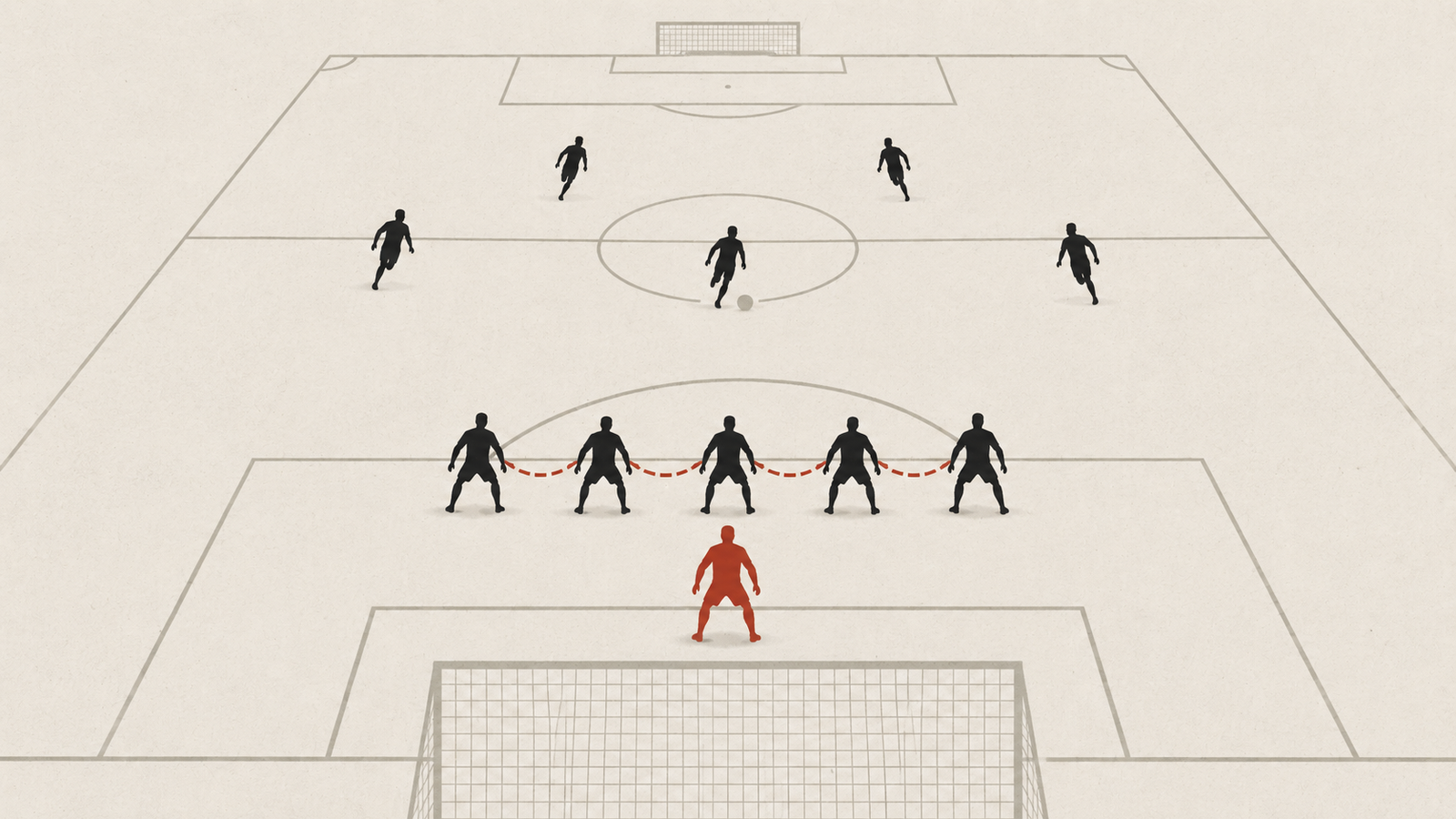
The offside trap uses the rule as a weapon. When the opponent is about to play a forward pass, the defenders step up together, at the same moment, so that the attackers who were onside a second earlier are now beyond the line when the ball is played.
It needs three things:
- A line that moves together: if one defender stays deep, he plays everyone onside. The centre-backs usually lead the step.
- A trigger: the line steps when the ball-carrier's head goes down or when he is about to pass, not after.
- Pressure on the ball: a passer with time and space can wait for the run; a pressed passer cannot.
Wikipedia credits Notts County with pioneering the tactic in the early 20th century. The best-known modern example is Arrigo Sacchi's AC Milan of the late 1980s, which combined a high back line and the offside trap with zonal marking and aggressive pressing. Total football at Ajax in the early 1970s also relied on a well-drilled trap, while Italian catenaccio preferred a deep line with a free sweeper behind it.
The tactic is still alive. Wikipedia reports that Jürgen Klopp's Liverpool, with Virgil van Dijk organising the line, caught 53% more opponents offside than Manchester City in the 2021-22 Premier League season.
Why teams use it
A high line with an offside trap squeezes the pitch. The opponent's forwards cannot wait in space behind the defence, the distance between the team's lines shrinks, and the press works better because there is less space to play through. It is the natural partner of gegenpressing and of a high defensive line.
The risks
The trap fails dramatically when it fails. If one defender misjudges the step, or the passer is not pressed and plays the ball a moment later, an attacker is through on goal with nobody behind the line except the goalkeeper. That is why teams that defend high also need a goalkeeper who can sweep behind the line, the job a libero once did, and fast centre-backs who can recover.
Modern technology has raised the stakes. With video replays and camera-based tracking, very small margins are now checked precisely, so a line that is a fraction late is punished more consistently, and a trap that works by a few centimetres also counts.
How to recognise an offside trap in a match
Watch the defensive line rather than the ball. When the opponent's playmaker gets the ball facing forward, a team using the trap will step up as a unit, often with a shout or a raised arm from the central defender, and the attackers suddenly find themselves beyond the line. Count how often the assistant referee's flag goes up in the first half: a high number usually means a deliberate trap, not bad luck for the attackers.
What is the offside rule in simple terms?
A player is offside if, when a team-mate plays the ball to him, he is in the opponent's half and closer to the goal line than both the ball and the second-last defender, and he then gets involved in play. Being level is onside.
Is it offside from a throw-in or a goal kick?
No. Law 11 says a player cannot be offside when he receives the ball directly from a goal kick, a throw-in or a corner kick.
Do arms count for offside?
No. Only the head, body and feet count. IFAB's Law 11 states that the hands and arms of all players, including goalkeepers, are not considered.
What is the offside trap?
The offside trap is a defensive tactic in which the back line steps up together just before an opponent passes forward, so that the attackers are left in an offside position when the ball is played.
Sources and further reading
- Law 11 – Offside — IFAB
- Offside (association football) — Wikipedia
- Arrigo Sacchi: AC Milan and Italy tactics — The Coaches' Voice
- The greatest teams of all time: Ajax 1971–73 — UEFA