Playing styles · Analysis
Total football: the Dutch system where every player could play anywhere
Total football let any outfield player take any role while the shape held. How Ajax and the Netherlands played it in the 1970s, its roots and its legacy.
By 01 Owen
· Updated 3 Oct 2026 · 6 min read
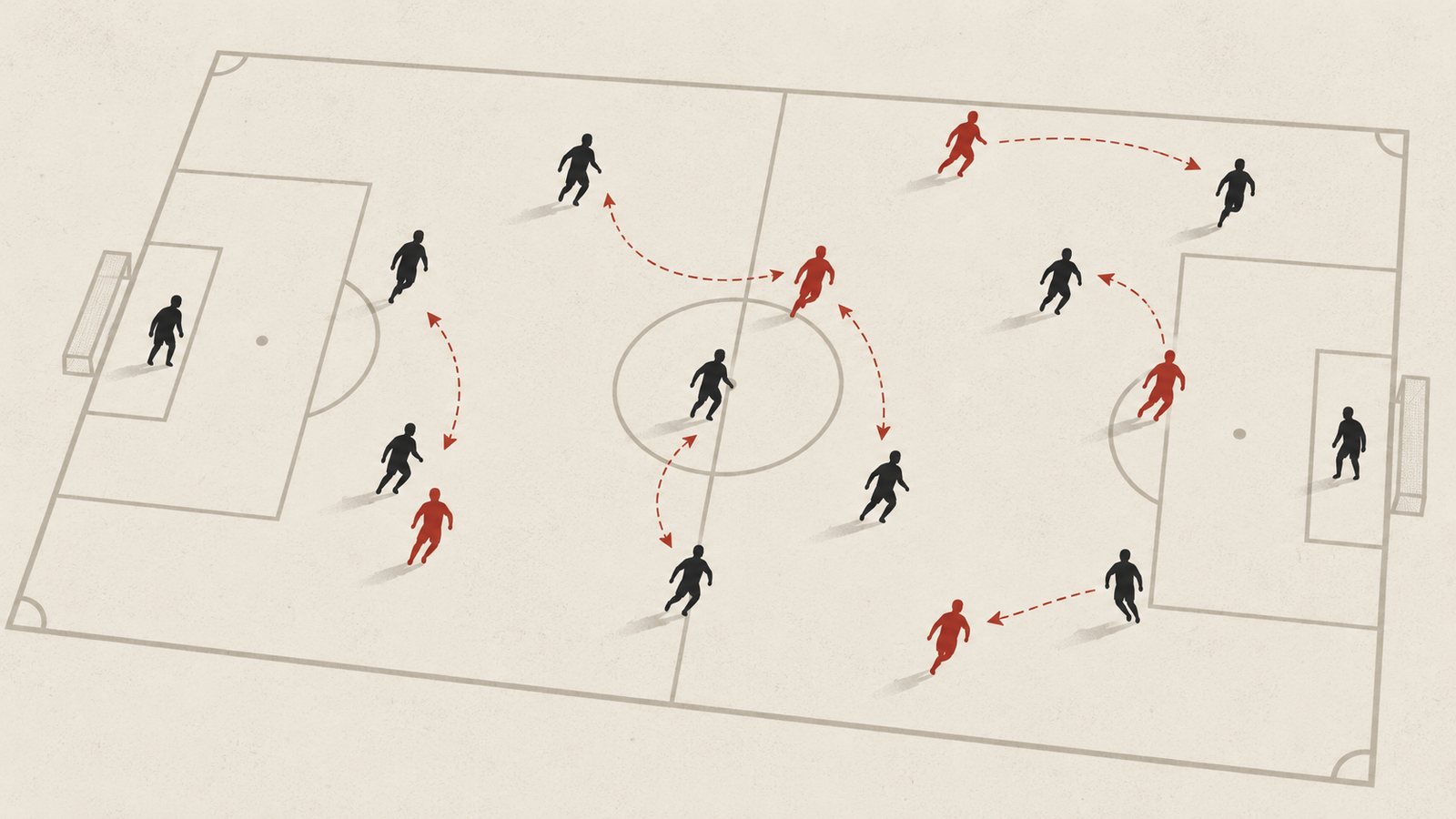
Total football is a style of play in which any outfield player can take over any other player's role. When a player leaves his position, a team-mate fills it, so the team keeps its shape while the individuals inside it keep moving.
The name is tied to Ajax and the Netherlands of the early 1970s, coached by Rinus Michels and led on the pitch by Johan Cruyff. The Dutch call it totaalvoetbal. It was never a formation on its own: the shape on paper was usually a 4-3-3. What made it total was the movement inside that shape, the pressing without the ball and the idea that a defender could attack and a forward could defend whenever the game asked for it.
The idea in one sentence
A player who moves out of his position is replaced by another, so the structure stays intact. That simple rule has big consequences. A full-back can overlap into attack because a midfielder will drop into his space. A centre-back can carry the ball into midfield because someone will cover behind him. A forward can drop deep, as Cruyff often did, because a midfielder will run past him into the space he left. For opponents who marked man to man, this was a nightmare: the player they were following kept turning into someone else's job.
Where it came from
Total football did not appear from nowhere. Wikipedia traces its ideas back to the Austrian Wunderteam of the 1930s under Hugo Meisl and to Hungary's Golden Team of the 1950s, both teams built on fluid passing and versatile players. The English coach Jimmy Hogan, who worked in both countries, is often credited with planting those ideas. At Ajax itself, Jack Reynolds had coached a similar style in the 1940s, and Vic Buckingham, who coached Ajax and later Barcelona, influenced both Michels and Cruyff.
Michels, Cruyff and Ajax
Rinus Michels became Ajax coach on 22 January 1965, according to FIFA. A former Ajax striker nicknamed "The General" for his demanding manner, he built a team around intelligence, movement and fitness. Cruyff was the on-field organiser who brought those ideas to life. Barry Hulshoff later described how constantly the team discussed space: where to run and where to stand.
UEFA's portrait of the team describes the style: a 4-3-3 with attackers on the wings, attacks starting from the goalkeeper, the ball moved around very quickly, and midfielders and defenders urged to push forward, which made Ajax very hard to man-mark. Heavy pressing and a well-drilled offside trap meant the team rarely lost the ball for long.
The results matched the reputation. Ajax won three European Cups in a row: 2-0 against Panathinaikos in London in 1971, 2-0 against Inter in Rotterdam in 1972 and 1-0 against Juventus in Belgrade in 1973. Michels left after the first, and Stefan Kovács won the next two with the same core of players: Cruyff, Johan Neeskens, Piet Keizer, Ruud Krol, Barry Hulshoff, Wim Suurbier, Johnny Rep and others.
The Netherlands in 1974
Michels took the idea to the national team for the 1974 World Cup. FIFA lists the run: 2-0 against Uruguay, 0-0 against Sweden and 4-1 against Bulgaria in the first group; then 4-0 against Argentina, 2-0 against East Germany and 2-0 against Brazil in the second. The press called the team Clockwork Orange.
In the final in Munich, the Netherlands lost 2-1 to West Germany. Berti Vogts marked Cruyff out of the game, and Franz Beckenbauer, Uli Hoeneß and Wolfgang Overath controlled the midfield. FIFA calls the Dutch side one of the greatest teams never to win a World Cup. Michels did win a trophy with the Netherlands later, the 1988 European Championship with a new generation, and FIFA named him Coach of the Century.
How total football worked on the pitch
Three mechanisms made the system run.
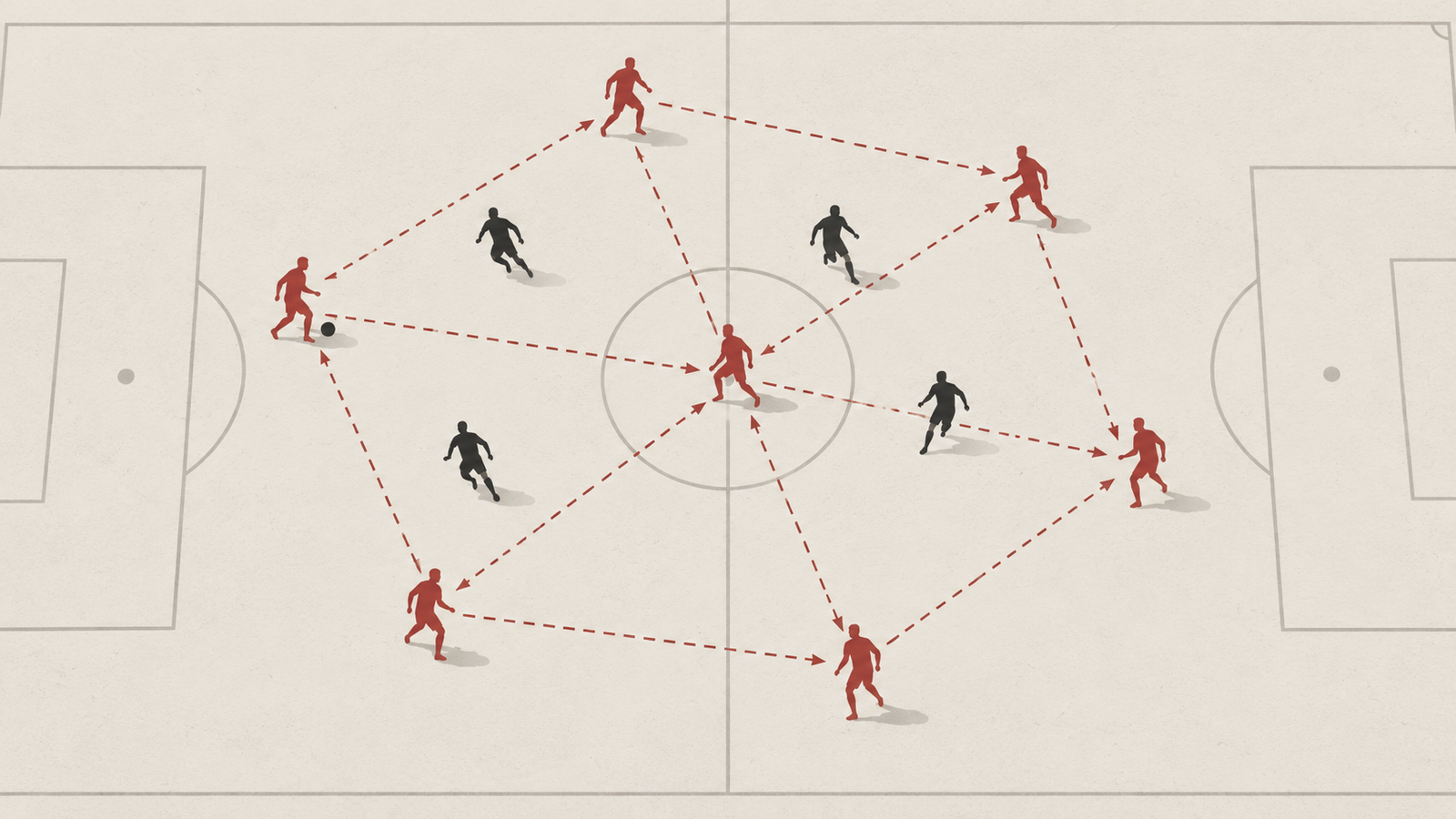
- Rotation: players swapped positions in chains, usually on one side of the pitch. A defender stepping up triggered a midfielder dropping, which freed a winger to move inside. The box-to-box midfielder Neeskens, a tireless runner and presser, was central to these rotations.
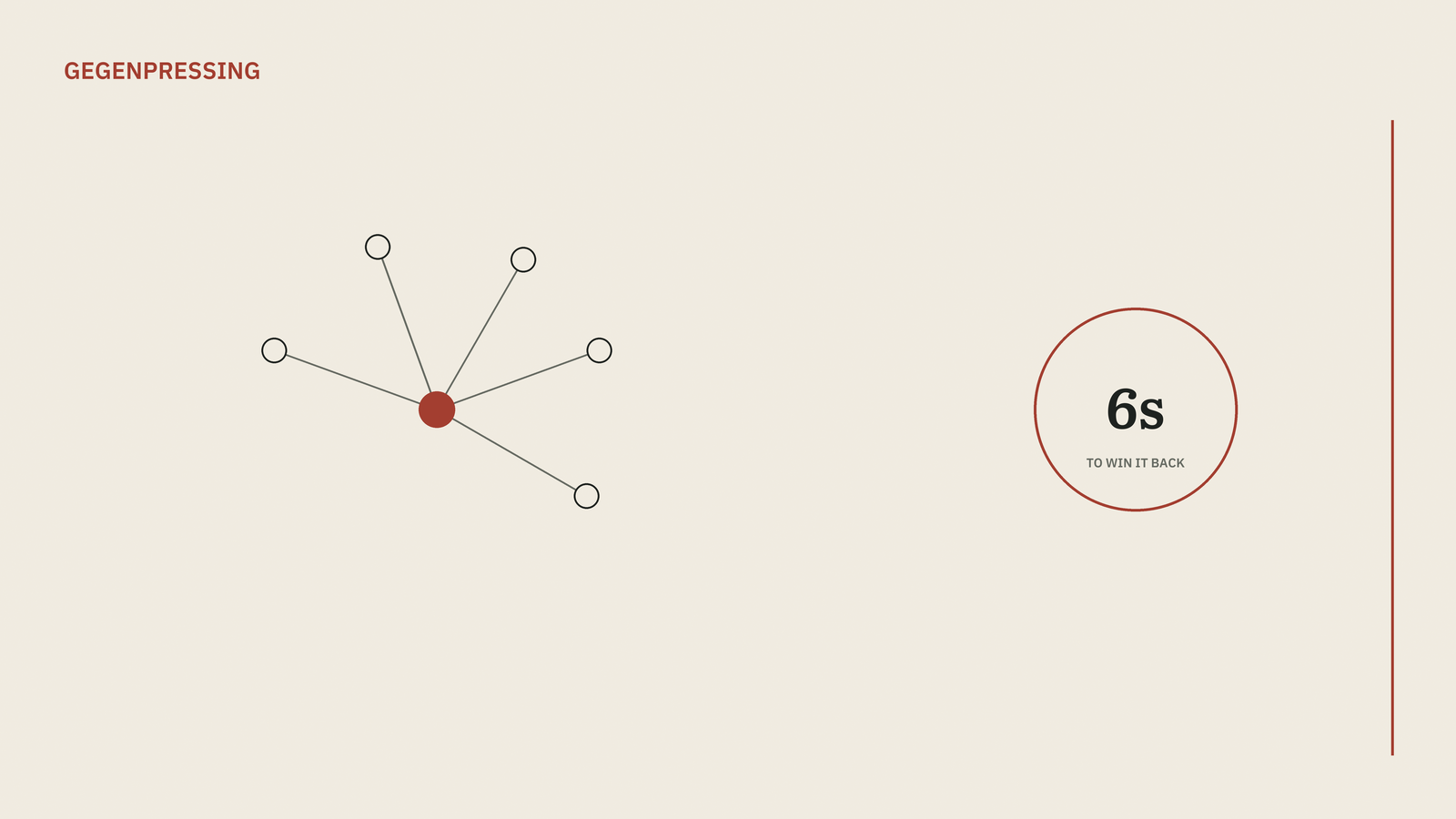
- Pressing: without the ball, the whole team pushed up and hunted it. This was decades before the word gegenpressing became common, but the logic was similar: win the ball back high, close to the opponent's goal.
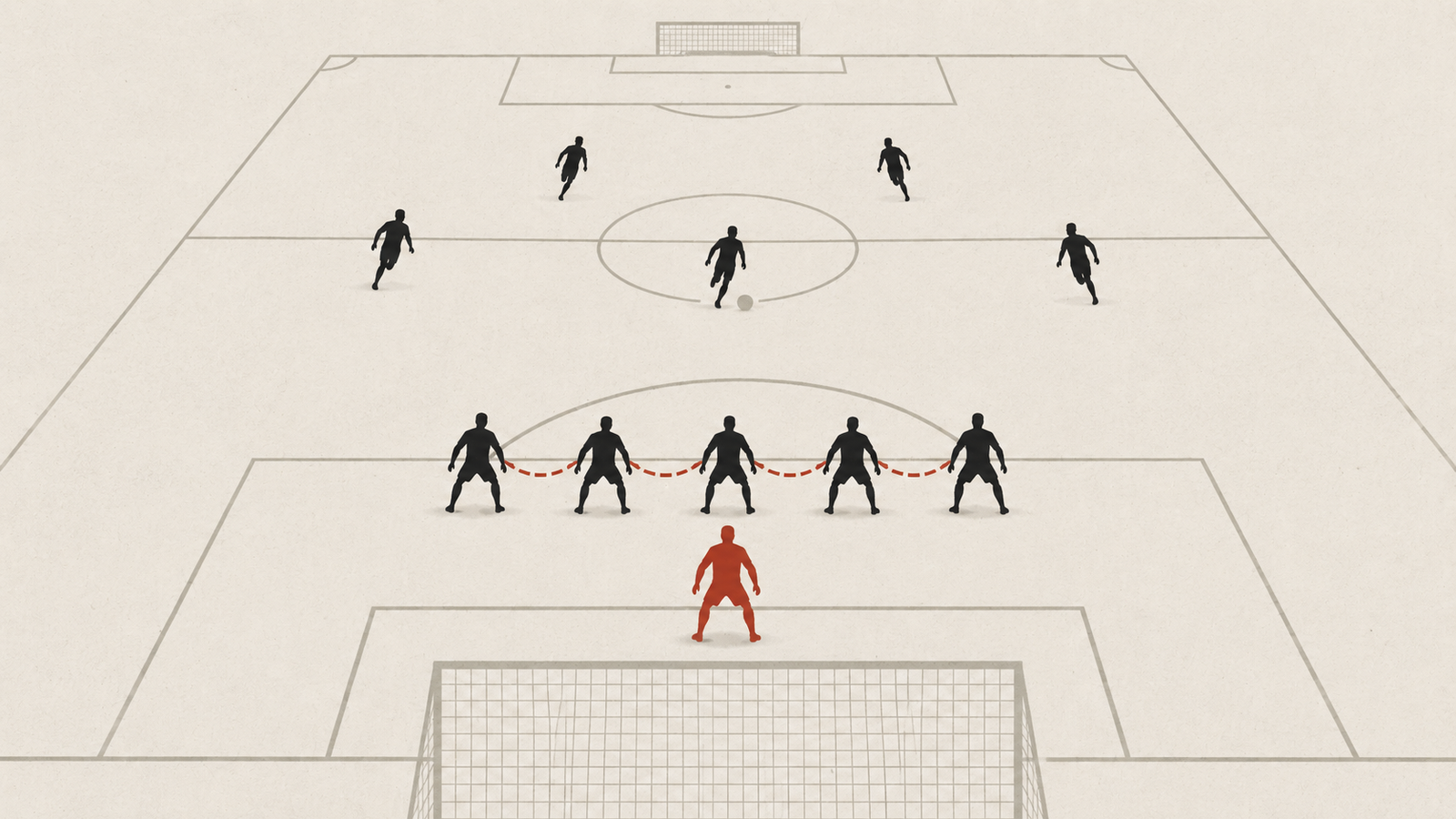
- The high line and the offside trap: the defence stepped up together to squeeze the space and catch forwards offside. A free defender, close to the classic libero but far more active with the ball, covered behind.
The demands were huge. Every player needed the technique to play in more than one zone, the fitness to keep moving, and the understanding to know who should cover whom. That is why Michels described his approach in terms of intelligence and versatility rather than fixed positions.
Legacy
Total football's influence runs through the modern game. Cruyff took its ideas to Barcelona, first as a player and then as a coach. Pep Guardiola, who played for Cruyff, built Barcelona and later teams on related principles, and Wikipedia connects the Spanish tiki-taka and juego de posición of the late 2000s and early 2010s directly to Dutch foundations. Modern ideas such as the false nine, the inverted full-back and coordinated pressing triggers all borrow something from the same toolbox: positions as starting points, not fixed homes.
What most modern teams do not copy is the full interchange. Rotations today are usually planned in detail, with each player's movement rehearsed, rather than improvised across the whole pitch.
Limits and criticism
Total football asked a lot of the players and left the team exposed when it went wrong. A high line beaten by one pass leaves a lot of space behind it, and constant rotation can leave gaps if one player reads the situation differently. The 1974 final also showed how one disciplined man-marker could disturb a system built around a single organiser. The style worked best with a rare group of players who had grown up together at one club.
How to recognise total football in a match
Watch whether the team's shape stays the same while the names in it change. If a centre-back carries the ball into midfield and a midfielder quietly takes his place, or a winger and a full-back swap roles several times in a few minutes, you are seeing the same principle the Dutch made famous. Then watch the team without the ball: total football always came with a high line and an aggressive press.
The high line of total football relied on a well-drilled offside trap: the whole back line stepped up together to squeeze the space and catch forwards offside.
What is total football in simple terms?
Total football is a style where any outfield player can take any other player's role. When one player leaves his position, a team-mate fills it, so the team keeps its shape while players move freely.
Who invented total football?
Rinus Michels developed it at Ajax from 1965 and with the Netherlands in 1974, with Johan Cruyff as the leader on the pitch. Its ideas go back further, to the Austrian Wunderteam, Hungary's Golden Team and earlier Ajax coaches such as Jack Reynolds.
What formation did total football use?
On paper Ajax and the Netherlands usually played a 4-3-3 with wingers. The formation mattered less than the movement inside it: players rotated positions while the overall shape stayed the same.
Why did the Netherlands lose the 1974 World Cup final?
West Germany won 2-1 in Munich. Berti Vogts marked Johan Cruyff closely and limited his influence, while Beckenbauer, Hoeneß and Overath took control of the midfield.
Sources and further reading
- Total Football — Wikipedia
- The greatest teams of all time: Ajax 1971–73 — UEFA
- The watchmaker behind the Clockwork Oranje — FIFA