Playing styles · Analysis
Positional play: how juego de posición creates superiority with structure
Positional play puts players in planned zones to create numerical, qualitative and positional superiority. The rules, the free man, Cruyff to Guardiola.
By 01 Owen
· Updated 3 Oct 2026 · 6 min read
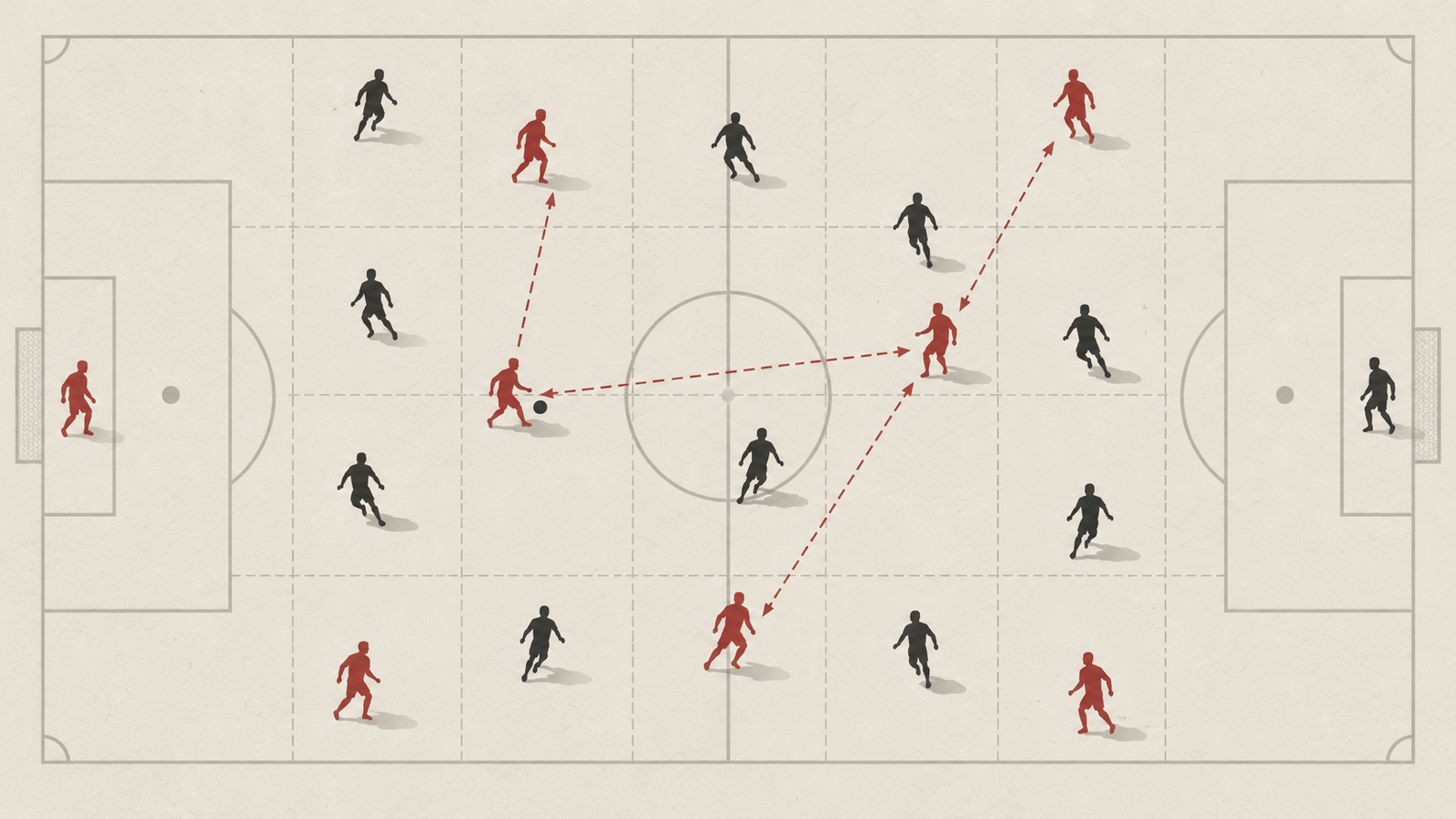
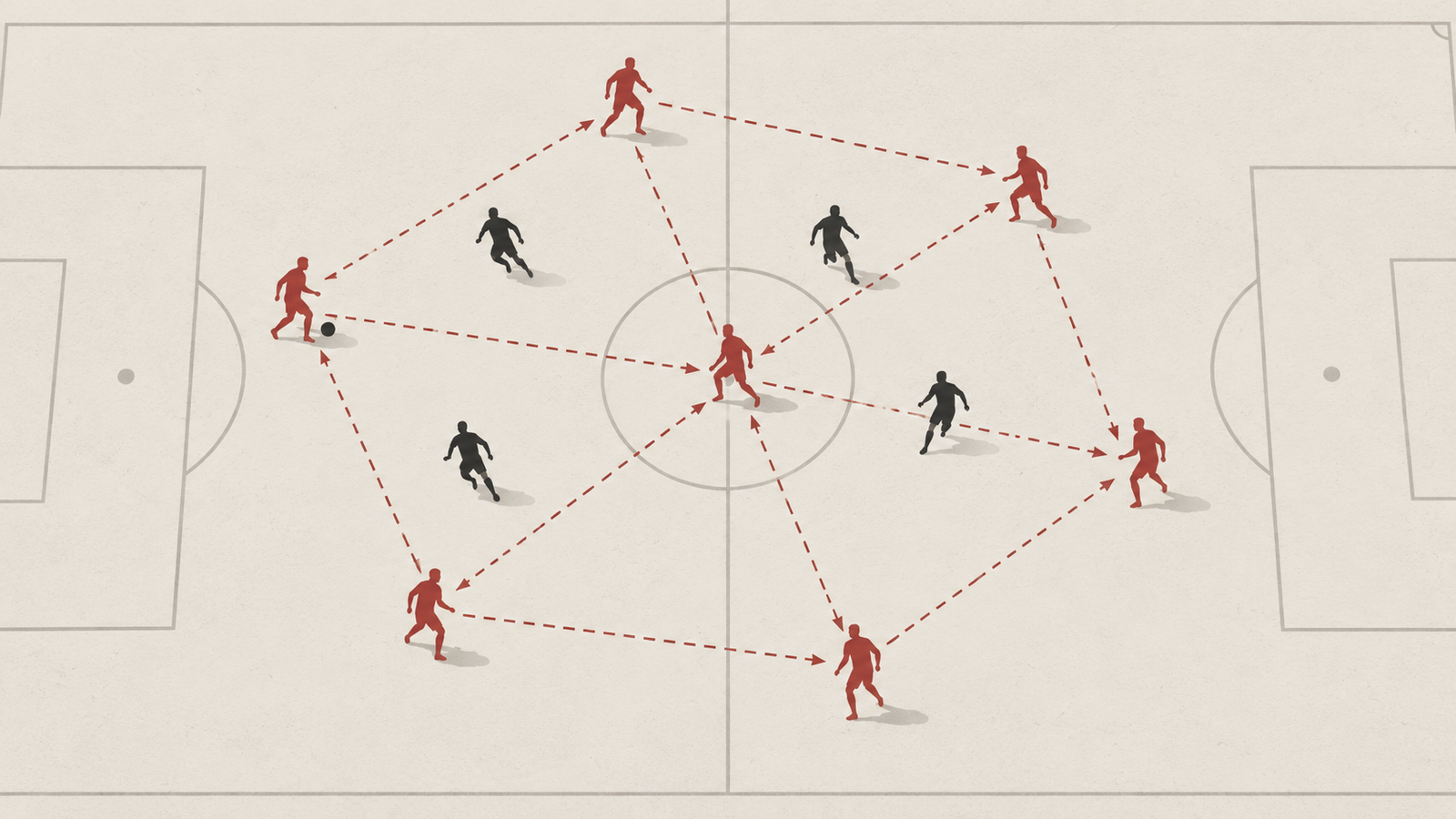
Positional play is a way of attacking in which players take up fixed zones on the pitch to create superiority over the opponent and pass the ball to the free man. In Spanish it is called juego de posición, in German Positionsspiel.
It is less a formation than a set of principles about where players stand. Coaches' Voice describes it as players positioning themselves to create numerical advantages in passing triangles or diamonds, so the team can move the ball through the thirds of the pitch. Pep Guardiola is its best-known coach today, but the ideas run back through Johan Cruyff and Louis van Gaal to Rinus Michels' Ajax.
The core idea: superiority
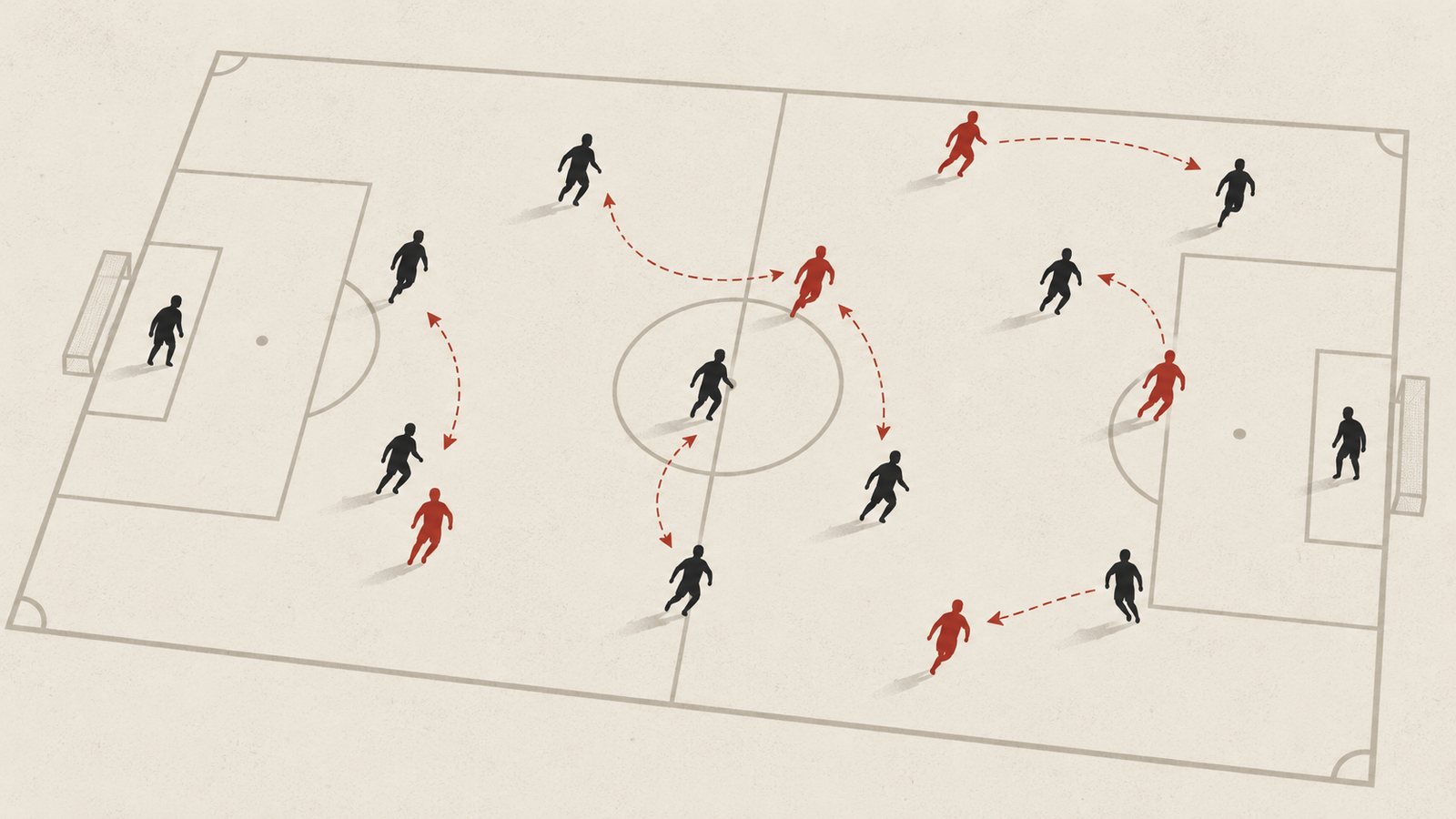
Positional play starts from one question: where on the pitch does my team have an advantage right now? Coaches' Voice and an analysis by Adin Osmanbasic on Martí Perarnau's site describe three kinds of superiority.
- Numerical superiority: more players than the opponent in one area, for example three against two in the build-up. This is the classic overload.
- Qualitative superiority: putting the team's best player against a weaker opponent, often by isolating a winger one against one with a full-back.
- Positional superiority: players standing between or behind the opponent's lines, where a defender cannot press them without leaving a gap.
The team then moves the ball to whichever superiority exists. That analysis quotes Guardiola's summary: the objective is to move the opponent, not the ball.
The free man and the third man
The most valuable player in positional play is the free man: the team-mate no opponent is marking, who can receive and turn to face play. The Spanish coach Juan Manuel Lillo, one of the style's main thinkers, told players to look for the third man, the free man, to turn and face play. The method is to attract pressure with short passes in one area, then release the ball to the free player elsewhere. That is why third-man runs and line-breaking passes are central to it: they are the moves that find the free man behind the first line of pressure.
The rules of the grid
Guardiola's teams train on a pitch divided into zones by vertical and horizontal lines. Coaches' Voice and the same analysis describe two guidelines:
- never more than three team-mates on the same horizontal line;
- never more than two on the same vertical lane.
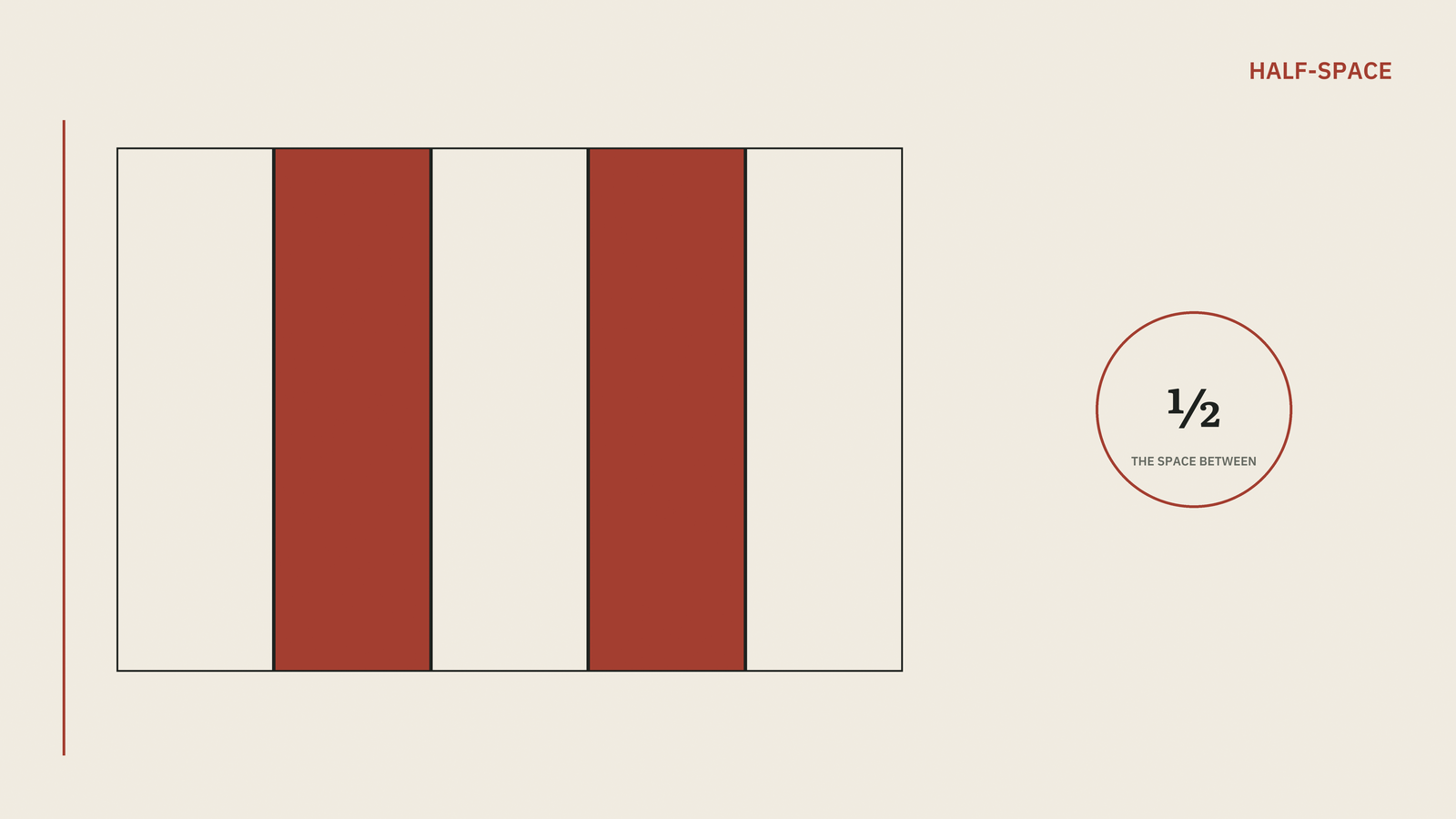
The pitch is usually split into five vertical lanes: two wide lanes, two inner channels (the half-spaces) and the central lane. By staggering players across these lanes and lines, the team always has diagonal passing options and triangles, and no two players block each other's passing lane. Perarnau notes that the inner channels are prioritised over the flanks, because a player receiving there can pass in every direction.
Where it comes from
Coaches' Voice traces the principles to Rinus Michels at Ajax, then to Johan Cruyff at Barcelona, who developed them further, and finally to Guardiola, who brought them into modern elite football. The link to total football is direct: both treat positions as roles in a structure rather than as fixed jobs for named players. Perarnau also names Louis van Gaal among the influences, and the Mexican-Argentine coach Ricardo La Volpe for the "salida lavolpiana", the build-up in which the defensive midfielder drops between the centre-backs.
In practice the salida lavolpiana works like this: the defensive midfielder drops between the two centre-backs, the centre-backs split wide towards the touchlines and the full-backs push up. The team now builds with three players against the opponent's first line, and the full-backs are free to give width higher up. It remains one of the most common ways to start build-up play under pressure.
How it looks in a modern team
Coaches' Voice gives the example of Guardiola's Manchester City in the build-up: centre-backs move wide, the number 6 positions himself to form a triangle with them, and the wingers stay wide on both sides to stretch the pitch. Other common features:
- Width from the wingers, so the opponent's back line is stretched and the half-spaces open up.
- Full-backs moving inside, as inverted full-backs, to add a player in midfield and protect the team against counter-attacks.
- A false nine or an 8 in the half-space, giving positional superiority between the lines.
- A structured rest defence behind the ball, because players already stand in planned zones when possession is lost.
The analysis on Perarnau's site notes that Guardiola's Bayern played a more vertical version than his Barcelona, building superiority with forward passes rather than mainly horizontal ones, which demanded even higher technical quality.
Positional play and tiki-taka
The two are often confused. Tiki-taka describes the visible surface: many short passes and long spells of possession. Positional play is the structure underneath: where players stand so that those passes create an advantage. A team can keep the ball for a long time without positional play, and a positional team can play direct passes if that is where the superiority lies. Guardiola himself rejected passing for its own sake.
Strengths and criticism
The main strength is control. Because every player knows where to stand, the team can keep the ball under pressure, attack with a clear plan and win it back quickly. The structure also makes it easier to integrate new players: the zones stay the same even when the names change.
Critics argue that strict positional rules can make a team predictable and limit individual freedom, and that well-organised opponents who defend deep and compact can neutralise it. Some coaches prefer more fluid, "relational" approaches in which players move towards the ball and each other rather than holding zones.
How to recognise positional play in a match
Watch the team in possession from a wide camera angle. If both wingers hug the touchlines, players never stand in the same lane as a team-mate directly in front of them, and the ball moves patiently until someone receives between the lines facing forward, you are watching positional play. Then watch the build-up: a defensive midfielder or full-back forming a back three or a box in front of the defence is another common sign.
What is positional play in football?
Positional play, or juego de posición, is an attacking approach in which players take up planned zones on the pitch to create numerical, qualitative and positional superiority, then pass the ball to the free player who can exploit it.
What are the rules of positional play?
The most cited rules are: no more than three players on the same horizontal line and no more than two in the same vertical lane, with the pitch divided into five lanes. These rules create triangles and diagonal passing options.
Who invented positional play?
Its principles come from Rinus Michels' Ajax and Johan Cruyff's Barcelona, with later contributions from Louis van Gaal, Juan Manuel Lillo and Pep Guardiola, who made it the dominant idea in modern possession football.
What is the difference between positional play and tiki-taka?
Tiki-taka is the visible style of many short passes and long possession. Positional play is the structure behind it: where players stand to create superiority. A positional team can also play direct passes when that is where the advantage is.
Sources and further reading
- Positional play: football tactics explained — The Coaches' Voice
- Juego de Posición under Pep Guardiola — Perarnau Magazine (Adin Osmanbasic)
- Tiki-taka — Wikipedia