Glossary · Analysis
The Third Man: How a Pass You Can't Play Becomes One You Can
A third man run uses a bounce pass to reach a runner the first passer could not find directly. Here's how it works, why it beats compact defences, and its limits.
By 01 Owen
· Updated 19 Sep 2026 · 5 min read
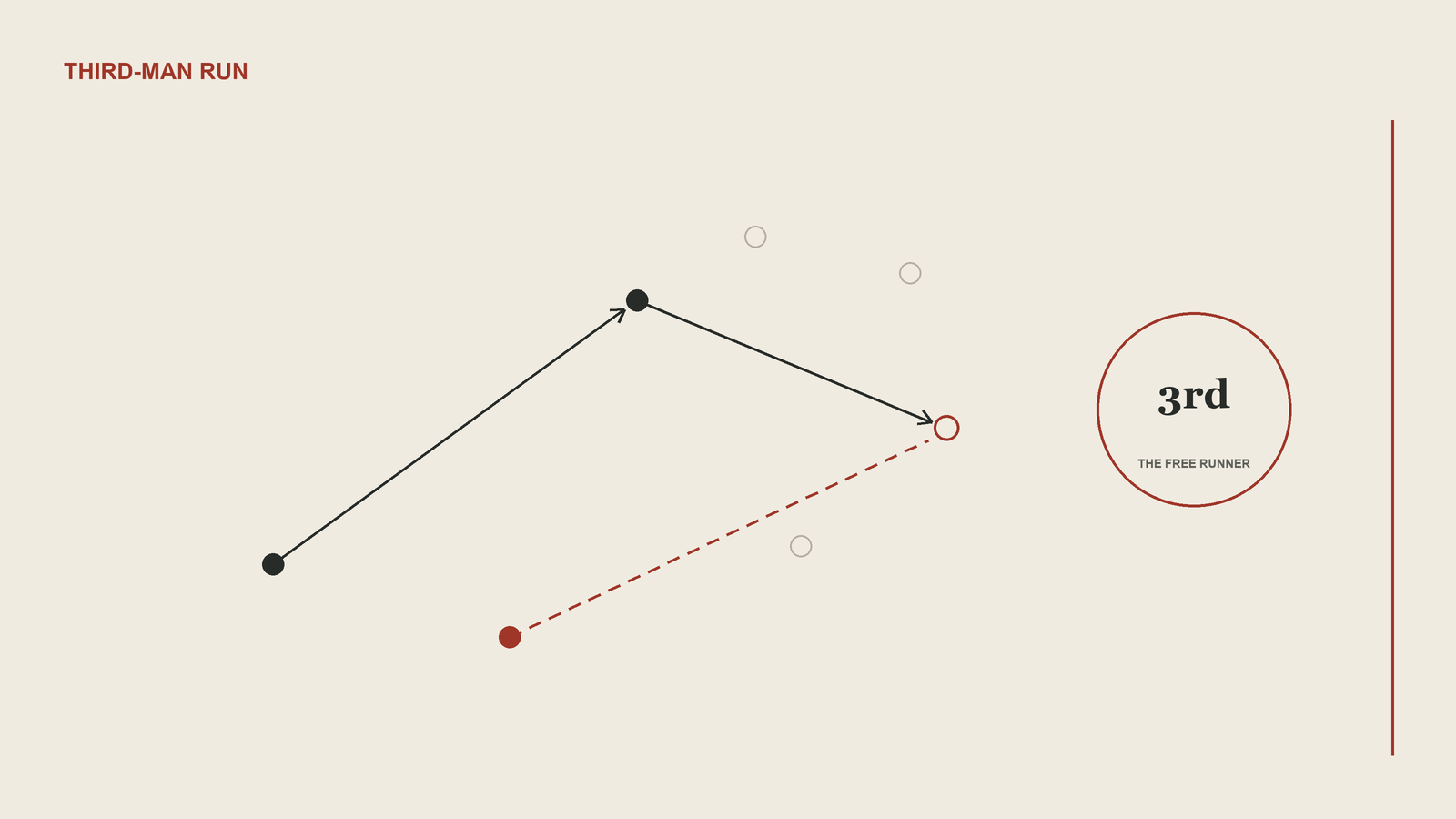
A third man run is a passing combination in which A passes to B, and while the defence reacts to that pass, C runs into space and receives the next ball from B. The point is that A could not have found C directly. The lane was closed, or C had not yet moved. By routing the ball through B, the team reaches a player the defence was not watching, because defenders track the ball and the man on it, not the runner arriving from somewhere else.
The mechanics are simple and the timing is not. The first pass has to do a job beyond moving the ball: it has to pull a defender. A striker dropping towards a centre-midfielder to receive from a centre-back drags his marker with him. A winger showing for the ball on the touchline tempts the full-back to step out. The moment that defender commits, the space behind him exists, and the third man has to already be moving into it. If C starts running when B receives, he is late. If he starts when A releases the ball, he is usually on time. Coaches spend whole sessions on this half-second, because an early run is offside or marked, and a late one meets a defender who has recovered.
B's role is often undersold. He usually receives with his back to goal, under pressure, and has to play a first-time layoff into a runner he may not see clearly. Teams that use the pattern well tend to have a striker or number ten who is happy being a wall for a moment. The bounce pass is the whole trick.
Why does this beat a compact defence? A well-organised low block closes the obvious vertical lanes. The centre-backs and midfielders position themselves between the ball and the players behind them, and a direct pass into the striker's feet is either intercepted or arrives with two defenders on it. A third man run does not ask for a lane that already exists. It creates one by making the defence move first. The pass to B is safe and short. The pass from B to C is played into the gap that the reaction to the first pass just opened. This is the same logic that sits behind overloads: you are not beating the defender in a duel, you are giving him two things to do at once and letting him choose wrong.
It is also one of the cleanest ways to add verticality without long balls. A team can circulate the ball sideways for thirty passes and never break a line. Two quick passes, up and then through, break it in three seconds, and the runner ends up facing goal.
The classic location for the third man run is the half-space, the channel between the centre-back and the full-back. A winger holds width, a full-back or a midfielder plays into the striker, and an eight runs from the half-space into the gap the striker's marker left. Coaches' Voice describes a Manchester City example against Chelsea where Sterling played to Cancelo, and Cancelo found Kevin De Bruyne arriving on a third man run behind the centre-backs. Guardiola's teams have used the pattern for years, and Gasperini's Atalanta built much of their attack around it, with wing-backs and midfielders taking turns as the runner.
How does it show up in data? Mostly it does not, and that is worth being honest about. Event data records the passes. It does not record the run, and it does not record the defender who stepped out and opened the space. You can see the shape of a third man combination in a passing sequence, a short pass followed immediately by a longer forward one, but nothing in a standard event feed flags it as such. Tracking data can catch the off-ball movement, but that is rarely public. Some analysts count "up-back-through" sequences by hand from video. If a site quotes a team's third man run total, ask how it was counted.
What it is not: a one-two. A one-two involves two players, and the first passer is also the runner. The defender who tracked the pass tracks the return. A third man run involves three players, and the runner was never on the ball. That is the entire advantage. The defence watches a pass and a player it can see, and the danger arrives from one it was not watching. Nor is it any pass into a runner. If A could have found C directly and chose B for no reason, that is a wasted touch, not a third man run.
Why is the third man run so hard to defend?
Because defending it requires a defender to leave the ball and cover a player who has not yet received it, and most defensive instruction points the other way. Defenders are coached to press the ball, to stay compact, and to follow their man. The first pass in a third man combination rewards all three habits and punishes them a second later. The defender who steps to B is doing his job. The gap he leaves is the problem, and the only fix is a teammate who reads the run before it happens and slides across. Zonal back lines that hold shape and let B receive cope better than man-oriented ones, but they concede the first pass every time.
Sources and further reading
- Third-man runs: football tactics explained — The Coaches' Voice (accessed 18 Sep 2026)
- Tactical theory: Third man principle — Total Football Analysis (accessed 18 Sep 2026)
- Third-Man Runs: Football Tactics Explained — The Football Analyst (accessed 18 Sep 2026)