Formations and roles · Analysis
5-4-1 Formation: Nine Behind the Ball and One Man Up Front
The 5-4-1 plays five defenders, four midfielders and a lone striker. How the back five defends deep, where it counters, and how to break it down.
By 01 Owen
· Updated 4 Oct 2026 · 8 min read
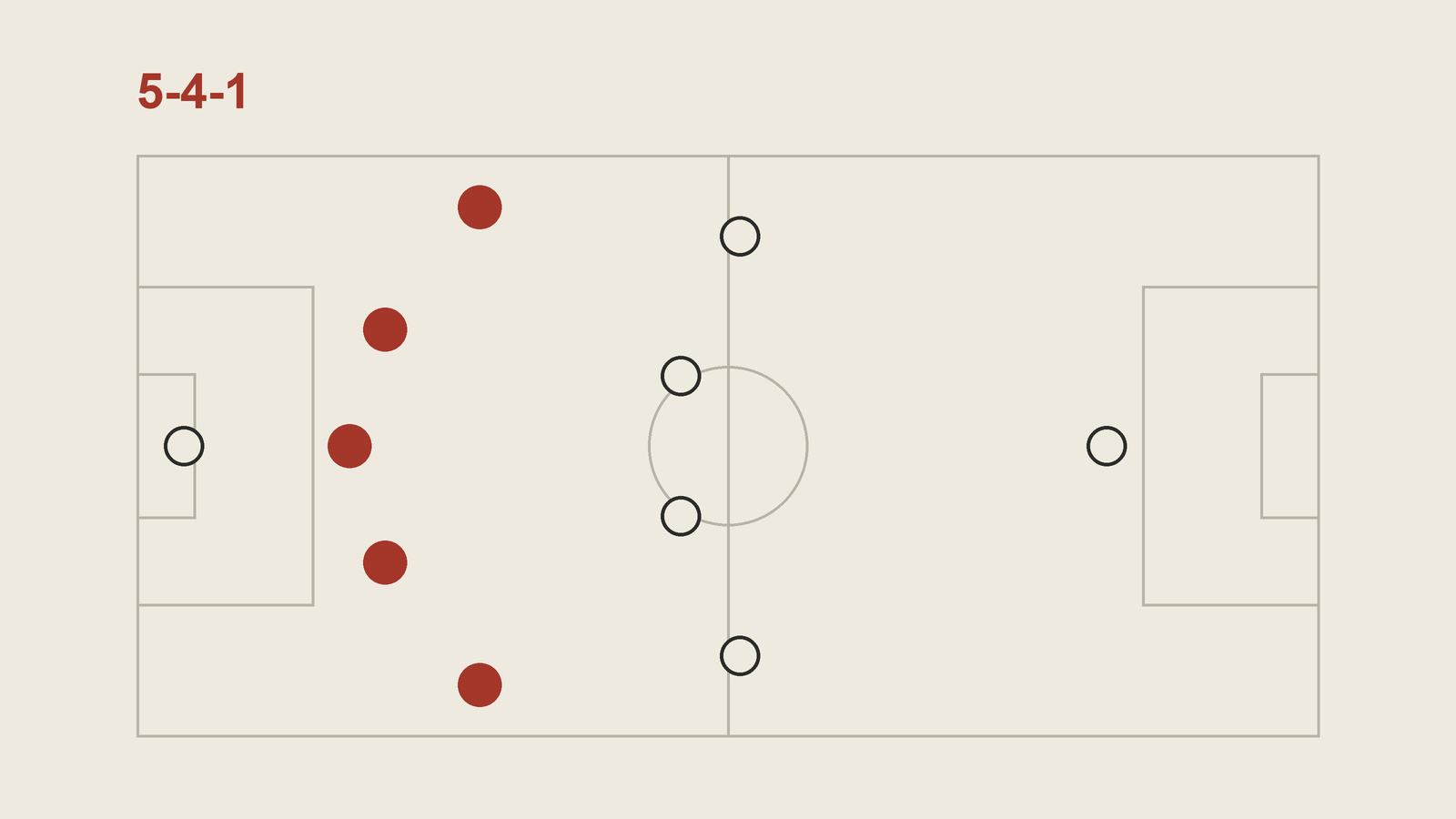
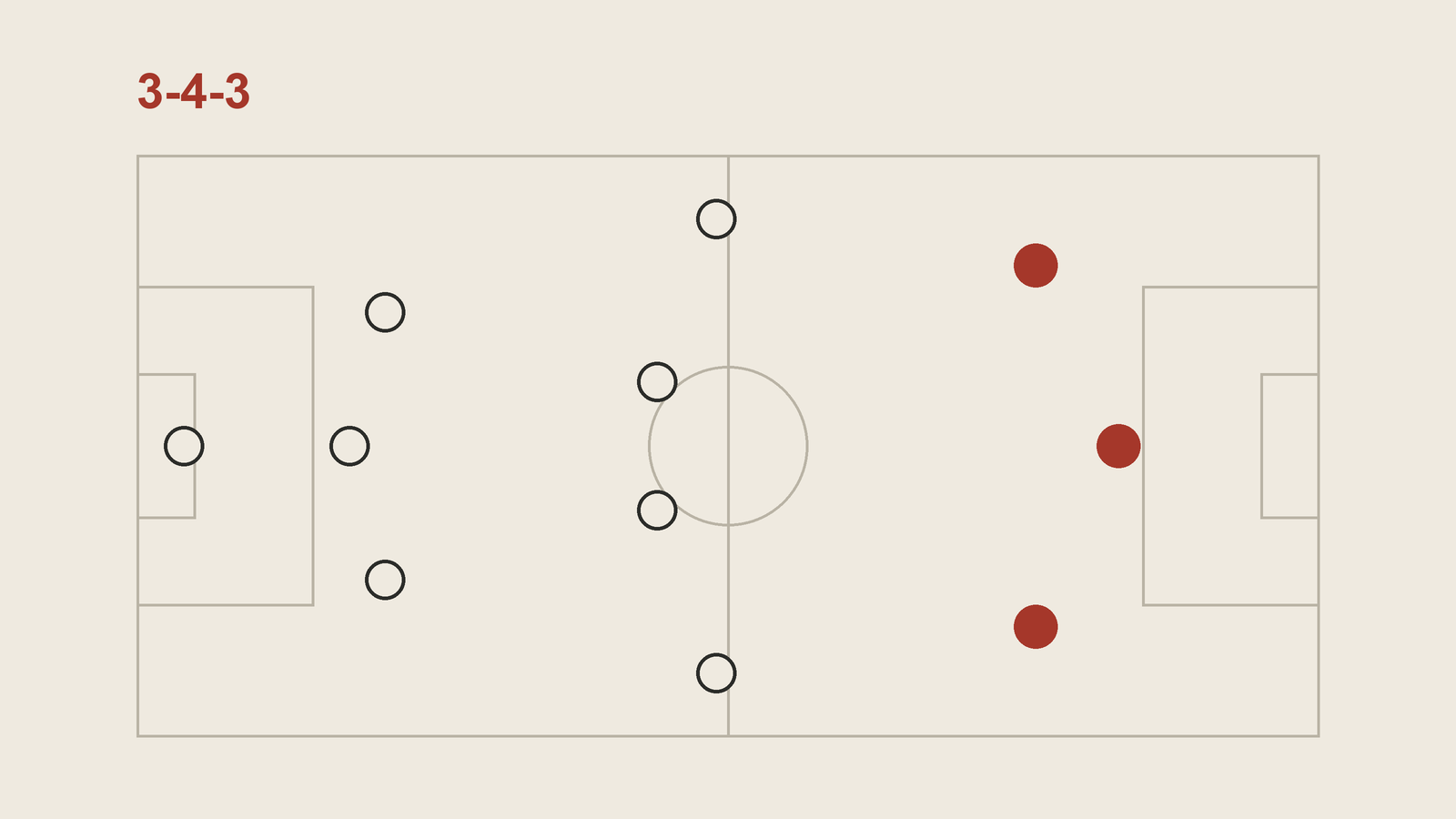
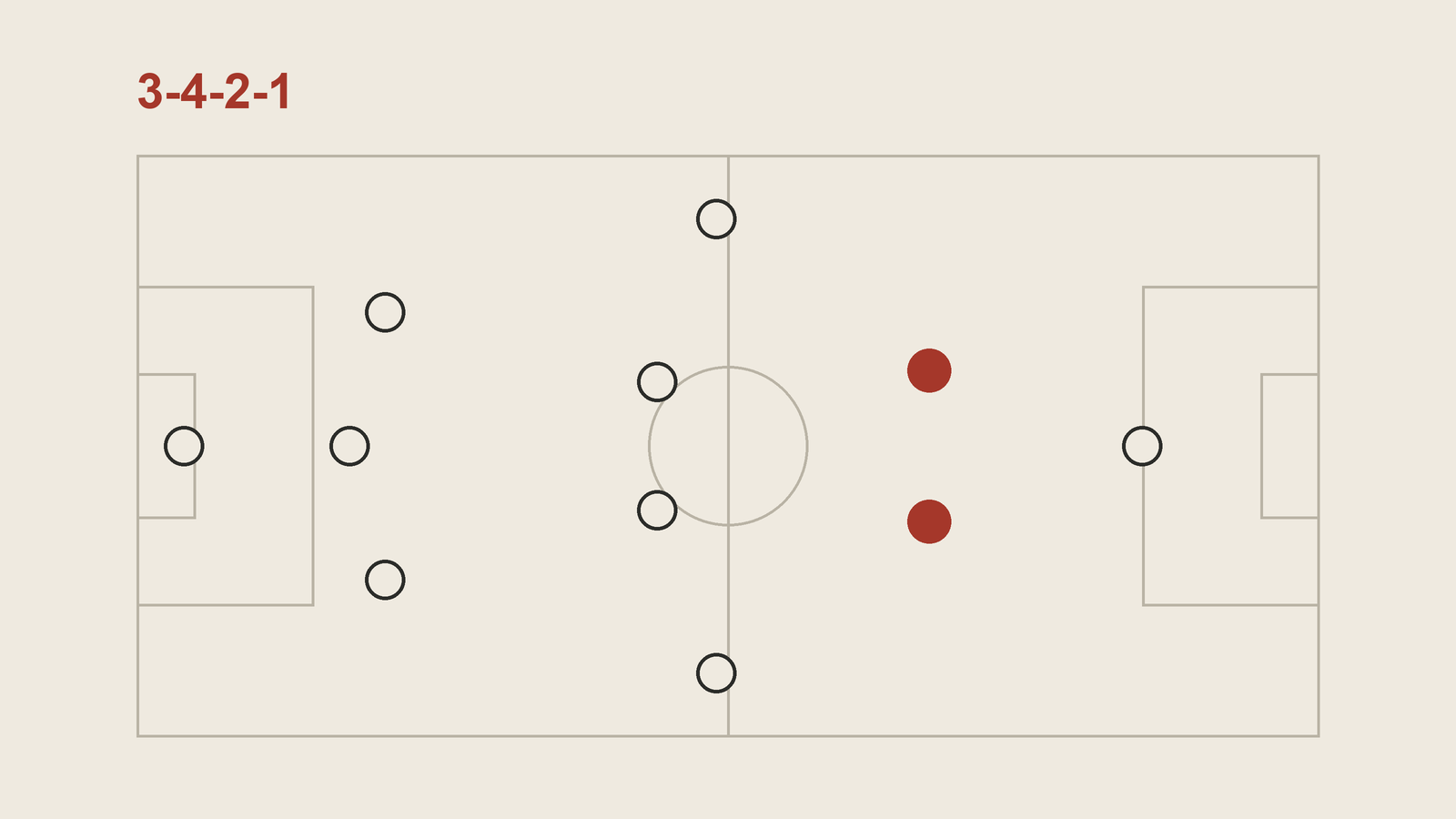
The 5-4-1 is a defensive formation with five defenders, four midfielders and a single striker. Most teams use it as the out-of-possession form of a 3-4-3 or 3-4-2-1, with the wing-backs dropping into the back line and the two attackers behind the striker dropping into midfield.
That second sentence matters more than the first. Very few coaches write 5-4-1 on the team sheet. They pick a back three with wing-backs and two players behind a centre-forward, and the 5-4-1 is what that team looks like when the opponent has the ball: two compact lines across the width of the pitch, nine outfield players behind the ball, one forward left to start the counter. Each role is explained in our guide to football positions.
The shape, player by player
The back five is three centre-backs and two wing-backs. The middle centre-back holds the line and deals with the striker. The two wide centre-backs cover the channels and track runs made in behind the wing-back on their side. Because there is a spare defender, a wide centre-back can also step out to follow a forward who drops into midfield, which a centre-back in a back four can rarely afford to do. For the wider family of systems built on three central defenders, see the back three.
The wing-backs are the hinge of the shape. Without the ball they are full-backs in a line of five, responsible for blocking crosses and defending one against one. With a third centre-back behind them, they can jump out of the line to engage the ball more freely than a full-back could.
The midfield four is usually two central midfielders and two wide players. The central pair is often a defensive midfielder and a more mobile partner, and their first job is to stay connected to the back line so there is no space between the lines. The two wide midfielders are, in possession, the players behind the striker: wingers or attacking midfielders who have tracked back. They narrow the gap to the central pair and help the wing-back outside them.
The lone striker has the hardest job in the team. He has to screen passes into the opposing holding midfielder, chase the ball across the centre-backs, and still have the legs to hold the ball up or run in behind when it is won.
How it defends
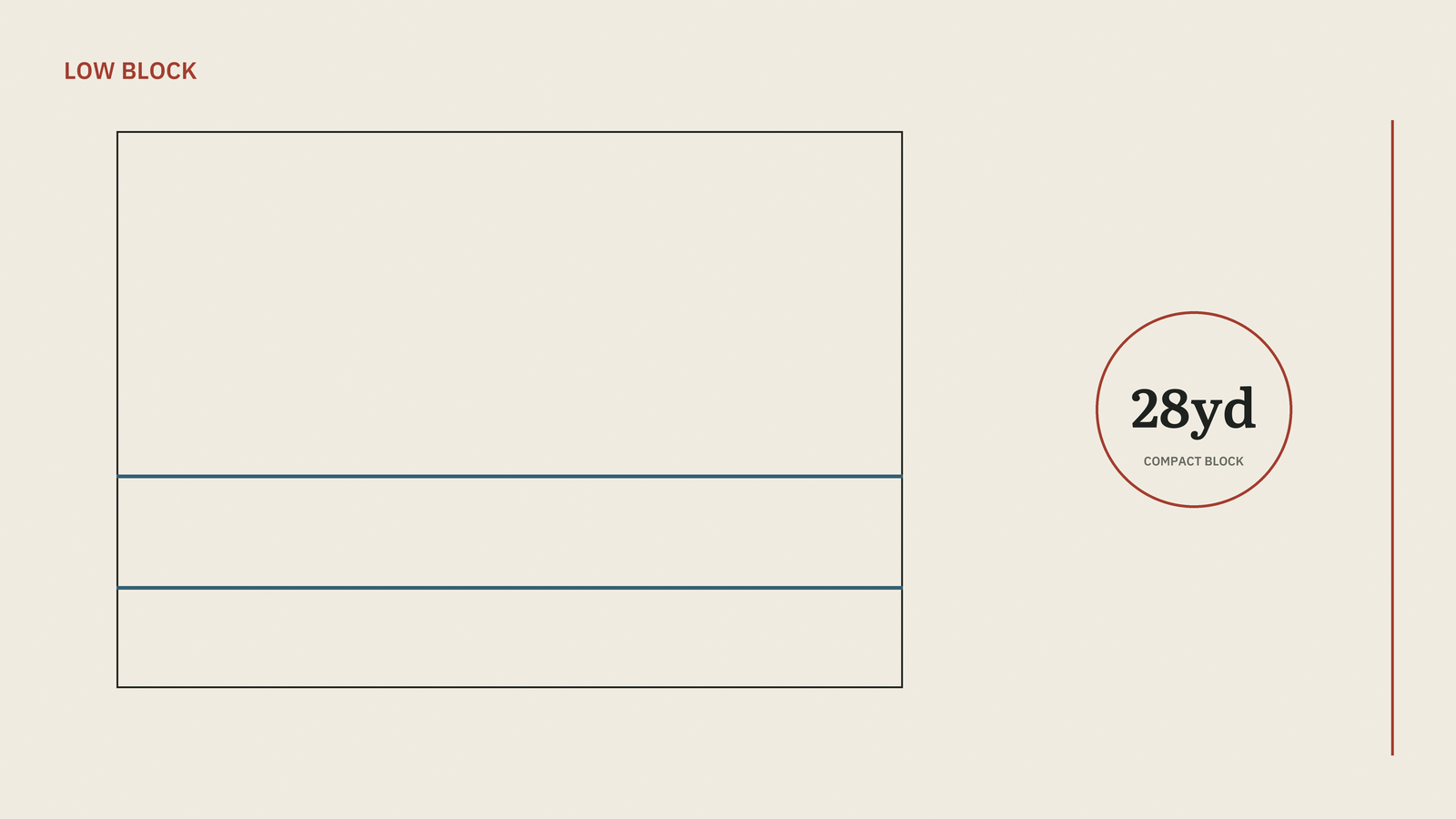
The 5-4-1 is the natural shape for a low block. Coaches' Voice describes the low block as a strategy that protects the defensive third, staying compact and deep so there is little space in behind. A back five helps in two ways. First, five defenders across the width mean the wide areas are covered without the centre-backs being pulled apart. Second, the extra centre-back gives a spare man against one striker and cover against two.
The second line of four does the screening. Its job is to keep the distances between the lines short and to close the half-spaces, the channels between the wide and central defenders where most chances against a deep block are made. When the ball goes wide, the shape slides across: the wing-back engages the winger, the wide midfielder doubles up, and the wide centre-back covers the run inside. The team tries to trap the ball by the touchline rather than let it come back into the middle.
How it attacks
The 5-4-1 attacks mostly through transitions. Coaches' Voice notes that once a team in a low block wins the ball, there is space behind the opposition to counter into, particularly down the flanks if the opposing full-backs have pushed forward. The first pass usually goes to the striker or to one of the two wide midfielders, who become the attacking pair behind him as soon as the ball is won. That is the moment the 5-4-1 turns back into a 3-4-2-1.
The wing-backs are the next wave. If they get forward, the shape becomes a five-man front line that stretches the opponent's back four. The problem is distance: a wing-back who has been defending on his own penalty area has a very long run to make, and Coaches' Voice points out that wing-backs who drop deep often have too far to travel to influence the attack.
Who made it famous
Wikipedia singles out the Greece side that won Euro 2004, which used a 5-4-1 against teams with two strikers to have an extra centre-back. According to the same page, Greece generally aimed to neutralise opponents in the first half and look to score in the second.
The more influential modern example is Antonio Conte's Chelsea. According to the Premier League, Conte switched from a 4-1-4-1 to a 3-4-3 for a match at Hull City in October 2016, after consecutive defeats, to shore up his defence. Marcos Alonso and Victor Moses started at wing-back, with Eden Hazard and Willian operating centrally behind the striker in a 3-4-2-1. Hull managed only three shots inside the penalty area. The Premier League's tactics explainer notes that Conte won the league with that 3-4-3, with N'Golo Kanté and Nemanja Matić as the midfield pair and Diego Costa up front, and that a 3-4-3 becomes a 5-2-3 or a 5-4-1 out of possession.
Thomas Tuchel's Chelsea used a 3-4-2-1 with wing-backs such as Reece James, Marcos Alonso and Ben Chilwell, which also dropped into a back five. Coaches' Voice notes that Diego Simeone's Atlético Madrid, best known for a 4-4-2 low block, has also used formations with a back five since 2020/21 to add another body in central defence.
Strengths and weaknesses
The strengths are numbers and coverage. Five defenders and four midfielders leave little room between or behind the lines. The spare centre-back absorbs mistakes, and the wing-backs can press wide without breaking the line. Against two strikers it gives a three-against-two at the back; against one, two spare defenders.
The weaknesses come from the same choices. With only one forward, the ball comes back quickly unless the striker can hold it. The wing-backs must defend and attack the full length of the pitch, and when they cannot, the 5-4-1 becomes a team that cannot get out of its half. Coaches' Voice notes that a back three covers less width than a back four, so opponents' counter-attacks can target the wide areas behind a wing-back caught upfield. The central pair can also be overloaded after a turnover, because there are only two of them and the wide midfielders are often too far forward to help.
How it changes in and out of possession
The 5-4-1 is a family name rather than one formation. In possession it is usually one of three shapes:
| In possession | What changes | Out of possession |
|---|---|---|
| 3-4-3 | Wide forwards drop into midfield | 5-4-1 |
| 3-4-2-1 | The two tens move wide to make a four | 5-4-1 |
| 3-5-2 | One striker drops into midfield | 5-4-1 or 5-3-2 |
A 3-4-3 can also defend as a 5-2-3, with the front three staying high to press. Choosing between the two is a choice about where to defend: the 5-2-3 wins the ball higher but leaves the central pair exposed; the 5-4-1 gives up territory to protect the middle.
How to beat it and how to spot it
You spot a 5-4-1 by counting the defensive line when the opponent has the ball deep in their half. If there are five, and two of them were standing in midfield a minute earlier, the team is defending in a back five. The second giveaway is the striker: if he is the only player left ahead of the ball, the second line is a four.
Beating it is mostly about width and speed. Switches of play make the five-man line and the four-man midfield slide a long way, and a quick switch can find a winger one against one with a wing-back. Pinning the wing-backs with high, wide attackers stops them from joining the counter, which leaves the striker alone. Players who receive between the midfield four and the back five force a centre-back to step out, and a runner into the space he leaves is the classic way through. Finally, a team that keeps players back when it attacks takes away the counter; good rest defence is what makes patience against a deep block affordable.
Is the 5-4-1 a defensive formation?
Yes, in the sense that it puts nine outfield players behind the ball. But most teams that defend in a 5-4-1 attack in a 3-4-3 or 3-4-2-1, so the label describes their shape without the ball rather than their whole approach. Chelsea under Conte defended in it and still won the Premier League.
What is the difference between a 5-4-1 and a 5-3-2?
The 5-4-1 has one striker and four midfielders; the 5-3-2 has two strikers and three midfielders. The 5-4-1 covers the width of the pitch better in midfield, while the 5-3-2 keeps two players high for the counter. A 3-5-2 usually defends as a 5-3-2, and a 3-4-3 as a 5-4-1.
Why do teams use a 5-4-1?
Usually because they expect to have less of the ball, want to protect a lead, or face an opponent with two strikers. Greece at Euro 2004 used it for exactly that last reason, to have an extra centre-back. The back five also gives wing-backs freedom to press wide without leaving the centre exposed.
Sources and further reading
- Formation (association football) — Wikipedia
- The 3-4-3: football tactics explained — Coaches' Voice
- The low block: football tactics explained — Coaches' Voice
- Wing-backs: football tactics explained — Coaches' Voice
- Chelsea change of shape puts Alonso on radar — Premier League