Glossary · Analysis
The Rectangle in Front of the Box Where Assists Come From
Zone 14 is the central area just outside the penalty box on an 18-zone pitch grid. Here is where the idea came from, why coaches care, and what it misses.
By 01 Owen
· Updated 19 Sep 2026 · 5 min read
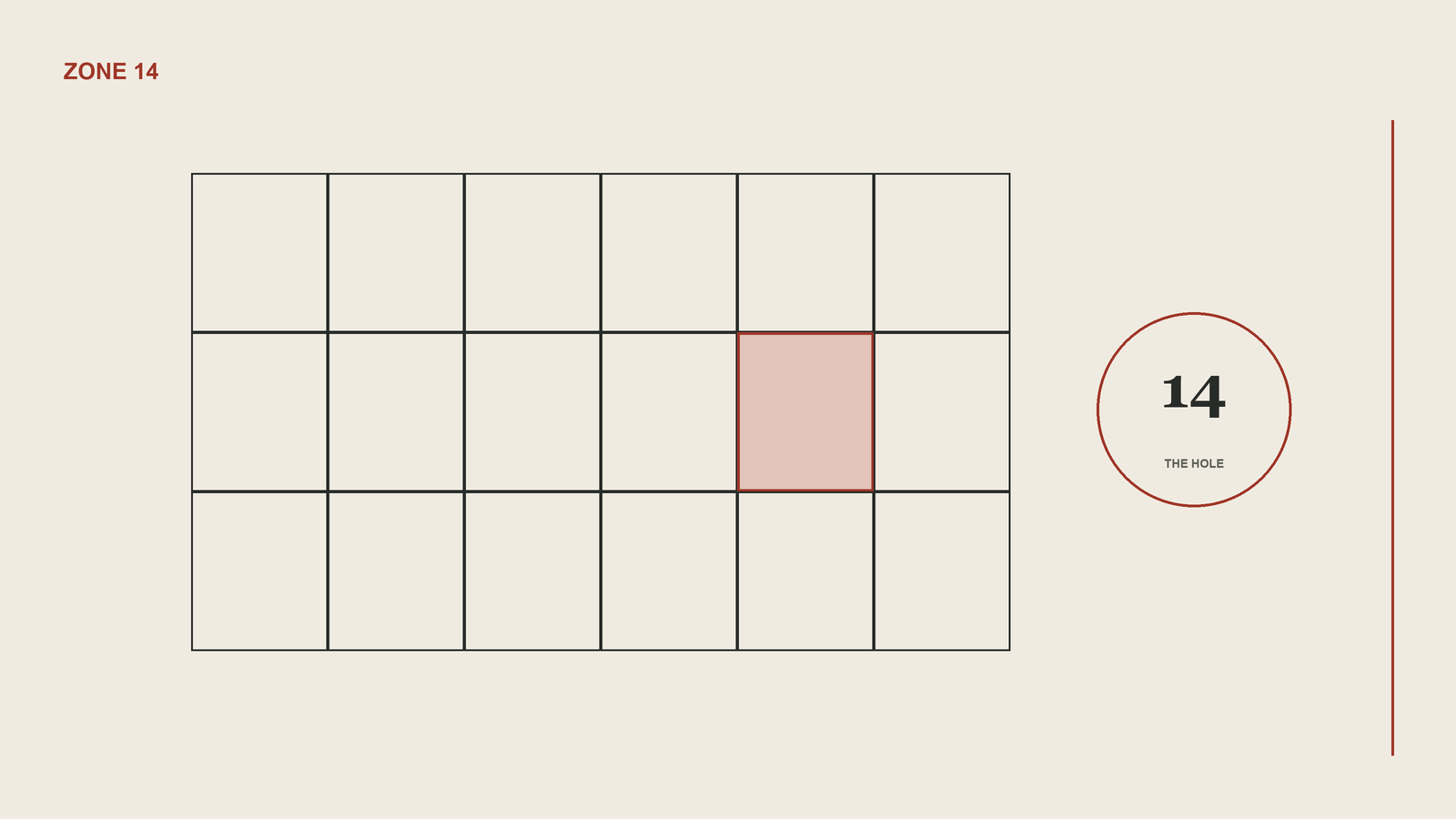
Divide a football pitch into a grid of six rows and three columns, number the eighteen rectangles from the defending goal line forward, and zone 14 is the central one directly outside the opposition penalty area. That is the whole definition. It is the patch of grass a number ten stands on when commentators say a player is "in the hole", stretching back from the edge of the D towards the middle of the attacking third, flanked on either side by the two attacking half-spaces.
The name comes from performance analysis research at Liverpool John Moores University in the late 1990s and early 2000s, associated with Tom Reilly and colleagues, who broke the pitch into that 18-cell grid and coded where attacks passed through before goals. Their work on the 1998 World Cup and Euro 2000 kept pointing at the same cell. Successful teams, France in particular, generated a large share of their assists from passes played out of the central zone in front of the box rather than from the flanks, and attacks that moved the ball forward into the penalty area from zone 14 were far more productive than attacks that moved it sideways to the wings. The researchers called it the "golden square". Coaches already knew the area as "the hole", so the study did not discover the space so much as give it a number and a place on coaching courses.
Why the space matters is mostly geometry. A player receiving there on the half-turn has the whole goal in front of him at a distance where a shot is realistic and a pass is even better. Both centre-backs have to decide whether to step out and leave the line or hold and let him look up. The holding midfielder has to decide whether to drop in and screen, which opens the space he came from. That is why the classic zone 14 action is a vertical pass in, a first touch that turns the receiver to face goal, and then either a through ball or a slipped pass into the channel for a runner. Spielverlagerung's glossary summarises the same finding from the research: the most effective use of the zone is a pass into the penalty area, and possessions that linger there tend not to produce a shot.
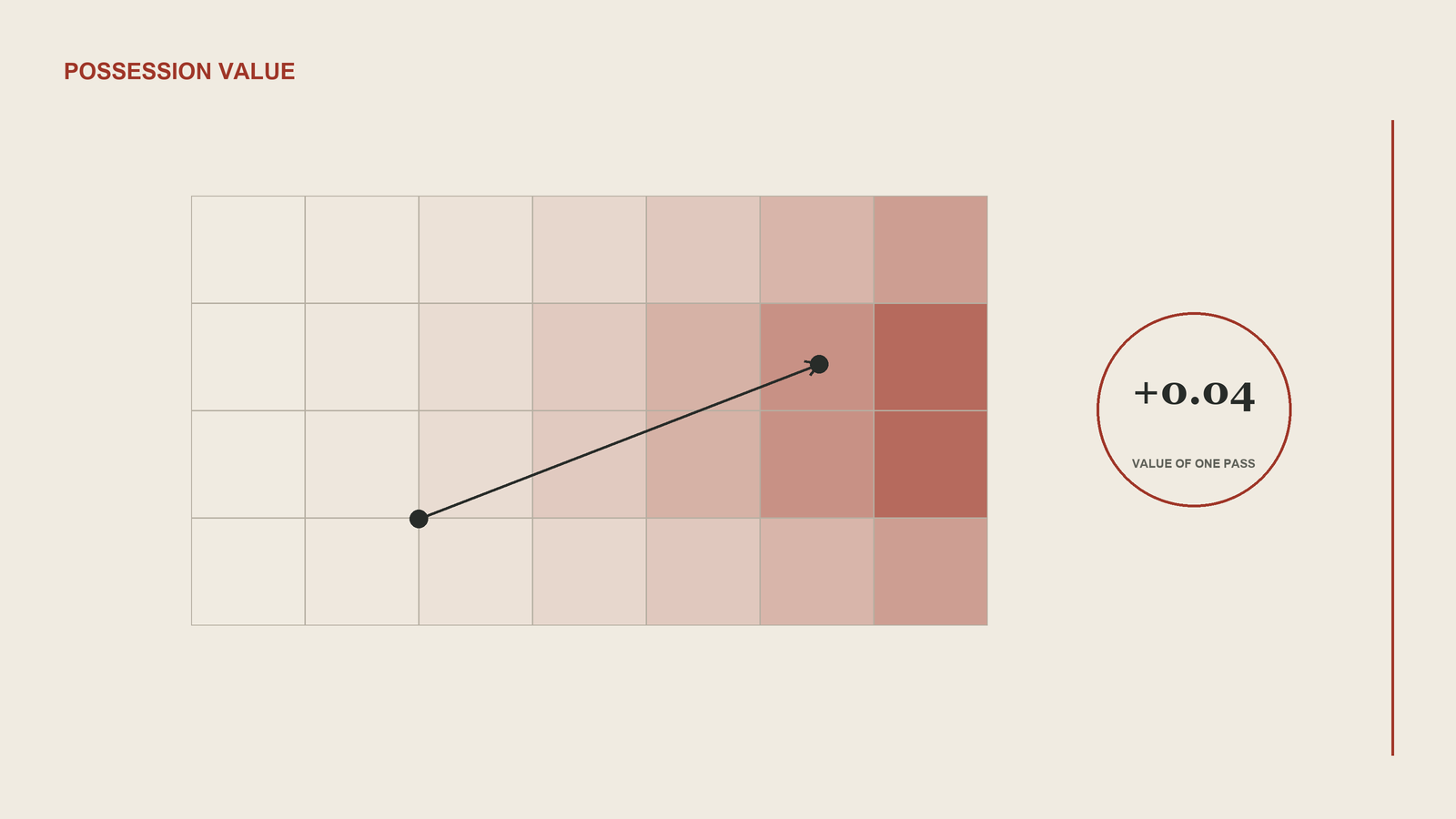
That makes zone 14 the natural companion to two other ideas on this site. The first is box entries, because a pass from zone 14 into the area is exactly the kind of entry the research valued most, and counting entries by origin zone is a cheap way to see whether a team is actually reaching the space or only passing around it. The second is expected threat, which puts a value on every location on the pitch by how likely a possession there is to end in a goal within a few actions. xT grids consistently light up in the centre just outside the box, which is a modern, data-driven way of arriving at the conclusion the LJMU researchers reached by hand. Zone 14 was, in effect, an early xT map with only eighteen cells.
A concrete picture of the idea working: Manchester City under Pep Guardiola work the ball to a midfielder, often Kevin De Bruyne, receiving between the opposition's midfield and defensive lines, facing goal. From there the pass is not a cross but a threaded ball to a winger or full-back arriving at the byline, followed by a cutback. Notice, though, that De Bruyne often takes that touch in the right half-space, slightly off centre, rather than dead in zone 14. That says something about how the concept has aged.
Because that is the honest limit of the term. The grid is coarse: an eighteen-cell map treats a ball received at the edge of the D and one received fifteen metres deeper as the same event. It also ignores what defenders are doing. The cell is only valuable if the receiver has time and a forward-facing body position, and any decent modern low block sits deep and compact specifically to deny both, so the pocket closes as soon as the ball arrives. Many teams now respond by attacking the half-spaces instead, which is why a lot of the "zone 14" activity in a modern match is actually zones 13 and 15. And the numbers behind the original research were counts of where assists came from, not a controlled measure of what would have happened had the ball gone elsewhere. Zone 14 tells you where good things tended to happen. It does not tell you how to get the ball there against a team that knows the same thing.
Why is it called zone 14?
Because of the numbering system the original researchers used. The pitch is cut into three columns across its width and six rows along its length, giving eighteen zones. Diagrams differ on how wide the central column is. The zones are numbered from the team's own goal line upwards, left to right, so the first row is zones 1 to 3, the second 4 to 6, and so on. The fifth row, directly in front of the opposition's penalty area, contains zones 13, 14 and 15. Zone 14 is the middle one. The two beside it are broadly the attacking half-spaces, and the final row, 16 to 18, covers the penalty area.
Sources and further reading
- Zone 14 — Spielverlagerung (accessed 18 Sep 2026)
- What is "Zone 14" in football? — Football Performance Analysis (accessed 18 Sep 2026)
- The use of Zone 14, the key to winning football matches — Football Bloody Hell (accessed 18 Sep 2026)