Formations and roles · Analysis
The Shape That Put a Bodyguard Behind Every Number Ten
The 4-2-3-1 uses four defenders, two holding midfielders, three attacking midfielders and one striker. How the double pivot and the number ten make it work.
By 01 Owen
· Updated 22 Sep 2026 · 4 min read
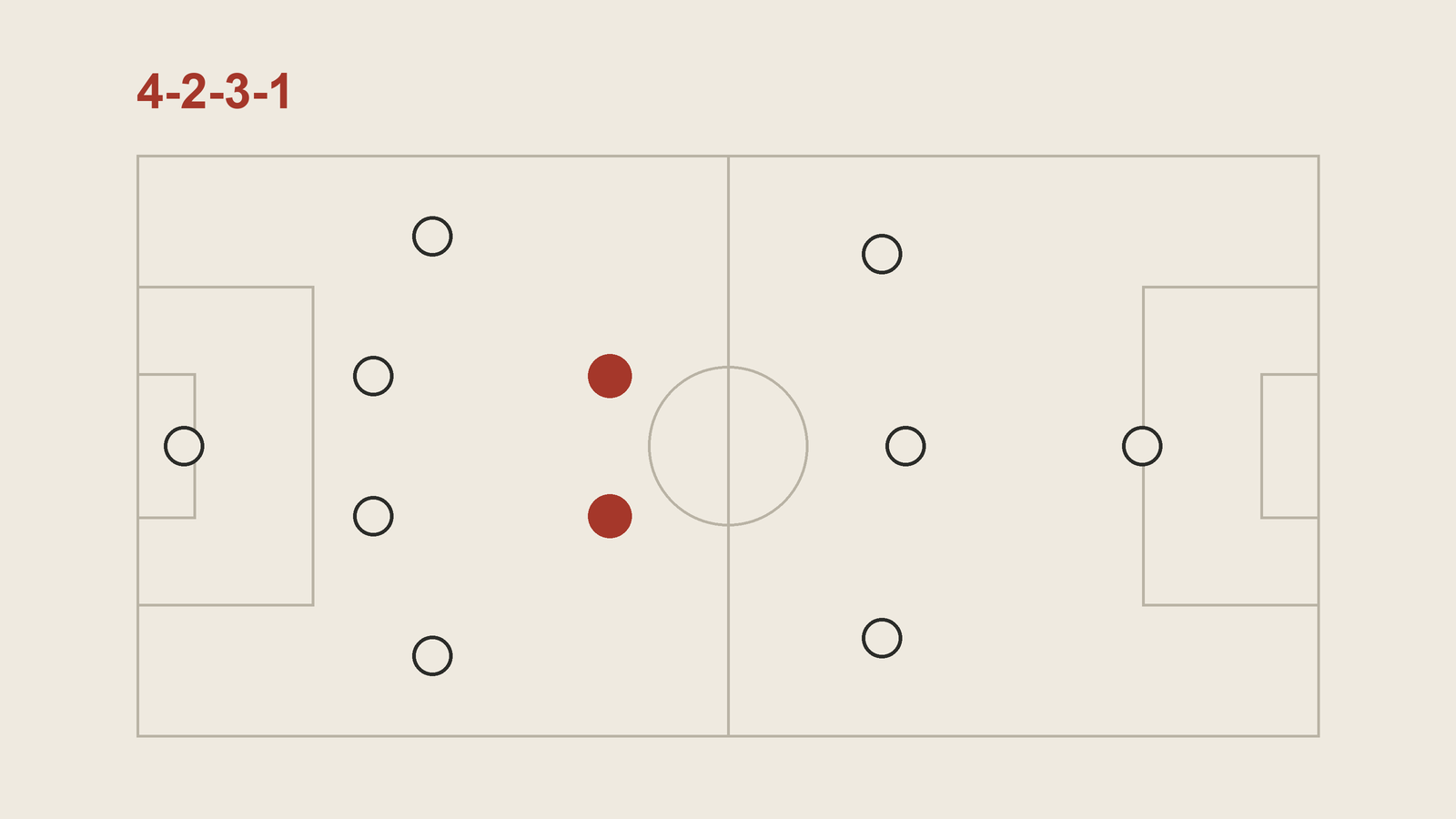
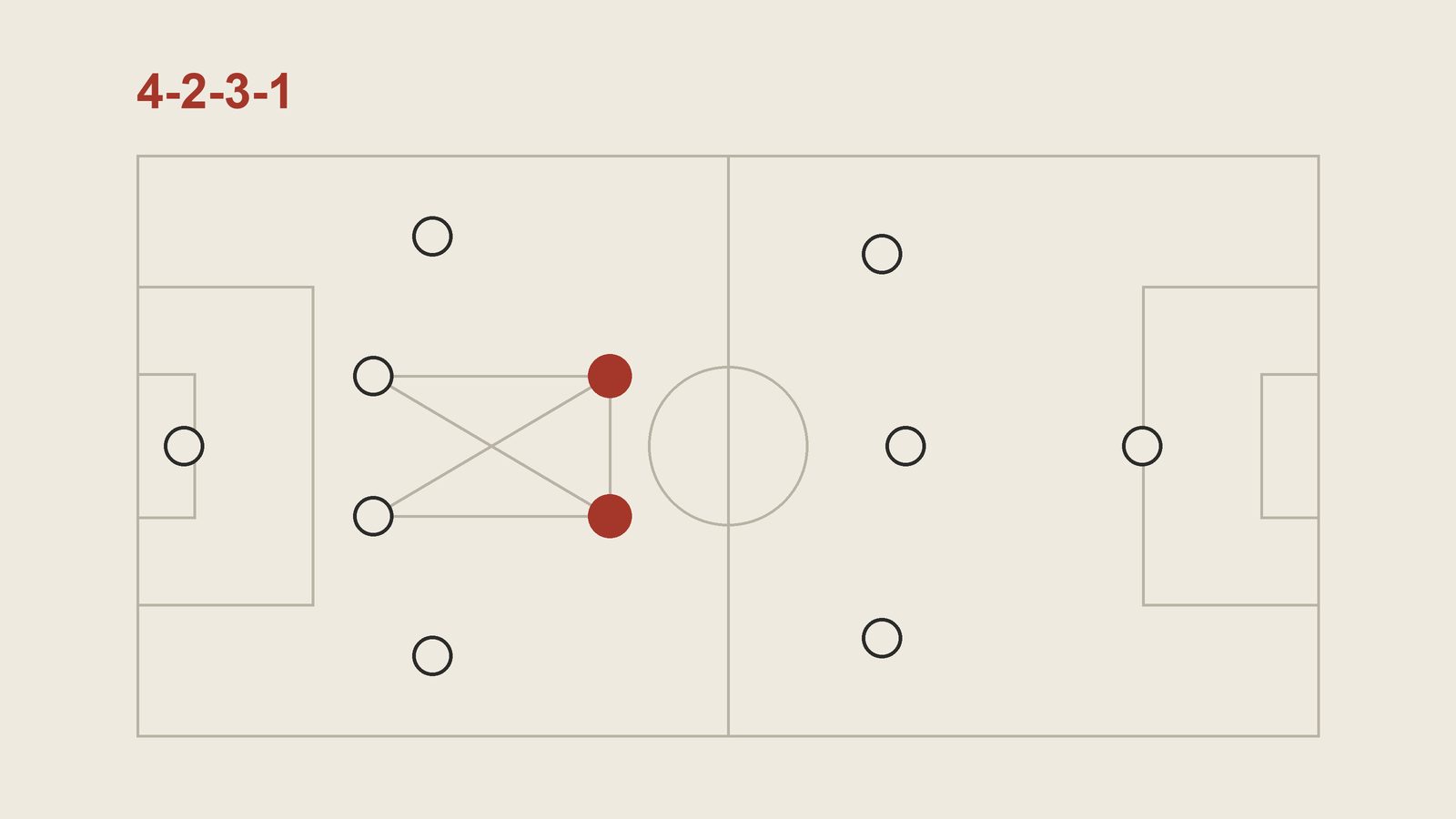
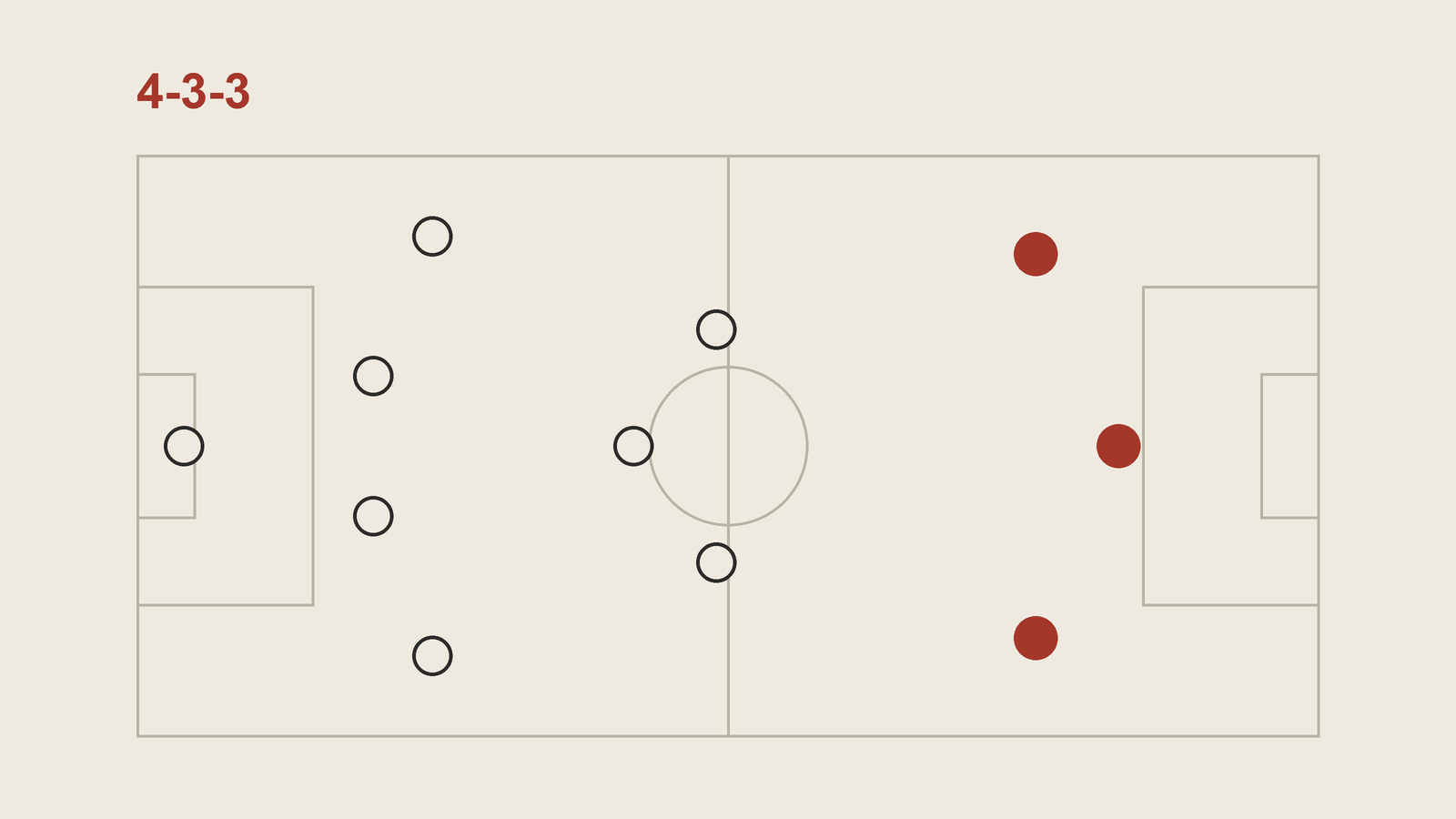
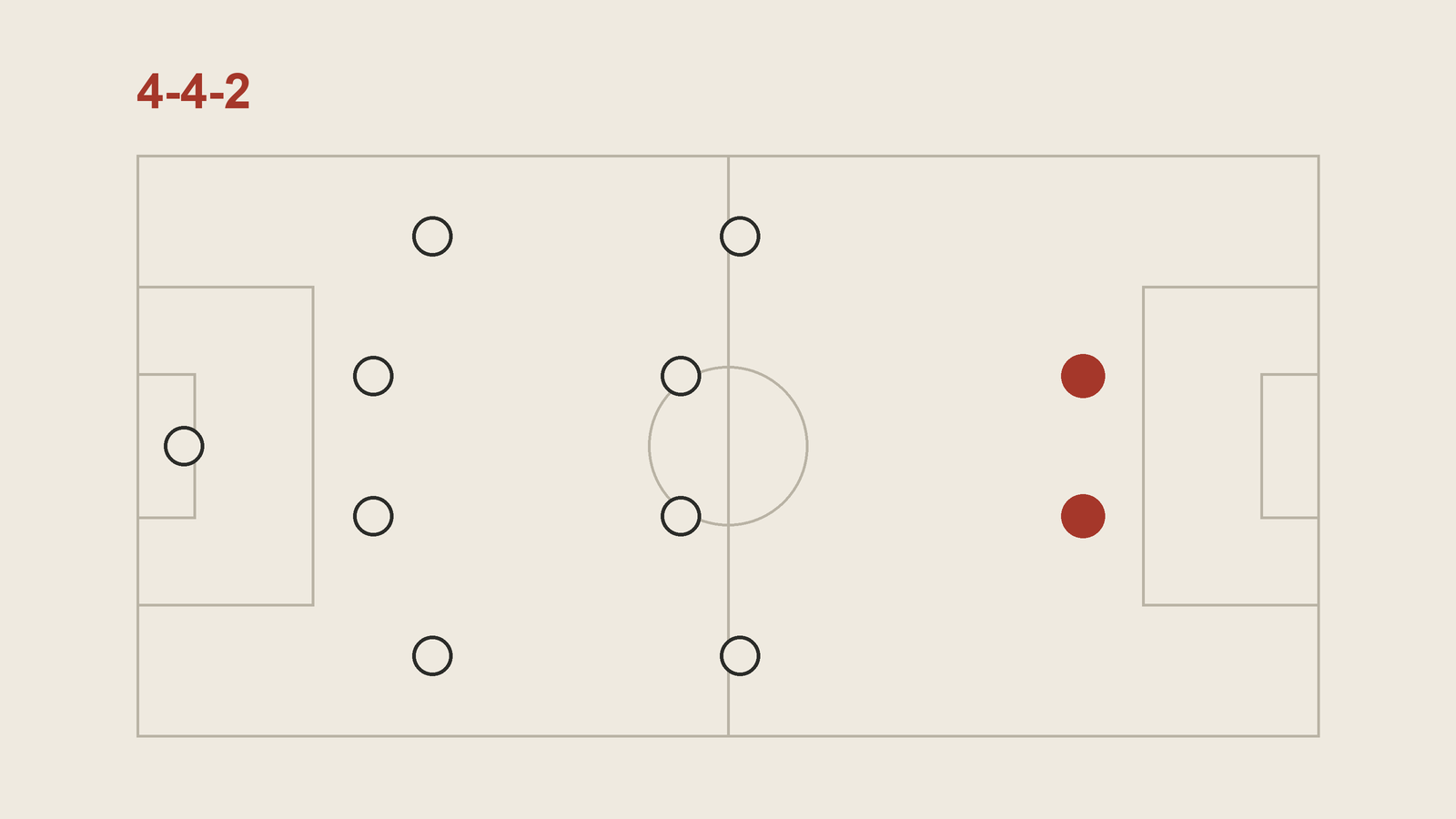
The 4-2-3-1 is a formation with four defenders, two holding midfielders, a line of three attacking midfielders and a single striker. It is a 4-4-2 with one forward pulled back into the hole, or a 4-3-3 with its midfield triangle turned upside down, and that flexibility is a large part of why it became the default shape of top-level football around 2010.
Its origins are usually traced to Spain in the 1990s, where coaches looking for more control in midfield withdrew one of the two strikers; Juanma Lillo is the name most often attached to its first systematic use. By the 2010 World Cup it was everywhere. Spain, the Netherlands and Germany, three of the four semi-finalists, all played versions of it, each with a recognisable pair in front of the defence: Sergio Busquets and Xabi Alonso, Mark van Bommel and Nigel de Jong, Bastian Schweinsteiger and Sami Khedira.
That pair, the double pivot, is the foundation. Two players screening the back four means the full-backs can go forward without the centre-backs being left alone, and it means the player ahead of them carries less defensive responsibility. The classic division of labour is one who wins the ball and one who passes it, though the better pairs blur that line. In build-up play one of them often drops beside or between the centre-backs to make a three, while the other stays ahead of the first line of pressure.
Ahead of them is the reason the shape exists: a number ten playing between the opponent's midfield and defence. Receiving there, in the central pocket the older literature calls Zone 14, is the hardest thing to defend against, because a centre-back who steps out leaves a hole and one who stays gives the ten time to turn. The two wide players can be classic wingers who hold the touchline, or inside forwards who come in on their stronger foot and leave the wing to an overlapping full-back. With four players within reach of the striker, the 4-2-3-1 rarely leaves him as isolated as a 4-3-3 can.
Without the ball it usually becomes a 4-4-2. The ten steps up next to the striker and the two of them screen passes into the opponent's holding midfielder, while the wide players drop level with the double pivot to make two banks of four. It is an easy shape to coach and an easy one to press from, because the front two can split the centre-backs and the ten can jump to the pivot on a pressing trigger.
The weaknesses are about distances. If the two holding players sit too deep, a gap opens between them and the front four and the team breaks into a defending six and an attacking four, which makes it easy to play through and hard to counter-press. The wide attackers have long defensive runs to make, and when they do not make them the full-back is left two against one. And against three central midfielders the double pivot can be outnumbered unless the ten drops in, which costs the team its player between the lines. José Mourinho's Real Madrid and Jupp Heynckes's Bayern Munich of 2013 solved that with wide players who worked both ways; many teams with a luxury ten did not.
The shape has lost some ground to the 4-3-3 and to back-three systems in the last decade, partly because pressing football asks the most advanced midfielder to do more defending than a classic ten wants to do. It is still the most common formation in many leagues, because it puts every player in a position that is easy to explain. You can open a 4-2-3-1 on the tactics board and drag the ten up alongside the striker to see the 4-4-2 it defends in.
What is the difference between a 4-2-3-1 and a 4-3-3?
Mainly the midfield triangle. A 4-3-3 has one holding midfielder and two players ahead of him; a 4-2-3-1 has two holding midfielders and one player ahead. In a 4-2-3-1 the wide attackers also tend to start a little deeper, level with the ten rather than the striker. On the pitch the two shapes turn into each other all the time, which is why coaches talk about them as variations rather than opposites.
Sources and further reading
- The 4-2-3-1: football tactics explained — The Coaches' Voice
- The 4-2-3-1 formation: key points — The Coaches' Voice
- Formation (association football) — Wikipedia