Formations and roles · Analysis
Single Pivot vs Double Pivot: One Holding Midfielder or Two
A single pivot is one holding midfielder in front of the defence; a double pivot is two side by side. A side-by-side table, the trade-offs and the formations.
By 01 Owen
· Updated 7 Oct 2026 · 7 min read
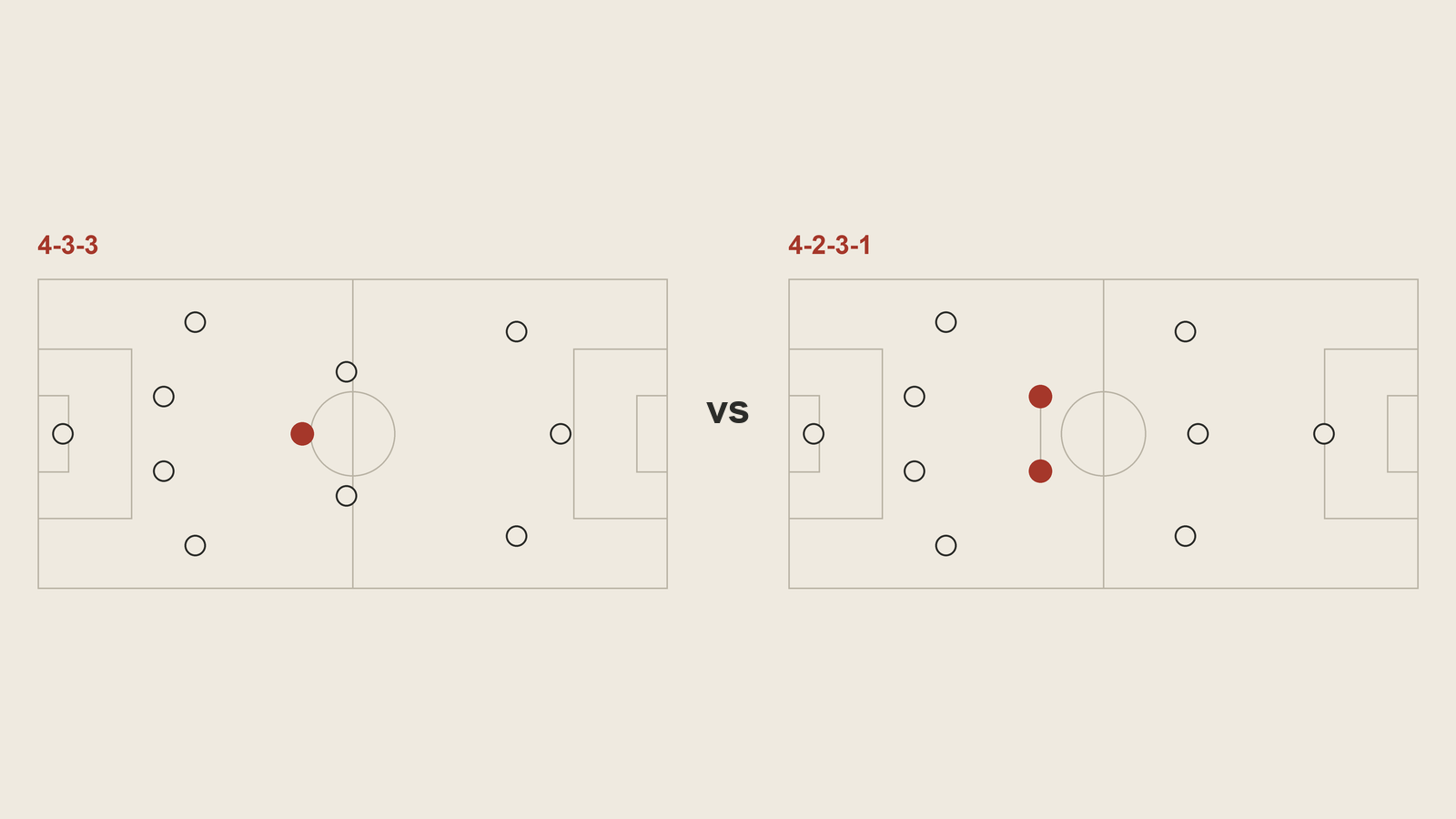
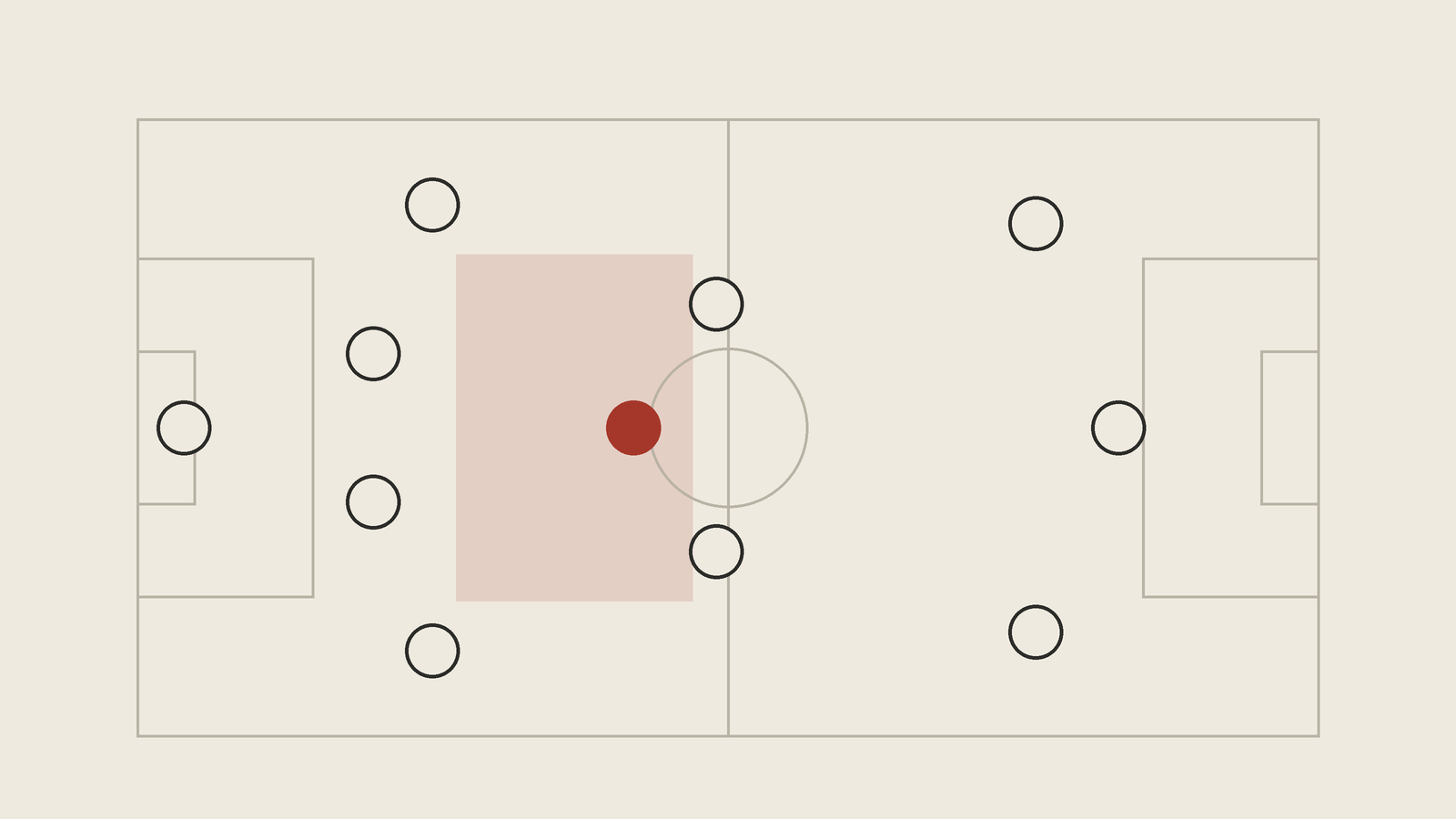
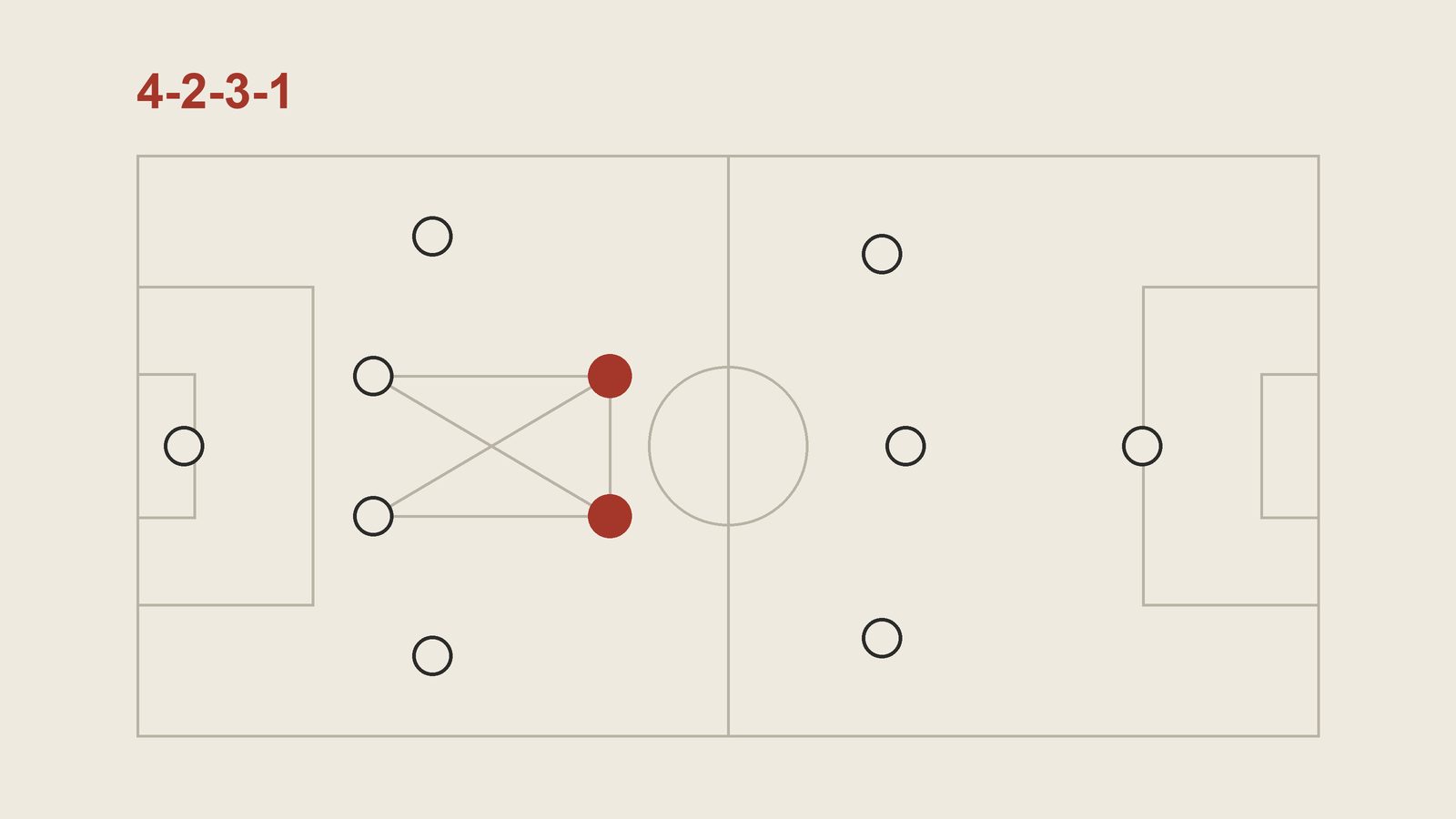
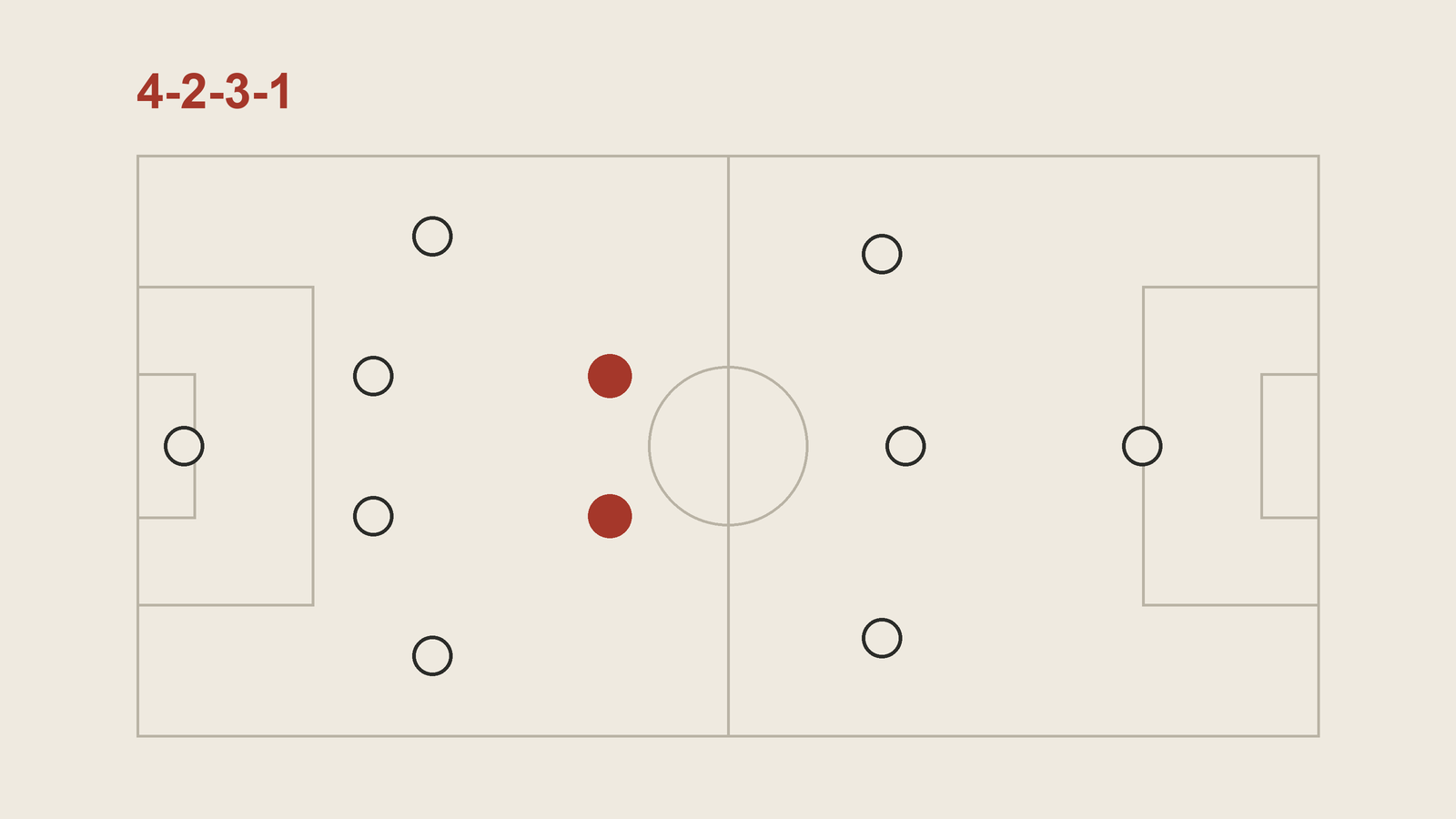
A single pivot is one holding midfielder in front of the defence, as in a 4-3-3 or 4-1-4-1. A double pivot is two holding midfielders side by side, as in a 4-2-3-1: safer in front of the back four, but with one fewer player free to attack.
Both answer the same question: who guards the space between the back four and the rest of the team? The defensive midfielder article explains what that player does. The double pivot article explains how a pair splits the work. This page puts the two set-ups next to each other.
| Single pivot | Double pivot | |
|---|---|---|
| Where they stand | One player at the base of the midfield, between the centre-backs and two 8s | Two players side by side, ahead of the centre-backs and behind a 10 |
| Main job | Screen, cover and protect the space ahead of the central defence on his own | Share that space, so one can step out while the other holds |
| Without the ball | Covers the full width of the middle alone; the spaces either side of him are the risk | Two bodies across the middle; a switch of play can still bypass both |
| With the ball | The main passing link from the back line; often drops between or beside the centre-backs | Two passing angles for the centre-backs; one can drop, the other stays beyond the first press |
| Typical formations | 4-3-3, 4-1-4-1 | 4-2-3-1, 3-4-3, 4-2-2-2 |
| Typical number | The 6 | Two 6s, or a 6 and an 8 |
| Well-known example | Claude Makélélé; Sergio Busquets at Guardiola's Barcelona | Rodri with Gündogan or Fernandinho at Manchester City, 2020/21 |
The midfield triangle, pointing up or down
The simplest way to see the difference is to look at the three central midfielders. With a single pivot the triangle points forward: one 6 at the base, two 8s ahead of him. With a double pivot it points backwards: two 6s at the base, one 10 at the tip. The Premier League's guide to the No 6 describes the double pivot exactly this way, as two sixes under a single 10, inverting the triangle.
That one change moves a player from behind the attack to in front of the defence.
With the ball: build-up
A single pivot is often the main passing link between the back line and the midfield. He shows for the ball in front of the centre-backs, drops into the back line when the team builds against a press, and switches play or breaks lines when he turns. Because there is only one of him, opponents can build their press around blocking the pass into him.
A double pivot gives the centre-backs two options instead of one. One holder can drop beside or between the centre-backs while the other stays beyond the first line of pressure, a common platform for build-up play in a 4-2-3-1. Coaches' Voice notes that the pair can also drift wide to help switch play. The cost: with both deep, the team relies on the 10 and the wide players to receive between the lines.
Without the ball: the space in front of the back four
This is where the double pivot earns its place. Coaches' Voice says the pair provides protection ahead of the centre-backs and covers the spaces between the lines. One can jump forward to press beside the 10 or slide across to help a full-back, and the other is still there. Coaches' Voice adds that the 4-2-3-1 was introduced to stop opponents reaching the central spaces between the lines, the area that includes Zone 14 just outside the penalty box.
A single pivot has the same job with half the bodies. The Premier League's 4-1-4-1 guide puts his task as screening, covering, duelling and intercepting in the space ahead of the central defence. Its No 6 guide names the problem: if a lone 6 has to cover wide areas, he leaves central spaces open. Opponents with two players between the lines, or two central forwards, can overload him.
The double pivot is not free of risk either. If both full-backs have pushed on, a quick switch of play on the counter can go past both holders and into the wide areas behind.
Rest defence and players free to attack
Rest defence is the shape a team keeps behind the ball while it attacks. A double pivot gives a natural 2+2 in the middle: two centre-backs and two holders. That security lets a 4-2-3-1 keep its 10 higher up the pitch and send the full-backs forward. The 10 still defends: Coaches' Voice describes him covering beneath and marking the opposition's pivot.
A single pivot leaves one more player free. With two 8s ahead of the 6 instead of one 10, the team has an extra runner who can arrive in the box and an extra body to press high. Teams that want a second holder anyway can push a full-back into midfield as an inverted full-back, so the rest defence is still two in front of the centre-backs.
Which formations use each
The single pivot belongs to the 4-3-3 and the 4-1-4-1. See them numbered on the 4-3-3 formation page and the 4-1-4-1 formation page. The 4-1-4-1 can be the more defensive version, with the wide players dropping into a line of four ahead of the pivot. The Premier League guide calls it a foundation for an effective low or mid-block.
The double pivot belongs above all to the 4-2-3-1 (numbered diagram). It also appears in the 3-4-3 (diagram), where the two central midfielders sit between the wing-backs, and in the 4-2-2-2.
The line between them is not fixed. In a 4-1-4-1, one central midfielder can drop towards the ball and form a brief double pivot when the build-up needs it.
Examples
Coaches' Voice traces the double pivot back to the single one. The 4-2-3-1 first relied on one holder covering the space, with Makélélé the best-known, before a second holder was added. Arrigo Sacchi explained why Real Madrid needed Makélélé: their attackers did not track back, so someone had to defend in front of the back four. Under Pep Guardiola, Sergio Busquets was the central holding midfielder in Barcelona's 4-3-3.
For double pivots, Coaches' Voice gives several recent pairs: Eric Dier and Mousa Dembélé under Mauricio Pochettino at Tottenham, Thiago with Leon Goretzka or Joshua Kimmich at Hansi Flick's Bayern in the 2019/20 Champions League, Rodri with Ilkay Gündogan or Fernandinho at Guardiola's Manchester City in 2020/21, and Kalvin Phillips with Declan Rice for Gareth Southgate's England at Euro 2020.
How to tell them apart in a match
Watch the moment a centre-back has the ball. Count the midfielders who show for it in front of him. One player in the middle with two others higher up is a single pivot. Two players at roughly the same depth, one moving towards the ball and one holding, is a double pivot.
When the ball is lost, a single pivot means one midfielder closing the middle; a double pivot means two already between the ball and the defence.
When a coach picks one over the other
A coach picks a double pivot to protect a back line, to give attacking full-backs cover, or to keep a 10 high up the pitch. It suits a team that expects to defend for long spells. A coach picks a single pivot to commit more players forward and to press with more bodies. It needs a 6 who can cover ground and read danger alone. Many teams switch between the two in the same match: two holders without the ball, one with it, or the other way round when they are protecting a lead.
Is a double pivot better than a single pivot?
Neither is better in general. A double pivot gives more protection in front of the back four and a safer rest defence. A single pivot frees one more player to attack and press. The choice depends on the players and on the opponent.
Which formation uses a single pivot?
The 4-3-3 and the 4-1-4-1 both use one holding midfielder at the base of the midfield. In both, two more central midfielders play ahead of him.
What is a double pivot in a 4-2-3-1?
It is the "2" in the formation: two holding midfielders side by side in front of the centre-backs and behind the attacking midfielder. They share the job of screening the defence and starting the build-up.
Can a team switch between a single and a double pivot?
Yes, and many do during a match. A central midfielder can drop alongside the 6 to make two holders, or one of the pair can step forward to make a single pivot with an extra player higher up.
Sources and further reading
- The 4-2-3-1: football tactics explained — Coaches' Voice
- The No 6 position in football explained — Premier League
- The 4-1-4-1 formation: football tactics explained — Premier League
- Midfielder — Wikipedia
- Formation (association football) — Wikipedia