Formations and roles · Analysis
3-4-3 Formation: Five Across the Front, Three at the Back, and Two Who Hold It Together
The 3-4-3 plays three centre-backs, two wing-backs, a double pivot and a front three. How it attacks, how it presses, who made it famous and how to beat it.
By 01 Owen
· Updated 4 Oct 2026 · 8 min read
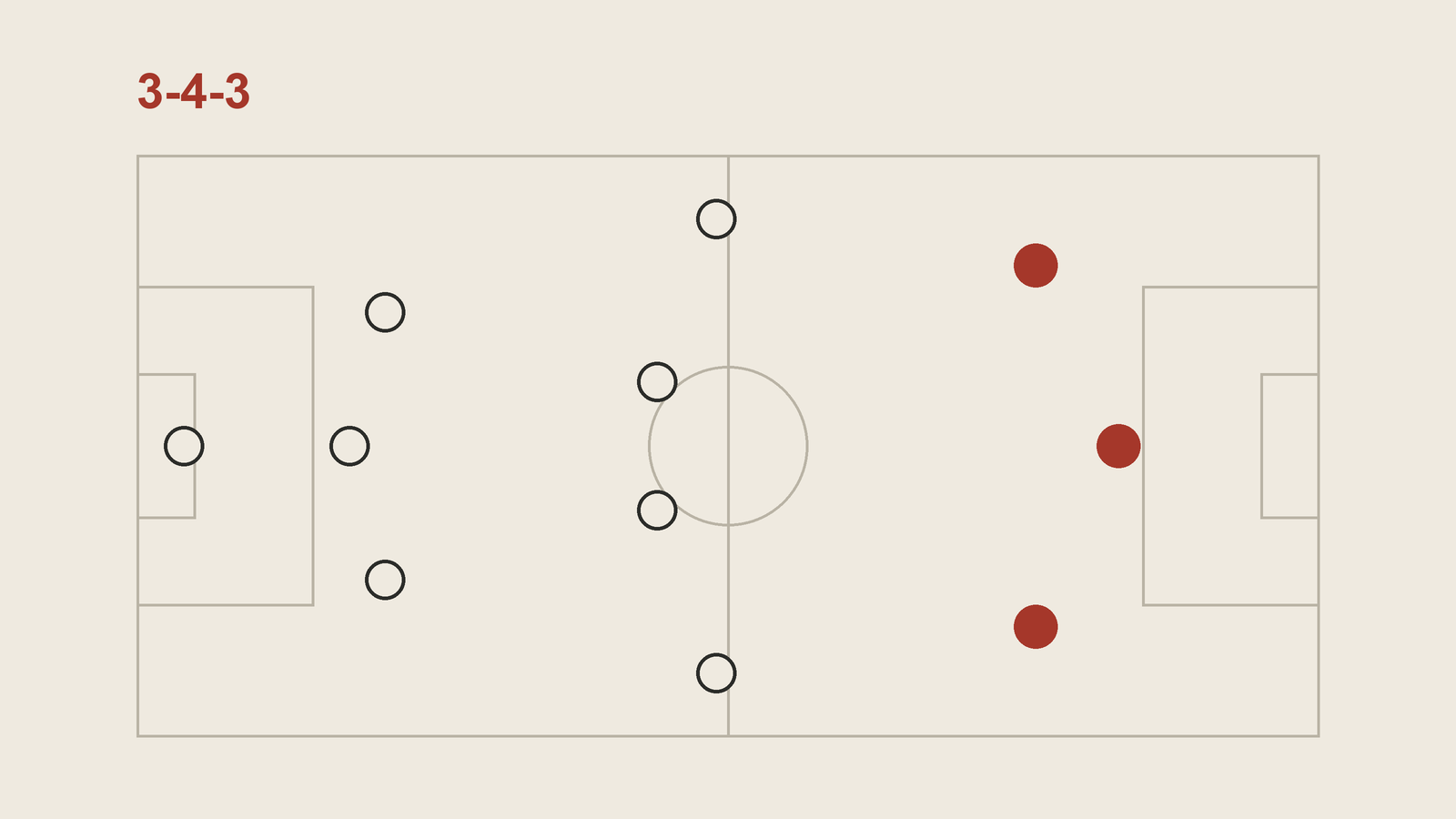
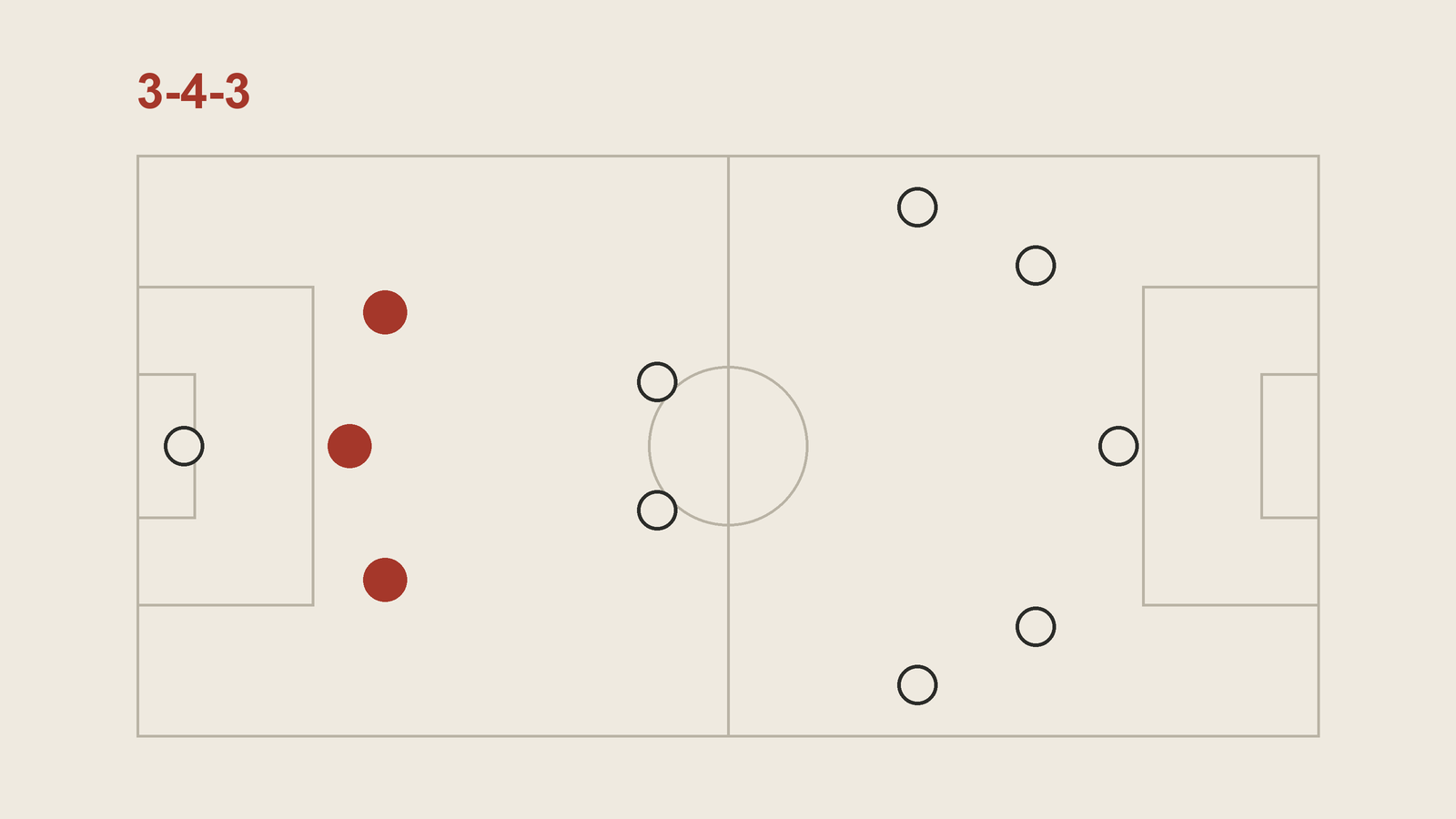
The 3-4-3 is a formation with three centre-backs, two wing-backs, two central midfielders and a front three. With the wing-backs high it attacks with five players across the pitch; without the ball it becomes a 5-4-1 or a 5-2-3.
It is the most attacking member of the back three family. The 3-5-2 keeps a third central midfielder and plays two strikers; the 3-4-3 gives up that midfielder to put a third forward on the pitch.
The shape, player by player
The back three. One central centre-back and two wide ones. The middle player organises the line and deals with the striker. The two outside him need more than defending: in possession they carry the ball into midfield, play passes into the forwards and, when the wing-back goes inside, make overlapping runs of their own. In defence they are the ones dragged towards the touchline.
The wing-backs. The wing-backs are the only players responsible for the full width of the pitch on their side. In attack they hold the touchline, overlap and underlap the forward ahead of them and arrive at the far post for crosses. Without the ball they are the fourth and fifth defenders. Coaches' Voice calls the physical demand on them significant.
The double pivot. Two central midfielders, side by side. A double pivot is the link between the back three and the front three: it receives from the centre-backs, switches play from one wing-back to the other and plays forward passes into the attackers. Without the ball it has to stay compact, because it is the only central protection in front of the defence. In a 3-4-3 one of the two is often a defensive midfielder and the other a more mobile passer.
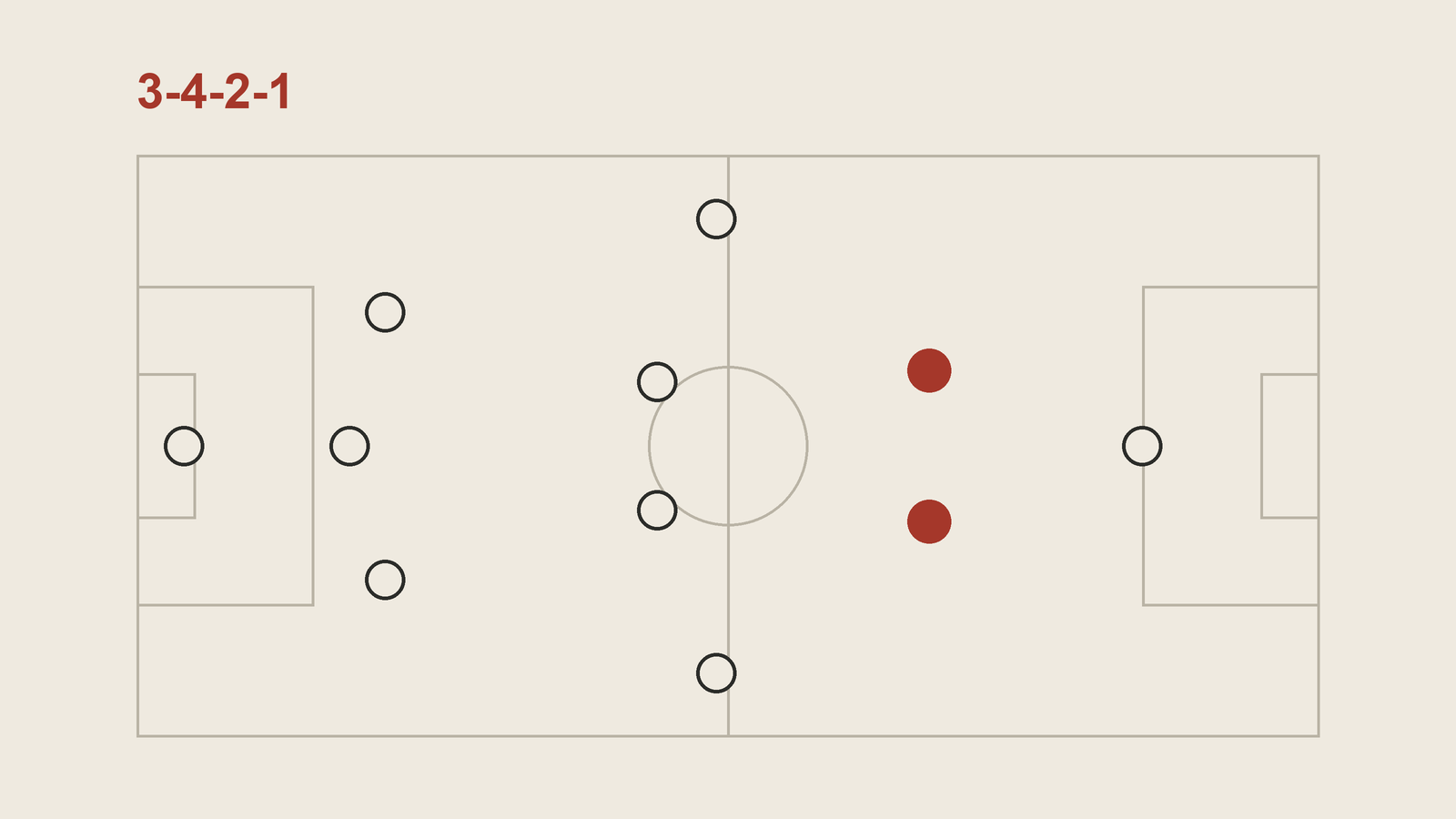
The front three. There are two common versions. In the narrow one, often written 3-4-2-1, two attacking midfielders play as number tens in the half-spaces behind a single striker. In the wide one, two inside forwards or wingers stand level with the centre-forward. A third option uses a false nine who drops into midfield to pull a centre-back out of the line.
How it attacks
The headline number is five. With both wing-backs high and three forwards ahead of the ball, the 3-4-3 can put one player in each vertical lane of the pitch against a back four that only has four. Something has to give: either a full-back is pulled inside and leaves the wing-back free, or he stays wide and opens a gap for the narrow forward between him and his centre-back.
The narrow version builds central overloads. Two tens behind a striker give the team three players between the opponent's midfield and defence, which is awkward for a midfield pair to defend. The wide version stretches the pitch instead: the wide forwards and wing-backs combine on the outside, pin the opposing full-backs and open space in the middle. In both, the wing-backs and forwards rotate. Under Thomas Tuchel at Chelsea the wing-backs pushed up and swapped places with the two tens to reach scoring positions, so the player arriving in the box was often a defender on the team sheet.
The build-up starts with the three centre-backs. Against a front two there is always a free player at the back, and the wide centre-backs can step into midfield with the ball. Mauricio Pochettino reached the same structure from the other direction: at Southampton and Tottenham his single pivot dropped between the centre-backs and the full-backs went up, turning a 4-3-3 into a 3-4-3 in possession.
How it defends and presses
Without the ball the wing-backs drop to make a back five. If the wide forwards drop too, the result is a 5-4-1 with two compact banks. If they stay up, the team defends in a 5-2-3 and keeps three players ready to press or counter.
The front three decides how aggressive it is. Coaches' Voice describes the forwards either screening passes into midfield or pressing high, often to force the ball into wide areas. That fits the shape: once the ball is on the touchline, the wing-back can jump to the full-back and the wide centre-back can step to the winger, with four players still in the line behind. The double pivot and the back three also give a solid rest defence against counter-attacks through the middle, and five defenders in the box help with defending crosses and set pieces.
Who made it famous
The best-known modern example is Antonio Conte's Chelsea in 2016-17. After league defeats to Liverpool (2-1) and Arsenal (3-0) in September, Conte switched to a 3-4-3 against Hull City on 1 October and won 2-0. César Azpilicueta, David Luiz and Gary Cahill formed the back three, Victor Moses and Marcos Alonso were the wing-backs, N'Golo Kanté and Nemanja Matić the midfield pair, and Eden Hazard and Pedro played inside Diego Costa. Chelsea won 13 league games in a row, equalling the Premier League record, and took the title with 93 points and 30 wins.
Thomas Tuchel won the 2021 Champions League with Chelsea in a back three. In the final in Porto they beat Manchester City 1-0 with a Kai Havertz goal, with Reece James and Ben Chilwell at wing-back, Jorginho and Kanté in the pivot, and Mason Mount, Havertz and Timo Werner in attack. Earlier, Rafael Benítez switched Liverpool to a 3-4-3 for the second half of the 2005 Champions League final, when they came back from three goals down. Gareth Southgate's England used a back three with Kyle Walker as the right-sided centre-back.
Johan Cruyff's 3-4-3 was a different animal. At Barcelona from 1988 he alternated between the 3-4-3 and the 4-3-3, and called the shape his diamond. The back three had a single central defender, and the midfield was a diamond rather than a flat four: Pep Guardiola at its base could drop in as a second defender, and Michael Laudrup played as a false nine ahead of it. That team won four straight league titles from 1991 to 1994 and the 1992 European Cup against Sampdoria at Wembley. Louis van Gaal kept versions of 4-3-3 and 3-4-3 at Ajax, who won the 1995 Champions League against Milan and went the 1994-95 league season unbeaten. That lineage runs back to total football and looks very little like Conte's wing-back system.
Strengths and weaknesses
The strengths are balance and numbers. Five attackers commit to the attack while three centre-backs and two midfielders stay behind the ball. A narrow front three can counter-press immediately when the ball is lost, because it is already close together. The wide combinations stretch any back four.
The weaknesses sit in the same places. Three centre-backs cover less width than a back four, so quick counters into the channels hurt, especially when the wing-backs are high. Two central midfielders can be outnumbered by a midfield three, particularly in transition. And the wing-backs carry a huge load: if they tire or are pinned back, the 3-4-3 stops attacking with five and becomes a passive 5-4-1.
How it changes with and without the ball
With the ball it is often a 3-2-5: three centre-backs, the double pivot, and five across the front with the wing-backs as the widest attackers. Without it, it is a 5-4-1 or a 5-2-3. A 4-3-3 can become a 3-4-3 in possession by dropping the pivot or pushing a full-back on, which is why the two shapes are so often confused.
How to beat it, and how to spot it
To spot it, look at the wings. If one player on each side covers the whole flank and the centre-backs spread wide when the goalkeeper has the ball, it is a back-three shape. If there are only two central midfielders and three forwards ahead of them, it is a 3-4-3.
To beat it, pin the wing-backs. A wide attacker who stays high forces the wing-back to defend, and a runner into the channel between wing-back and wide centre-back pulls a central defender to the touchline. Switching play quickly stretches a back three that cannot slide as fast as a back four. And a midfield three can overload the double pivot, especially if one of its midfielders breaks forward when the ball is won. A 4-3-3 with high wingers and an extra midfielder does all of this by design, which is why it is the natural opponent.
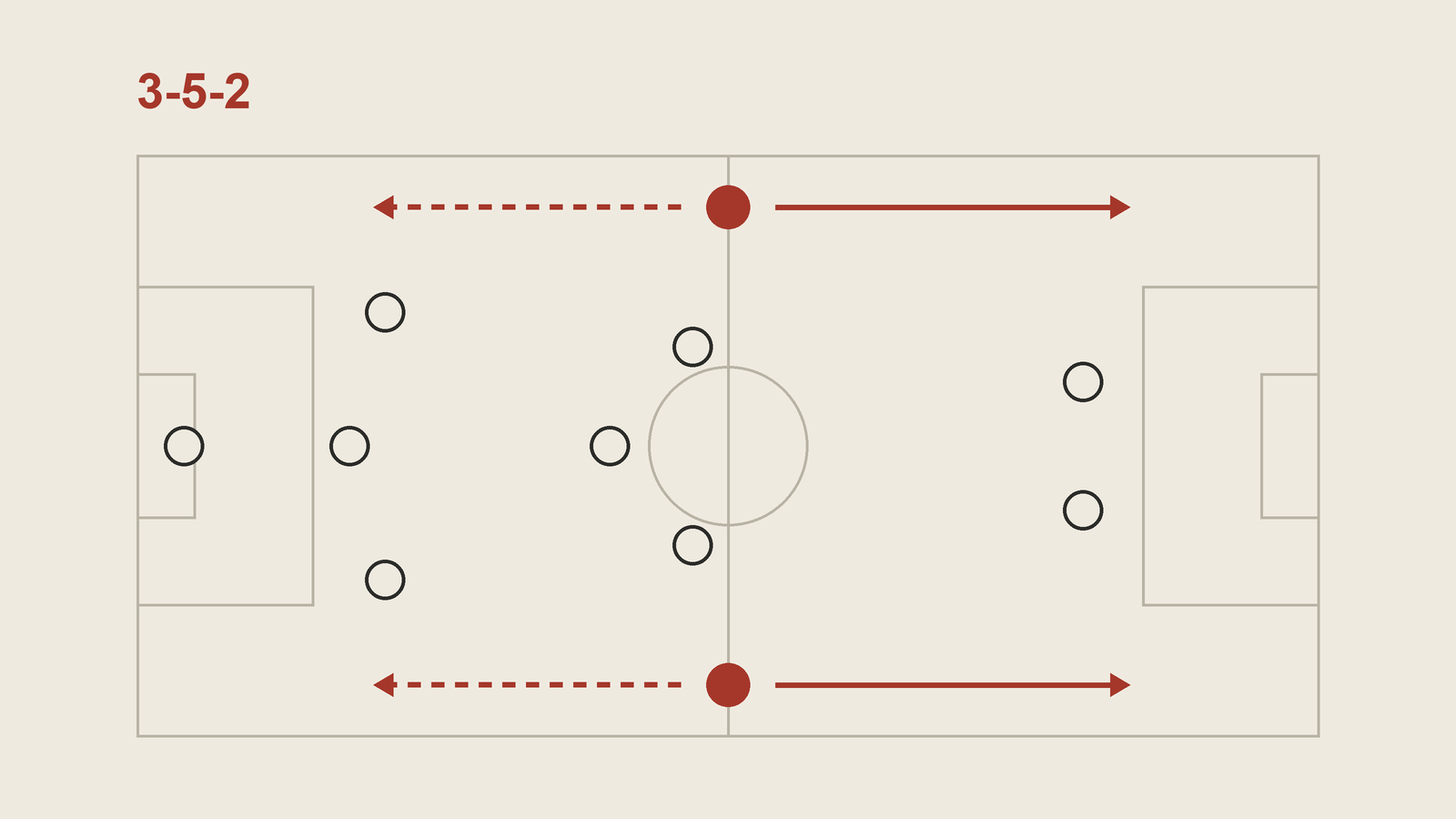
What is the difference between a 3-4-3 and a 3-5-2?
Both play three centre-backs and two wing-backs. The 3-4-3 has two central midfielders and three forwards; the 3-5-2 has three central midfielders and two strikers. The 3-4-3 is usually the more attacking of the two, while the 3-5-2 is stronger in central midfield.
Is the 3-4-3 a defensive formation?
Not in possession. With the wing-backs high it attacks with five players and keeps only three centre-backs and two midfielders behind the ball. Without the ball it becomes a back five, so it can defend deep when needed, but the shape is built to attack.
What is a 3-4-2-1?
It is the narrow version of the 3-4-3. Instead of wide forwards, two attacking midfielders play behind a single striker in the half-spaces. Tuchel's Chelsea used it to win the 2021 Champions League.
What is Cruyff's diamond 3-4-3?
It is a different shape from the wing-back 3-4-3. Cruyff's Barcelona used a single central defender and a midfield diamond, with Guardiola at its base able to drop into defence. The idea was possession through triangles and constant movement rather than width from wing-backs.
Sources and further reading
- 3-4-3 formation: football tactics explained — Coaches' Voice
- Johan Cruyff: The Tactical Masters — Coaches' Voice
- 2016–17 Chelsea F.C. season — Wikipedia
- 2021 UEFA Champions League final — Wikipedia
- Formation (association football) — Wikipedia