Formations and roles · Analysis
4-1-4-1 Formation: One Holding Midfielder, Two Banks of Four, and a Striker on His Own
The 4-1-4-1 plays a back four, one holding midfielder, a line of four and a lone striker. How it attacks, defends, and turns into a 4-3-3 or 4-5-1.
By 01 Owen
· Updated 4 Oct 2026 · 8 min read
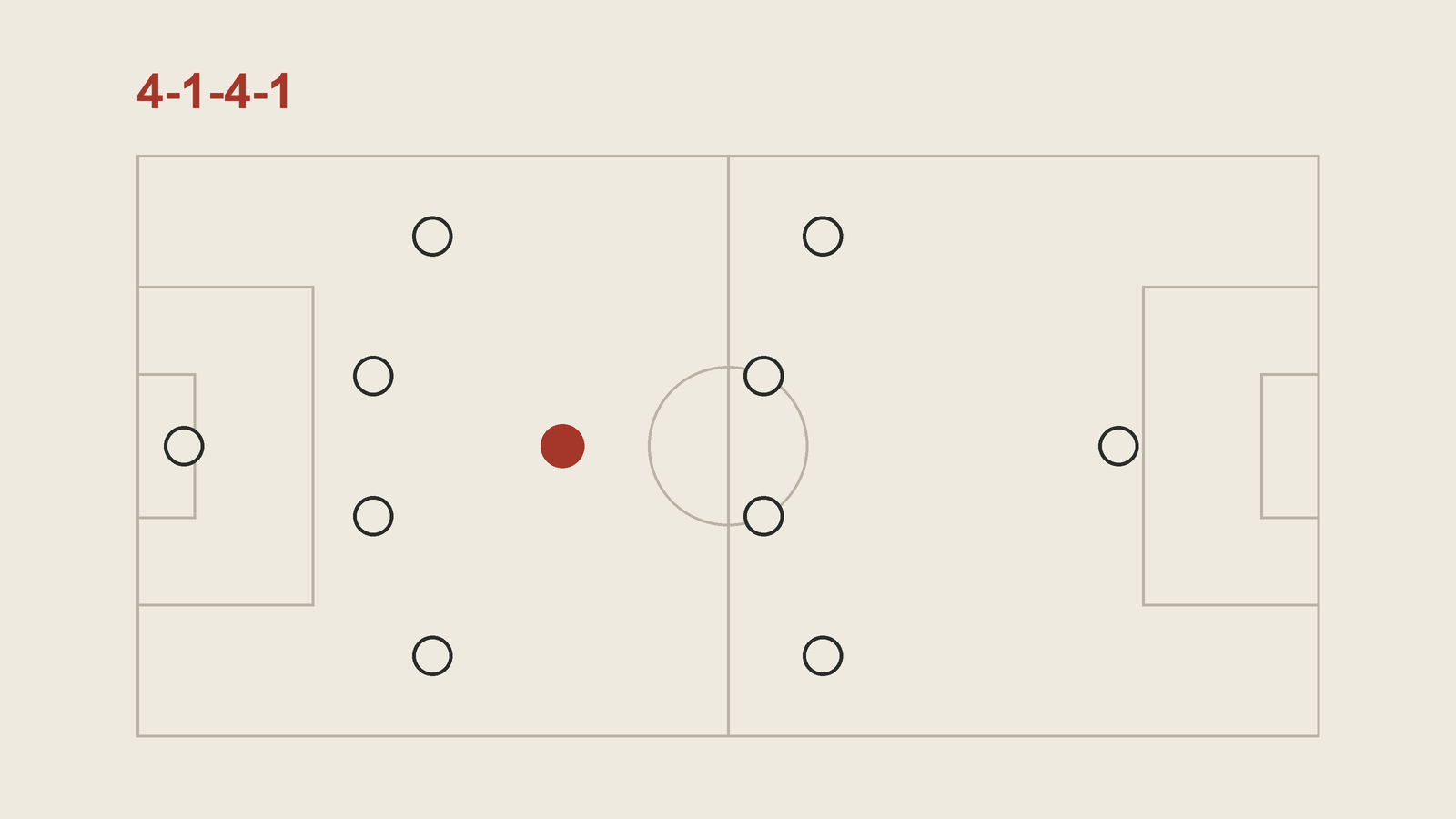
The 4-1-4-1 is a formation with four defenders, a single holding midfielder, a line of four midfielders and one striker. It is mostly a defensive shape: the holder screens the space in front of the back four while two banks of four keep the team compact.
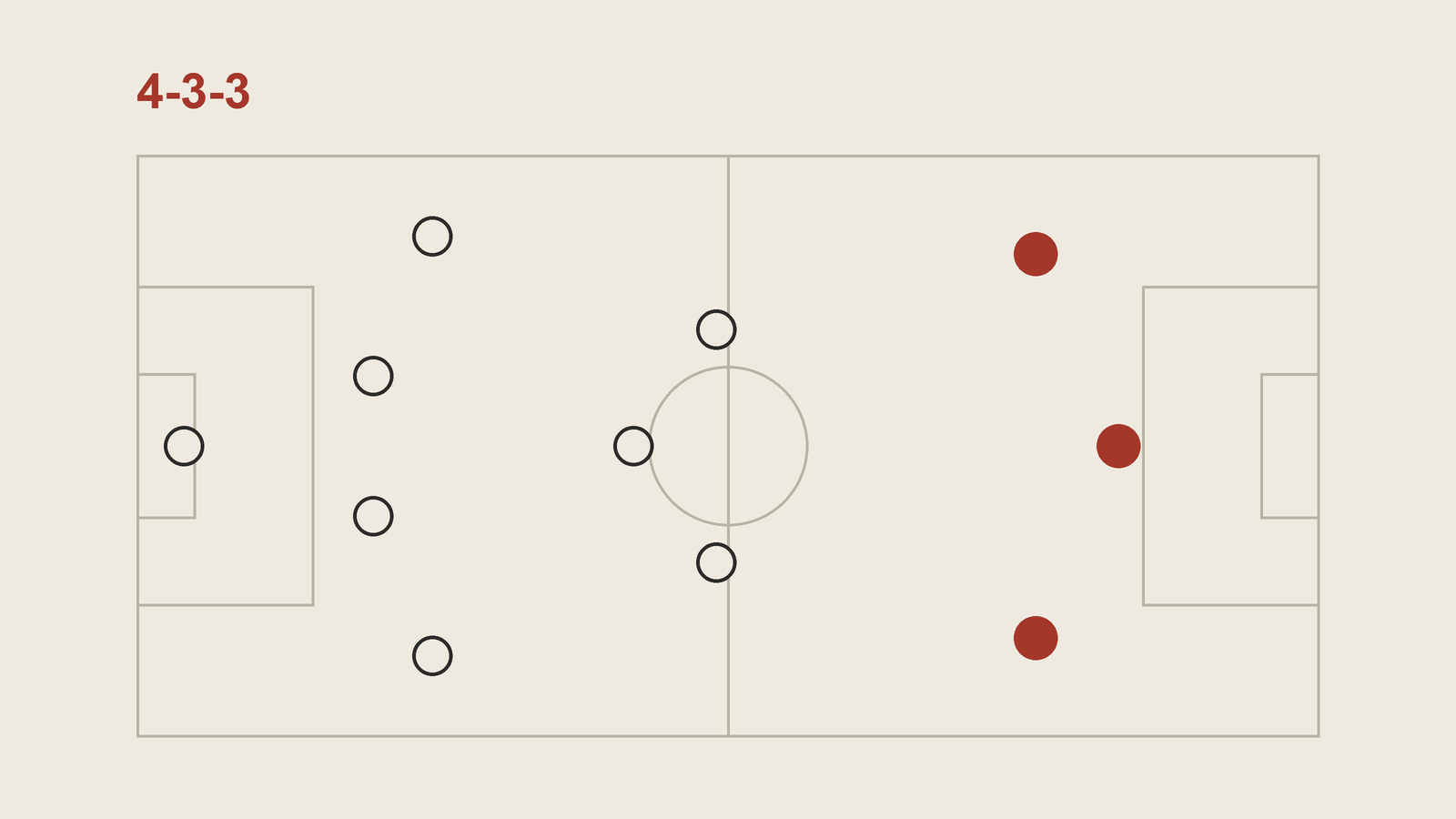
On paper it uses the same eleven positions as a 4-3-3. The difference is where the wide players stand. In a 4-3-3 the wingers start high, level with the centre-forward. In a 4-1-4-1 they start deeper, next to the two central midfielders, so the team has a full line of four between the holding player and the striker. Most teams that use a 4-1-4-1 are really playing a 4-3-3 that has dropped its wingers without the ball.
The shape, player by player
The back four is conventional: two centre-backs and two full-backs. What makes their job easier is the player directly in front of them. Because the space between the defence and midfield is already covered, the centre-backs can concentrate on the space behind them.
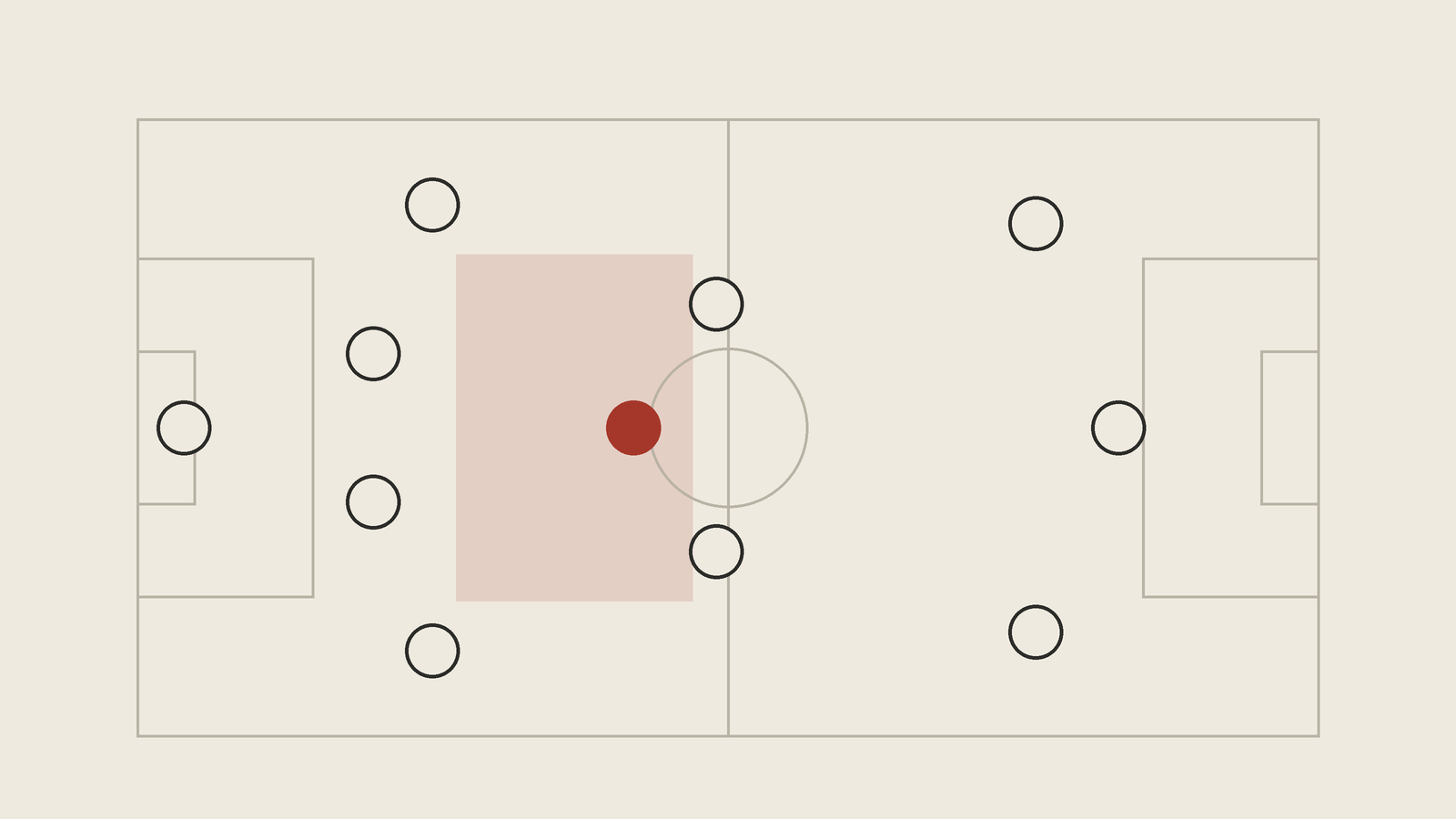
The single pivot is the defensive midfielder on his own between the two lines. Coaches' Voice describes his job as screening, covering, duelling, intercepting and protecting the space in front of the central defenders. He rarely steps up into the midfield four.
The two central midfielders are the number eights. They are usually box-to-box midfielders who have to cover a lot of ground. Without the ball they can mark the opposing midfielders or hold a zone, and they jump forward to support the striker's press. With it they make forward runs, often inside the wide midfielders. One of them can also push up close to the striker and play almost as an attacking midfielder.
The wide midfielders are the players who decide what the formation is. They start deeper than a winger in a front three, closer to the midfield and to their full-back. In defence they narrow to help the central midfielders and track the opposing full-back's runs. In attack they become wingers.
The lone striker presses the centre-backs and steers the ball towards one touchline. When his team wins it back he has to hold it up, often against two defenders, until help arrives. Our guide to football positions covers each role in more depth.
How the 4-1-4-1 attacks
Teams rarely attack for long in the 4-1-4-1 itself. When they keep the ball, the wide midfielders push up and the shape becomes a 4-3-3. The striker's first job is to secure the ball so that this can happen. One of the eights may drop towards the ball to form a brief double pivot in a deeper build-up, while the other runs beyond.
On the counter-attack the wide midfielders are the main outlets. Because they start deeper than wingers, they have to carry the ball forward with dribbles rather than receive it high. The full-backs arrive earlier in support, which gives more combinations on the flank than a formation with wingers already pinned high.
Guardiola's Bayern Munich showed how a single pivot can run the build-up. An August 2013 analysis on Bavarian Football Works described the pattern early in his first season. The full-backs pushed on and Bastian Schweinsteiger dropped between the centre-backs. A central midfielder, most often Toni Kroos, came deep to distribute from midfield, with Thomas Müller or Xherdan Shaqiri as the other eight. The author argued the role needed a passer, not Javi Martínez.
How it defends and presses
Without the ball the 4-1-4-1 is compact through the middle. The striker presses the centre-backs or drops to block the pass into their holding midfielder. The two eights jump out to help, the wide midfielders narrow and use the touchline as an extra defender, and the back four shift across as play is locked on one side.
The same shape can be held at very different heights. Coaches' Voice notes that Jürgen Klopp's Liverpool, a pressing 4-3-3 side, often used a 4-1-4-1 to defend just inside the opponent's half rather than retreating into a low block. Their far-side wide midfielder tucked in but stayed high, ready to counter. José Mourinho's Tottenham used it as a mid or low block, with the pivots staying close to the centre-backs. Sometimes they dropped between them to make a back five or six.
Who made it famous
The 4-1-4-1 came out of the 4-3-3. Brazil's 1958 World Cup winners are usually credited with the first real 4-3-3, turning their 4-2-4 into it when they attacked. As more coaches adopted the 4-3-3, they dropped the wingers when defending, and the 4-1-4-1 was the result.
Its modern examples are mostly 4-3-3 teams in their defensive phase. Pep Guardiola used it at Manchester City when he had no traditional centre-forward. Phil Foden, Ilkay Gündogan, Riyad Mahrez, Raheem Sterling and Ferran Torres all played as a false nine. The wide midfielders started deeper to create a numerical overload in midfield, then moved up into winger positions.
Carlo Ancelotti's Real Madrid, after his return in 2021, often turned their 4-3-3 into a 4-1-4-1, especially in European games. Versatile midfielders such as Luka Modric, Toni Kroos, Federico Valverde and Jude Bellingham made the switch possible. Vinícius, playing on the left, was allowed to stay higher so he was ready to counter.
England under Gareth Southgate, after Euro 2020, defended in a mid-block that Coaches' Voice describes as either a 4-1-4-1 or a flatter 4-5-1. Declan Rice was the pivot. He often jumped forward so the eights could push up around Harry Kane.
Strengths and weaknesses
The strengths are compactness and flexibility. With numbers and cover in the centre, opponents struggle to play through the middle, which makes the shape a natural base for a low or mid-block. The pivot covers the zone between the lines, which almost every attack wants to use. And the team can change shape in one movement: wide midfielders go up for a 4-3-3, a defender steps into midfield for a 3-2-4-1, or the eights rearrange into a 4-2-3-1.
The weaknesses come from how deep the players stand. After a regain the team is far from goal and can be pressed, so its players must pass and receive under pressure. The pivot is a player taken from elsewhere, so the others have more ground to cover. Wide midfielders who defend deep have less energy and distance left for the counter. And the striker is often isolated on direct passes. If his teammates run early to support him, the block they just left is less compact.
How it changes in and out of possession
The 4-1-4-1 sits between two related shapes. Push the wide midfielders up and it is a 4-3-3. Move the pivot up into line with the eights and it becomes a 4-5-1, the flatter version that Coaches' Voice says grew out of it. Wikipedia calls the 4-5-1 a conservative formation that can be likened to a 4-3-3 when its wide players attack. The 4-1-4-1 is the middle point: deeper wingers than a 4-3-3, but a staggered midfield rather than a flat line of five.
When a 4-1-4-1 team keeps the ball, look for a full-back or centre-back stepping into midfield next to the pivot. That makes a 3-2-4-1, which Coaches' Voice calls a common Premier League trend. A team that loses the ball in that shape relies on its rest defence before it can drop back into two banks of four.
How to beat it and how to spot it
You can spot a 4-1-4-1 when the opponent has the ball. Count the lines: a back four, one midfielder alone in front of it, four players level with each other, and one forward. If the deepest midfielder is level with the eights, it is a 4-5-1. If the wide players stay up beside the striker, it is a 4-3-3.
To beat it, attack its weaknesses. Press straight after losing the ball, because a deep team must play out under pressure. Gegenpressing works well here. Pin the wide midfielders back with full-backs who attack, so the counter has no outlet. Leave the lone striker outnumbered so he cannot hold the ball. And move the pivot: two players operating either side of him force him to choose which space to guard.
What is the difference between a 4-1-4-1 and a 4-3-3?
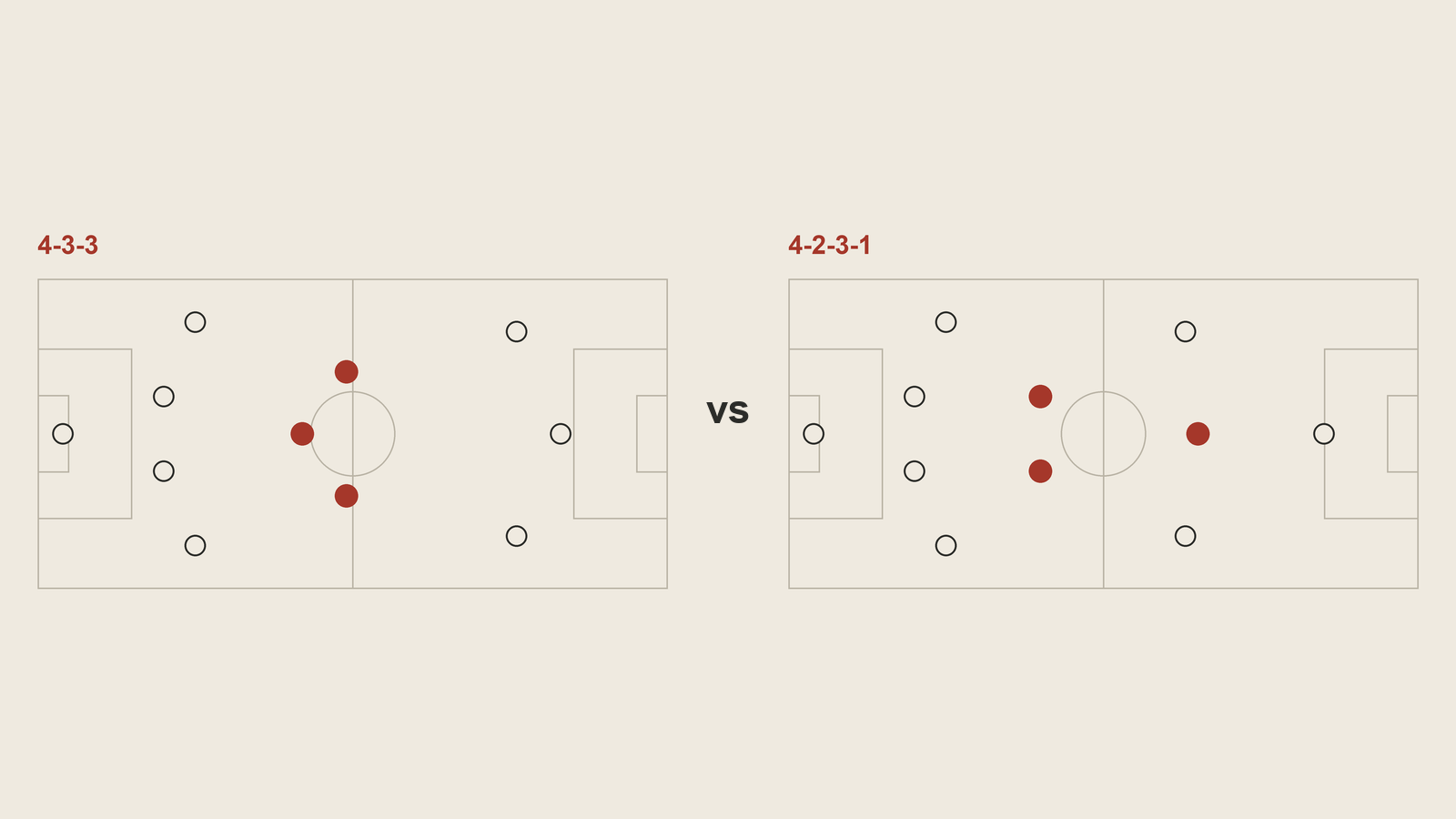
They use the same positions: a back four, one holding midfielder, two central midfielders, two wide players and a striker. In a 4-3-3 the wide players start high, level with the striker. In a 4-1-4-1 they start deeper, level with the eights. Many teams attack in a 4-3-3 and defend in a 4-1-4-1.
Is the 4-1-4-1 the same as a 4-5-1?
Not quite. In a 4-1-4-1 the holding midfielder stays alone between the defence and a line of four. In a 4-5-1 he moves up level with the other midfielders, making one flat line of five. A team can switch between them in the same game.
Is the 4-1-4-1 a defensive formation?
Mostly, yes. It gives a team two compact banks with a screen between them, which is hard to play through. Teams that use it usually attack by pushing the wide midfielders up into a 4-3-3.
What does the single pivot do in a 4-1-4-1?
He protects the space between the back four and the midfield line. That means screening passes, covering for teammates, winning duels and intercepting. In possession he can drop between the centre-backs to start the build-up, as Schweinsteiger did for Guardiola's Bayern.
Sources and further reading
- The 4-1-4-1 formation: football tactics explained — Coaches' Voice
- The 4-5-1 formation: football tactics explained — Coaches' Voice
- Formation (association football) — Wikipedia
- Understanding the 4-1-4-1: Schweinsteiger, Guardiola's vision of the single pivot, and the transition into attack — Bavarian Football Works