Formations and roles · Analysis
4-3-3 vs 4-2-3-1: One Midfield Triangle, Turned Upside Down
A 4-3-3 plays one pivot behind two 8s; a 4-2-3-1 plays two holding midfielders behind a 10. Side-by-side table, diagram and how to tell them apart.
By 01 Owen
· Updated 7 Oct 2026 · 7 min read
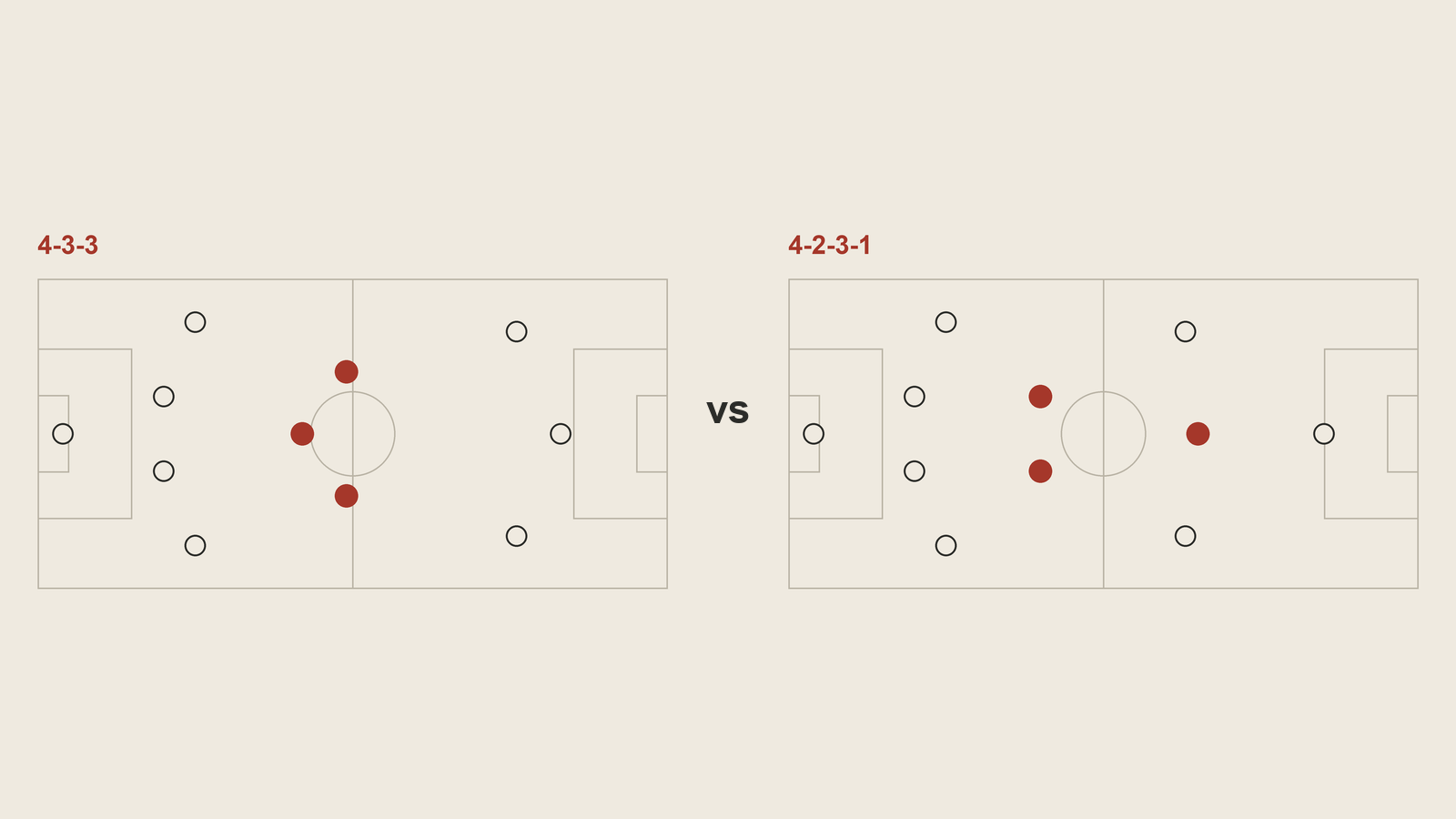
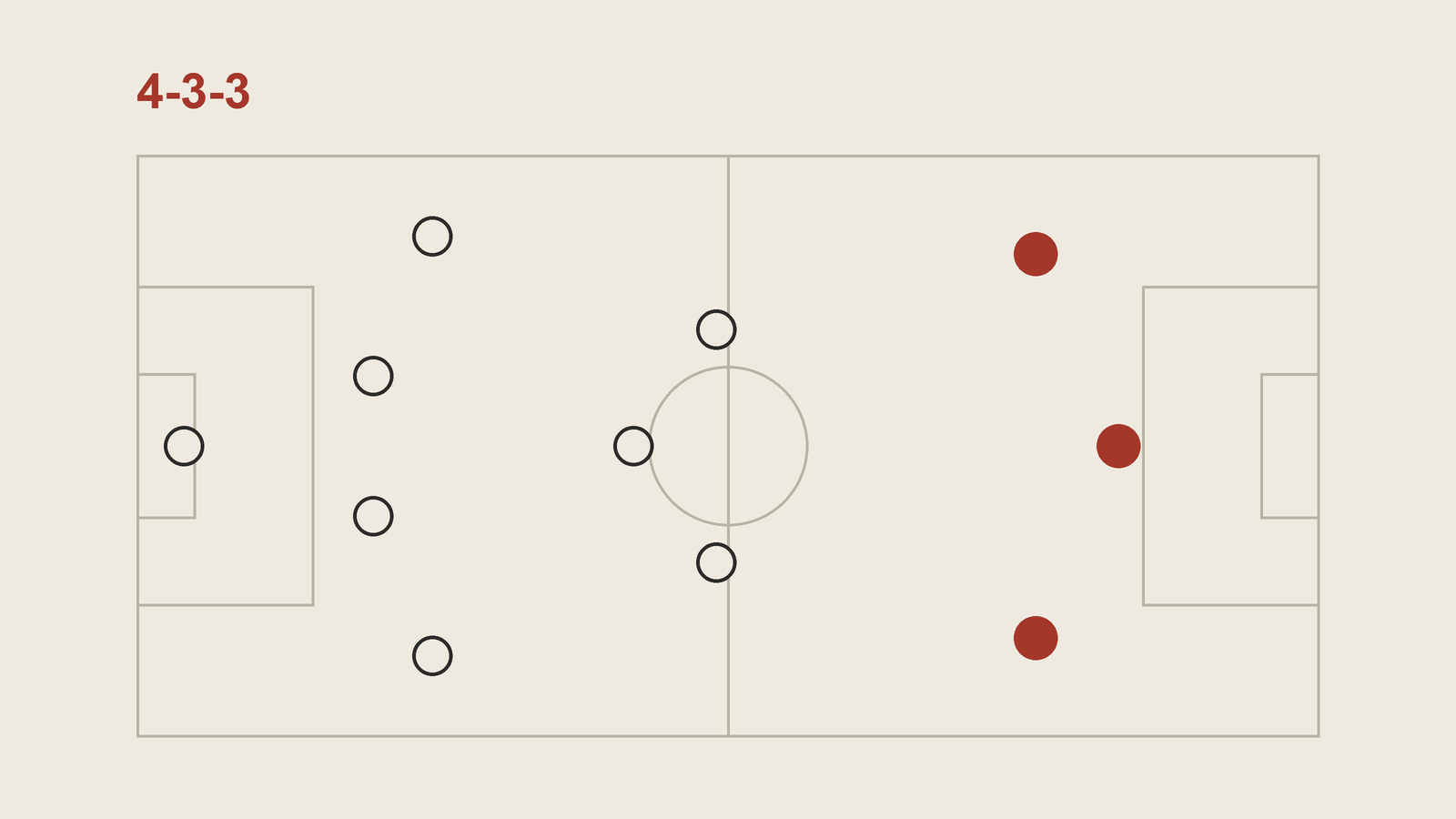
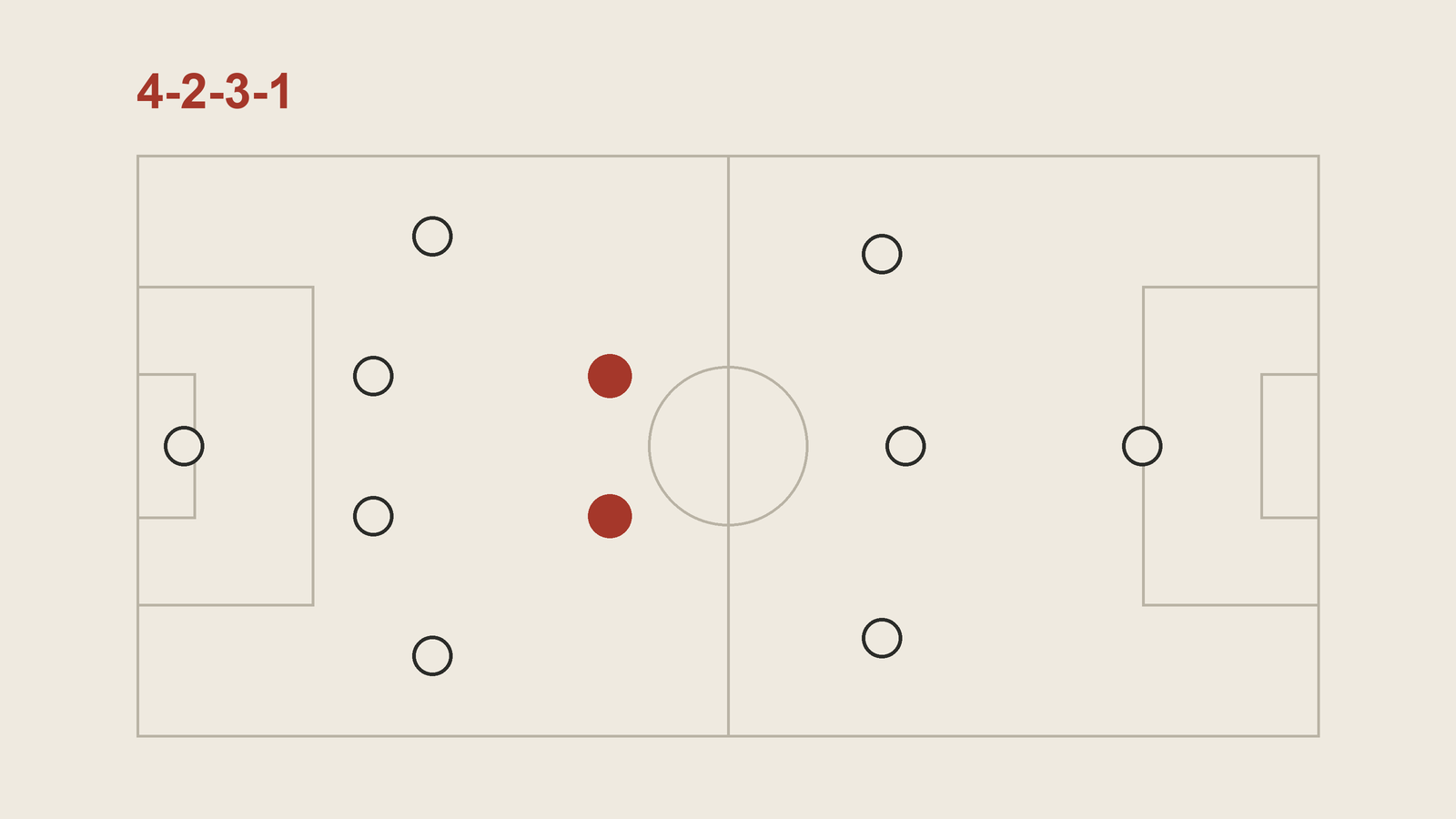
A 4-3-3 puts one holding midfielder behind two number eights and plays two wingers beside the striker. A 4-2-3-1 flips that triangle: two holding midfielders sit behind a number ten, and the wide players start a line deeper, level with him.
Both shapes use a back four, a lone centre-forward and five players in between. How those five are stacked decides who protects the defence, who receives between the lines and who presses first. The full background on each lives in the 4-3-3 formation and 4-2-3-1 formation articles.
| 4-3-3 | 4-2-3-1 | |
|---|---|---|
| Midfield triangle | One pivot behind two eights | Two holding midfielders behind one ten |
| Typical numbers | 6, 8 and 8 | 6 and 8 (or two 6s), then 10 |
| Main source of creativity | The eights arriving in the half-spaces, and the wingers | The ten between the lines, with the wide attacking midfielders |
| Wide players | Wingers, high and level with the striker | Wide attacking midfielders, a little deeper, often cutting inside |
| Without the ball | Front three press; often drops to 4-5-1 or 4-1-4-1 | Usually 4-4-2 or 4-4-1-1, with the ten next to the striker |
| Built-in risk | Space either side of the single pivot | A gap between the holding pair and the front four |
| Well-known example | Klopp's Liverpool, Guardiola's Barcelona | Pochettino's Tottenham, Slot's Liverpool |
The midfield: one pivot and two eights, or a double pivot and a ten
In a 4-3-3 the deepest midfielder is alone. Coaches' Voice describes the single pivot as an axis of the play who must draw the opponent's press, with Sergio Busquets at Barcelona as its example. In front of him the two eights play at different heights, offer passing lanes behind the opponent's first line and make diagonal runs into the box. A wide-drifting eight is what Italians call a mezzala. The creativity is shared between them.
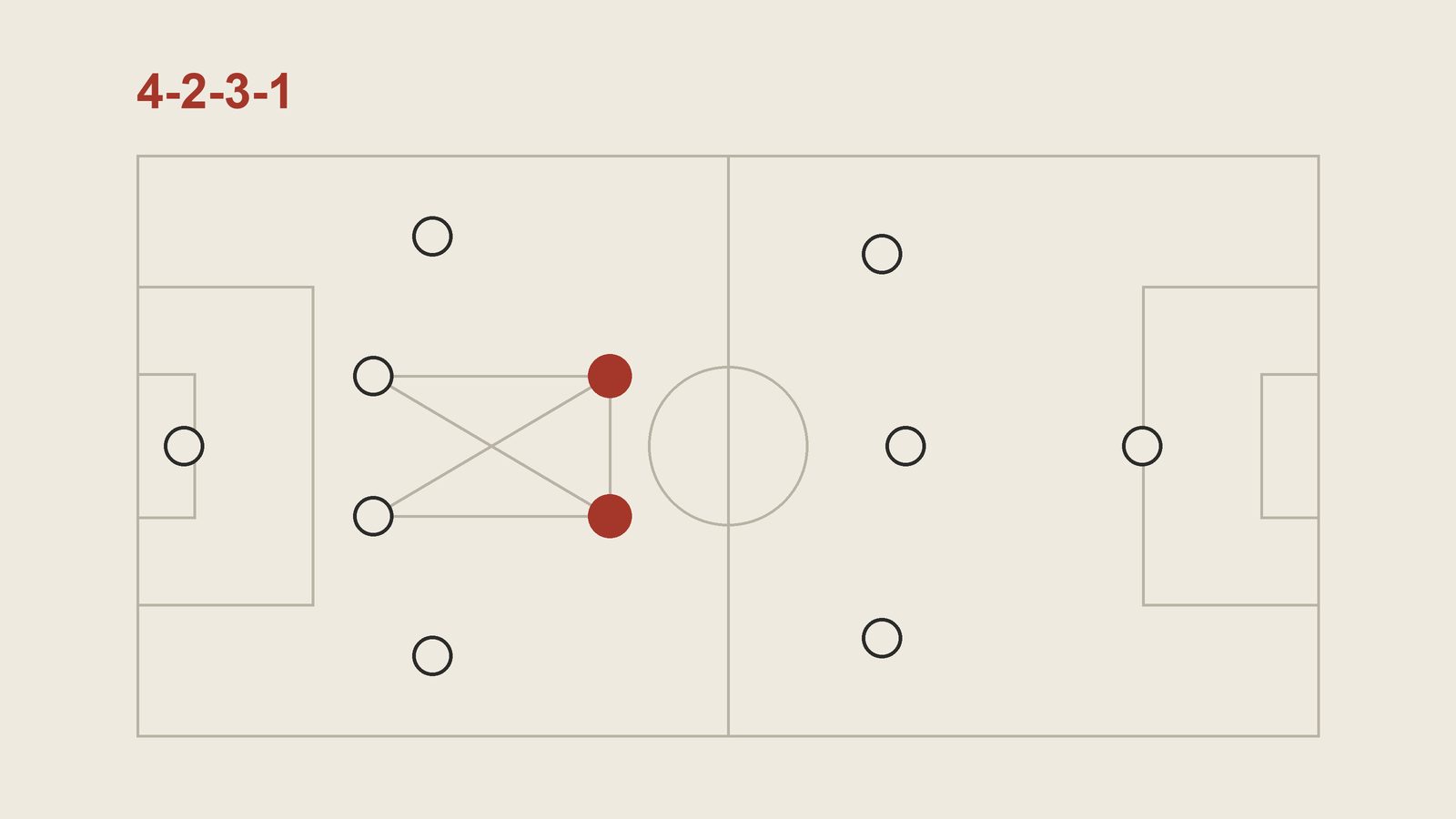
A 4-2-3-1 concentrates it. The double pivot shields the back four and supports play from underneath the ball. That frees one player, the attacking midfielder or ten, to stay between the opponent's midfield and defence, in the central pocket known as Zone 14. Coaches' Voice traces the shape to the 2000s, when teams wanted to deny access to that space. First a single holding player such as Claude Makélélé covered it, and then a second defensive midfielder was added.
The trade-off: the 4-3-3 has two midfielders who can arrive in the box and one who must stay. The 4-2-3-1 has two who stay and one who receives, so it is safer in front of the centre-backs but leans on a single creator.
Wingers against wide attacking midfielders
In a 4-3-3 the front three should all be clearly offensive players. The wingers start level with the striker and either hold the touchline on their natural foot to go one against one, or play inverted and cut inside to open the lane for the full-back. At Real Madrid under Carlo Ancelotti, Vinícius Júnior and Rodrygo used that height to run into space behind defences on the counter.
In a 4-2-3-1 the wide players are part of the attacking midfield line. They often play on their unnatural flank and cut inside for a more direct threat on goal, while the full-backs overlap. Starting deeper, they have a shorter run back into a midfield four.
With the ball: building up
A 4-3-3 builds through its triangle. The pivot drops or shows, the eights stagger at different heights, and the full-backs' positions decide whether the team gets an extra player when the opponent presses the midfield.
A 4-2-3-1 has two players behind the ball before the attack starts. One holding midfielder can drop beside the centre-backs while the other stays ahead of the first line of pressure, so the full-backs can push on. The weak point is the striker: Coaches' Voice notes that he can be isolated, always outnumbered by the opposing centre-backs.
Without the ball: how each presses
The 4-3-3 presses with its front three. They can steer the opponent's build-up play to one side, but if they are bypassed the opponent advances easily. The midfield three then have to shuffle side to side to cover the width, which takes endurance and positional discipline. Many 4-3-3 teams drop the wingers into midfield and defend in a 4-1-4-1 or a 4-5-1, which leaves the striker alone.
The 4-2-3-1 presses in pairs. The centre-forward starts the press and the ten joins him as a flat two, so the team defends as a 4-4-2 or 4-4-1-1. The double pivot covers the gaps between the three attacking midfielders behind them. The risk is distance: if the holding pair sits too deep, the team splits into a defending six and an attacking four. If both full-backs are high, a quick switch can leave the wide areas exposed.
How teams switch between them
One midfielder moving changes it. Push one holding player of a 4-2-3-1 forward and pull the ten back, and you have a 4-3-3. Drop one eight of a 4-3-3 next to the pivot and push the other into the hole, and you have a 4-2-3-1. The wide players move a few yards up or down to match.
Liverpool show it across two managers. Wikipedia notes that Jürgen Klopp's Liverpool won the Premier League and the Champions League with a 4-3-3 and a front three of Mohamed Salah, Sadio Mané and Roberto Firmino. Adrian Clarke's analysis for the Premier League says Arne Slot made an immediate switch to a 4-2-3-1 as his base shape in 2024/25. Ryan Gravenberch and Alexis Mac Allister formed a double pivot screening passes into opposition nines and tens, and Dominik Szoboszlai, as a floating ten, fed Salah and Luis Díaz. Liverpool won the title. Single matches still varied: the Premier League's review of the 2–0 win over Manchester City in December 2024 describes a 4-3-3 structure.
A 4-2-3-1 whose ten drops beside the holding pair looks like a 4-3-3. For three against two in midfield, see our 4-4-2 vs 4-3-3 analysis.
How to tell them apart in a match
Look at the midfield when the opponent has the ball near halfway. If one player sits alone in front of the centre-backs with two team-mates ahead and either side of him, it is a 4-3-3. If two sit side by side and one player hovers behind the striker, it is a 4-2-3-1.
Then watch the press. Three forwards jumping together onto the defenders suggest a 4-3-3. A striker and one midfielder jumping as a pair, with two banks of four behind, suggest a 4-2-3-1. Finally, wide players level with the striker suggest wingers; level with the ten, wide attacking midfielders.
When a coach picks one over the other
A coach picks the 4-3-3 for a midfield that can press across the width and two eights who can both pass and arrive in the box. It needs a pivot who can cover a lot of grass on his own. A coach picks the 4-2-3-1 for protection in front of the defence, for a player who is at his best between the lines, and for a team that defends more comfortably in a 4-4-2. Wikipedia's examples include Rafael Benítez's Liverpool, with Javier Mascherano and Xabi Alonso behind Steven Gerrard and Fernando Torres, and Jupp Heynckes's treble-winning Bayern Munich in 2012–13.
Compare the numbered diagrams of the 4-3-3 and the 4-2-3-1, with positions and shirt numbers.
Is a 4-2-3-1 more defensive than a 4-3-3?
It is usually safer in front of the centre-backs, because two midfielders hold their position instead of one. That does not make it defensive overall: the ten and the wide attacking midfielders give it four attackers, and the instructions decide how high the team plays.
Can a 4-3-3 turn into a 4-2-3-1 during a game?
Yes, and it happens all the time. If one eight drops beside the pivot and the other pushes up behind the striker, the shape is a 4-2-3-1. The change usually adds protection in front of the defence and gives one player more freedom between the lines.
What is the difference between a winger and a wide attacking midfielder?
A winger in a 4-3-3 starts high, level with the striker, and is mainly an attacker. A wide attacking midfielder in a 4-2-3-1 starts a little deeper, level with the ten, and often cuts inside from the opposite flank. He also has a shorter run back to form a midfield four.
Which formation is better for pressing?
Both can press well, but they do it differently. A 4-3-3 presses with three forwards and needs its midfield to shuffle quickly behind them. A 4-2-3-1 presses with a front two of striker and ten, backed by two banks of four, which is a simpler structure to organise.
Sources and further reading
- The 4-3-3 formation: five key points — Coaches' Voice / Premier League
- The 4-2-3-1: football tactics explained — Coaches' Voice / Premier League
- Analysis: The tactical tweaks that won the title for Liverpool — Premier League
- Formation (association football) — Wikipedia
- Why Slot's tactics got the better of Guardiola — Premier League