Formations and roles · Analysis
Inverted Winger: the wide forward who cuts inside onto his stronger foot
An inverted winger plays on the side opposite his stronger foot and cuts inside to shoot or combine. Role table, diagram, examples and how to spot one.
By 01 Owen
· Updated 7 Oct 2026 · 7 min read
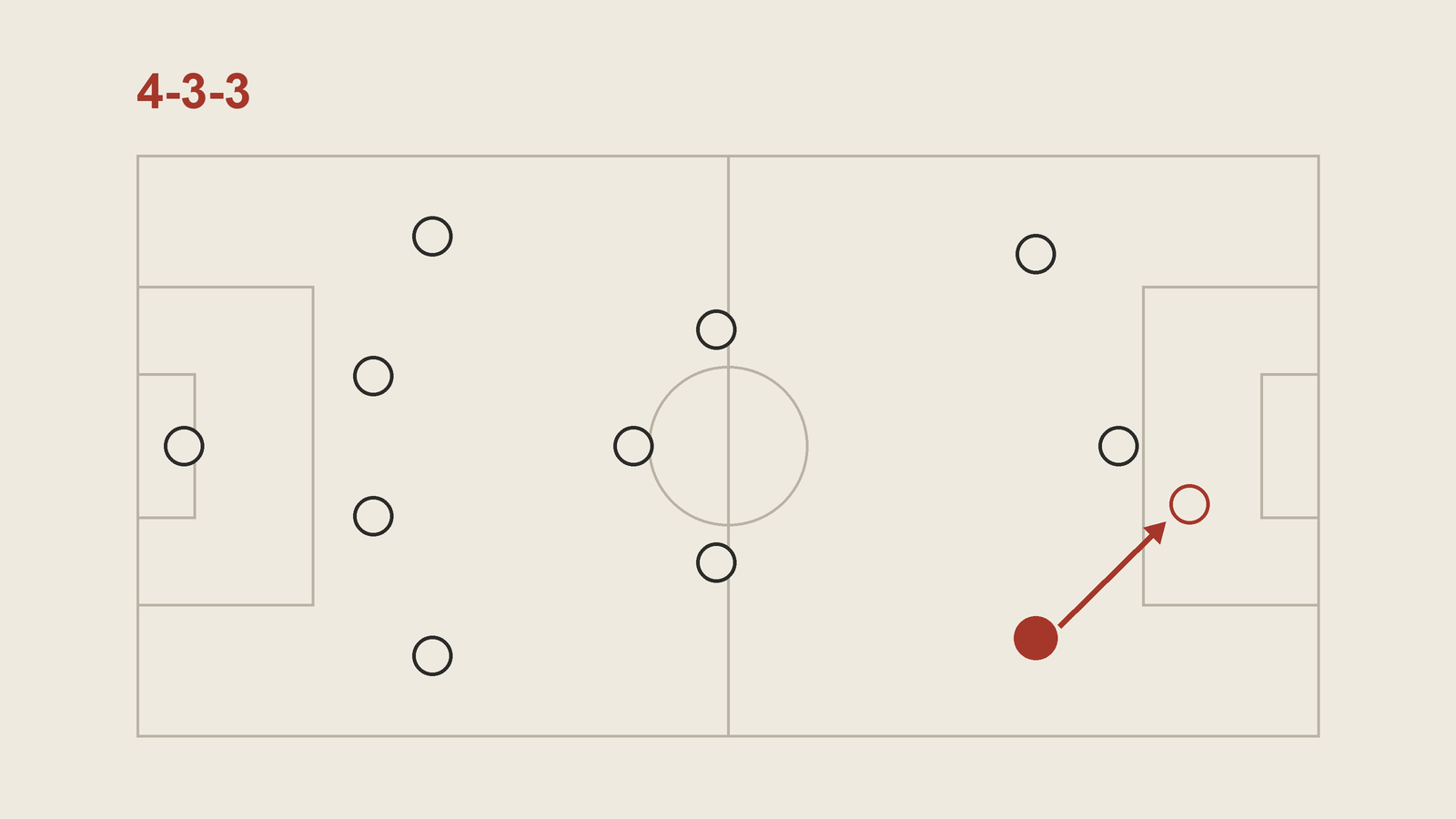
An inverted winger is a wide attacker who plays on the side opposite his stronger foot, such as a left-footer on the right. Instead of going outside to cross, he cuts inside onto that foot to shoot, pass or combine.
The winger article covers the basic split between classic and inverted wingers. This page goes further: why coaches flip the feet, what the role needs around it and what it costs.
| At a glance | Inverted winger |
|---|---|
| Where he plays | High on the flank, on the side opposite his stronger foot |
| Main job | Cut inside from the wing to shoot or combine in the half-space |
| Without the ball | Presses the full-back, blocks the pass down the line, tracks runs |
| Typical formations | 4-3-3, 4-2-3-1, 3-4-3 |
| Typical shirt number | No fixed number; wingers traditionally wear 7 or 11 |
| Related roles | Classic winger, inside forward, overlapping full-back |
| Well-known examples | Arjen Robben, Lionel Messi (early Barcelona), Mohamed Salah, Lorenzo Insigne |
Why a coach flips the feet
Wikipedia notes that most wingers are assigned to the side of their stronger foot, on the assumption that this gives a more powerful cross and better ball protection along the touchline. That suits a winger whose job is to reach the byline.
Turn the player round and the geometry changes. A left-footer coming in from the right has the ball on his good foot, away from the defender and pointing at goal. Minnesota United's club explainer points out that he can curl the ball towards the far post, a far easier finish than a right-footer has from the same side. Two quieter advantages follow. A cross hit from that angle is in-swinging: the ball is already heading towards goal, so a slight touch, or sometimes none, can be enough. And a right-footed inverted winger on the left, driving inside, attacks a right-footed full-back on his weaker side.
It also solves a crowding problem. When full-backs push high, a classic winger and his full-back want the same strip of grass. If the winger goes inside, the full-back has it to himself.
What he does with the ball
His first target is the half-space, the vertical lane between the wide area and the centre of the pitch. From there he has four routes:
- Shoot: a curled finish across the keeper from the edge of the box, the move most associated with the role.
- Thread a pass: a ball between centre-back and full-back for the striker or a runner from midfield.
- Combine: a one-two with the striker or the midfielder on his side.
- Release the overlap: if the full-back follows him inside, the overlapping full-back outside is free.
The best ones keep the outside route alive. Wikipedia's page on Robben quotes ESPN praising his ability to reach the byline and cross; without that threat, the defender can simply show him inside and wait.
He can also finish moves from the other flank. Coaches' Voice names Raheem Sterling and Mohamed Salah as wingers who have profited at the back post from crosses from the far side.
What he does without the ball
He presses the opposing full-back, blocks the pass down the line and tracks runs, like any modern winger. The difference is positional. He finishes attacks in narrow areas, so he is often close to the ball when it is lost, which helps a team that counter-presses. The flank behind him is left to his full-back, who has a long way to recover.
The full-back partnership
An inverted winger only works if somebody else gives the team width, usually the full-back behind him. Coaches' Voice describes Jürgen Klopp's Liverpool this way: in the 4-3-3, wrong-footed wingers Salah and Sadio Mané moved inside and the full-backs Trent Alexander-Arnold and Andy Robertson overlapped to supply crosses, cut-backs and most of the width.
The pairing is not only about attacking. Wikipedia's Robben article notes his relationship with the right-sided full-back at Bayern Munich, Philipp Lahm: Robben often tracked back to cover when Lahm pushed forward, becoming a temporary right-back.
Coaches' Voice notes that the width can also come from a number eight who moves out to overlap, and that an inverted full-back moving inside can help overload the half-space in deeper build-up. In a back three the job goes to the wing-back; the wing-back vs full-back comparison explains the difference in what each defends.
Formations
- 4-3-3: the natural home. The two wide forwards are inverted and the full-backs supply the width. See the 4-3-3 page in the formations tool.
- 4-2-3-1: the wide players in the three behind the striker can be inverted. Minnesota United's club site describes Adrian Heath doing it in his favoured 4-2-3-1, starting Robin Lod on the right and Kevin Molino on the left as inverted wingers. See the 4-2-3-1 in the formations tool.
- 3-4-3: the wing-backs can hold the touchline, which in principle lets the two wide forwards play narrower.
Examples
- Arjen Robben: a left-footer on the right whose signature move, according to Wikipedia, was cutting inside onto his stronger foot to get into a central position. The same page records 134 league goals with his left foot and ten with his right.
- Lionel Messi: Coaches' Voice notes that he started at Barcelona cutting inside from the right wing to combine and shoot, before moving more often between the lines.
- Mohamed Salah: the wrong-footed right winger of Klopp's Liverpool, cutting in while Alexander-Arnold overlapped.
- Lorenzo Insigne at Maurizio Sarri's Napoli: Coaches' Voice describes an asymmetric 4-3-3. On the left, the right-footed Insigne cut inside and left-back Faouzi Ghoulam overlapped. On the right, the right-footed José Callejón held the width and right-back Elseid Hysaj stayed back: one inverted winger, one classic.
Wikipedia also lists Eden Hazard and Megan Rapinoe among players of this type.
How it differs from neighbouring roles
- Classic winger: same starting position, opposite foot. He goes outside, crosses from near the byline and pulls the full-back wide.
- Inside forward: an older term, first used for the forwards beside the centre-forward in early formations. Coaches' Voice uses it alongside "wrong-footed wingers" for wide players who come off the flank to shoot; most inverted wingers fit it, but the term describes how he attacks, not which foot he uses.
- "Goalscoring" or "false" winger: Wikipedia describes a variation where the player is wide on paper but is given the freedom to run unmarked into the box, effectively as a striker, with Cristiano Ronaldo on Real Madrid's left as the example.
- False nine: comes out of the centre into midfield; the inverted winger comes in from the side.
How to spot one in a match
Watch his first touch on the flank. If it goes inside, onto the foot further from the touchline, he is inverted. Then check three things. Does the full-back behind him overlap when he moves inside? Does the opposing full-back show him outside, onto his weaker foot? And when the ball is crossed from the other wing, is he arriving at the back post?
When a coach picks it
When the team wants goals from its wide players and has full-backs who can attack. When the opponent sits in a low block and crosses into a packed box are unlikely to work. When the striker drops off and someone must fill the space. The role suits a target man who wants early crosses less well, and without attacking full-backs nobody gives the width and the attack turns narrow and predictable. Against a full-back who forces him outside, an inverted winger without a decent weaker foot can disappear.
What is the difference between an inverted winger and a normal winger?
A normal, or classic, winger plays on the side of his stronger foot and goes outside to cross. An inverted winger plays on the opposite side and cuts inside to shoot or pass with his stronger foot. Both start wide, but they finish their attacks in different places.
Why do teams play inverted wingers?
Cutting inside puts the ball on the stronger foot, pointing at goal, so the winger becomes a scorer as well as a creator. It also frees the flank for an overlapping full-back. The cost is that someone else has to provide the width.
Is Salah an inverted winger?
Yes. Under Jürgen Klopp at Liverpool he was a left-footer on the right who moved inside while the full-backs overlapped to give the team its width.
Is an inverted winger the same as an inside forward?
Not exactly. "Inverted" describes the player's foot relative to his flank; "inside forward" describes a wide forward who attacks the goal like a striker. Most inverted wingers play like inside forwards, so the terms are often used for the same players.
Sources and further reading
- Midfielder: Inverted winger and raumdeuter — Wikipedia
- Arjen Robben — Wikipedia
- The 4-3-3: football tactics explained — Coaches' Voice
- The half-spaces: football tactics explained — Coaches' Voice
- Understanding the Game: Inverted Wingers — Minnesota United FC
- In focus: attacking in the final third, crossing and finishing — Coaches' Voice