Formations and roles · Analysis
Wing-Back vs Full-Back: Same Flank, Different Job
A wing-back covers the whole flank in front of a back three; a full-back shares it with a winger in a back four. Table, diagram and formations.
By 01 Owen
· Updated 7 Oct 2026 · 6 min read
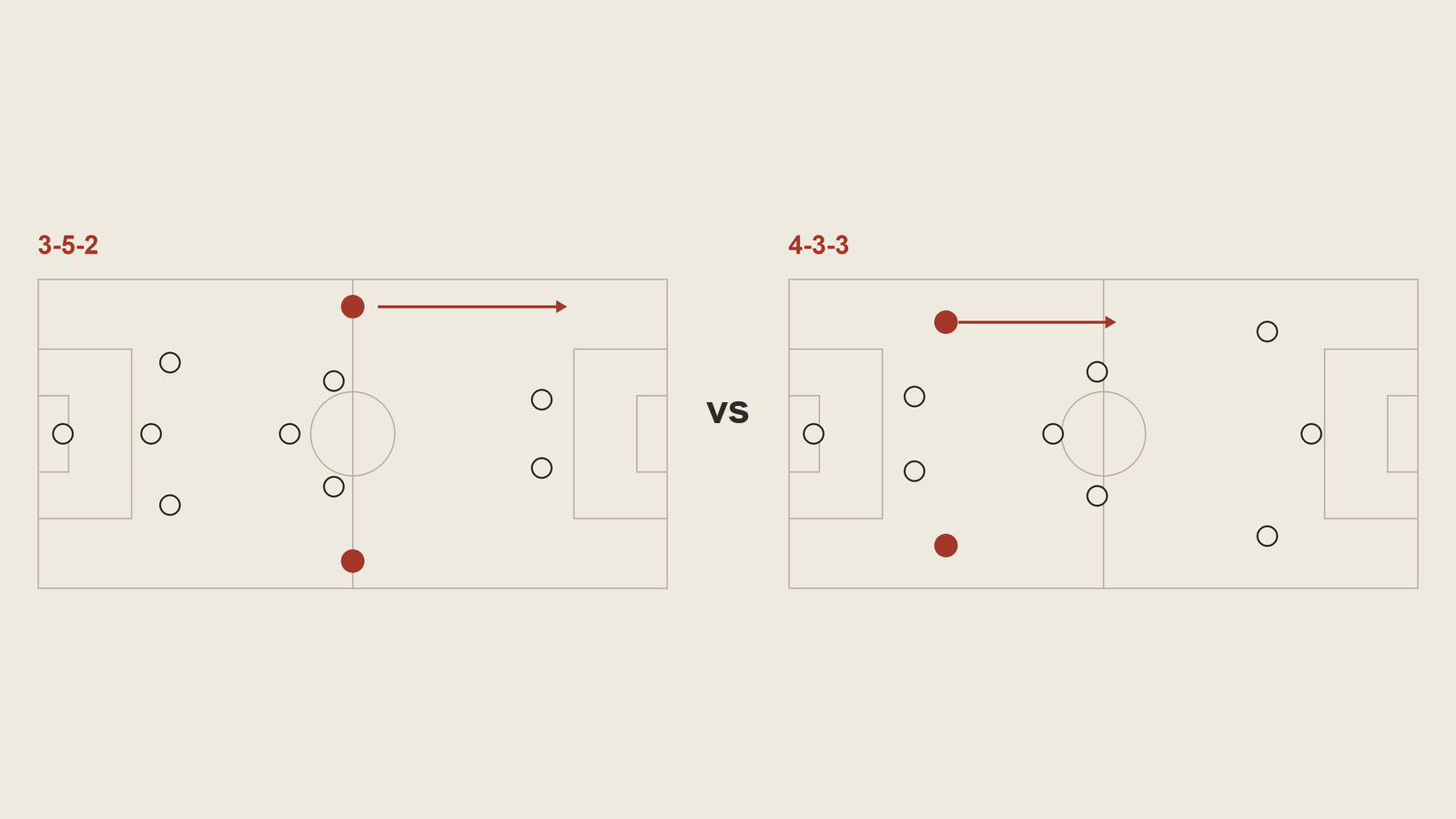
A full-back is the wide defender of a back four and shares his flank with a winger in front of him. A wing-back plays outside a back three, has no winger ahead, and covers the whole flank alone, so he starts higher and carries more of the attack.
Both play on the touchline and both are asked to defend and attack, which is why the names get mixed up. The difference is what stands next to them and in front of them. Our articles on the wing-back and the full-back cover each role in depth; this page puts them side by side.
| Wing-back | Full-back | |
|---|---|---|
| Where he stands | Wide, often level with the midfield or higher | Wide in the defensive line, next to a centre-back |
| Who is beside him | Three centre-backs inside him | Two centre-backs inside, a winger or wide midfielder ahead |
| Main job | Gives the team its width in attack | Defends his flank first, supports attacks when he can |
| Without the ball | Drops in to make a back five | Holds a line of four |
| Typical formations | 3-5-2, 3-4-3, 3-4-2-1, 5-3-2, 5-4-1 | 4-3-3, 4-2-3-1, 4-4-2 |
| Typical number | Varies by club and system | 2 (right-back), 3 (left-back) in the British tradition |
| Well-known example | Victor Moses and Marcos Alonso, Chelsea 2016-17 | Trent Alexander-Arnold at Liverpool |
Starting height
The simplest way to tell them apart is where they stand when their team has the ball. A full-back begins in the defensive line and moves up from there. A wing-back usually begins in the midfield line, and Wikipedia notes that wing-backs are sometimes classified as midfielders rather than defenders.
The extra centre-back is what makes the difference possible. Coaches' Voice explains that the wing-back has a third central defender as cover, so he can take up wider positions even when defending. A full-back who pushes as high leaves his centre-back alone in the channel.
With the ball
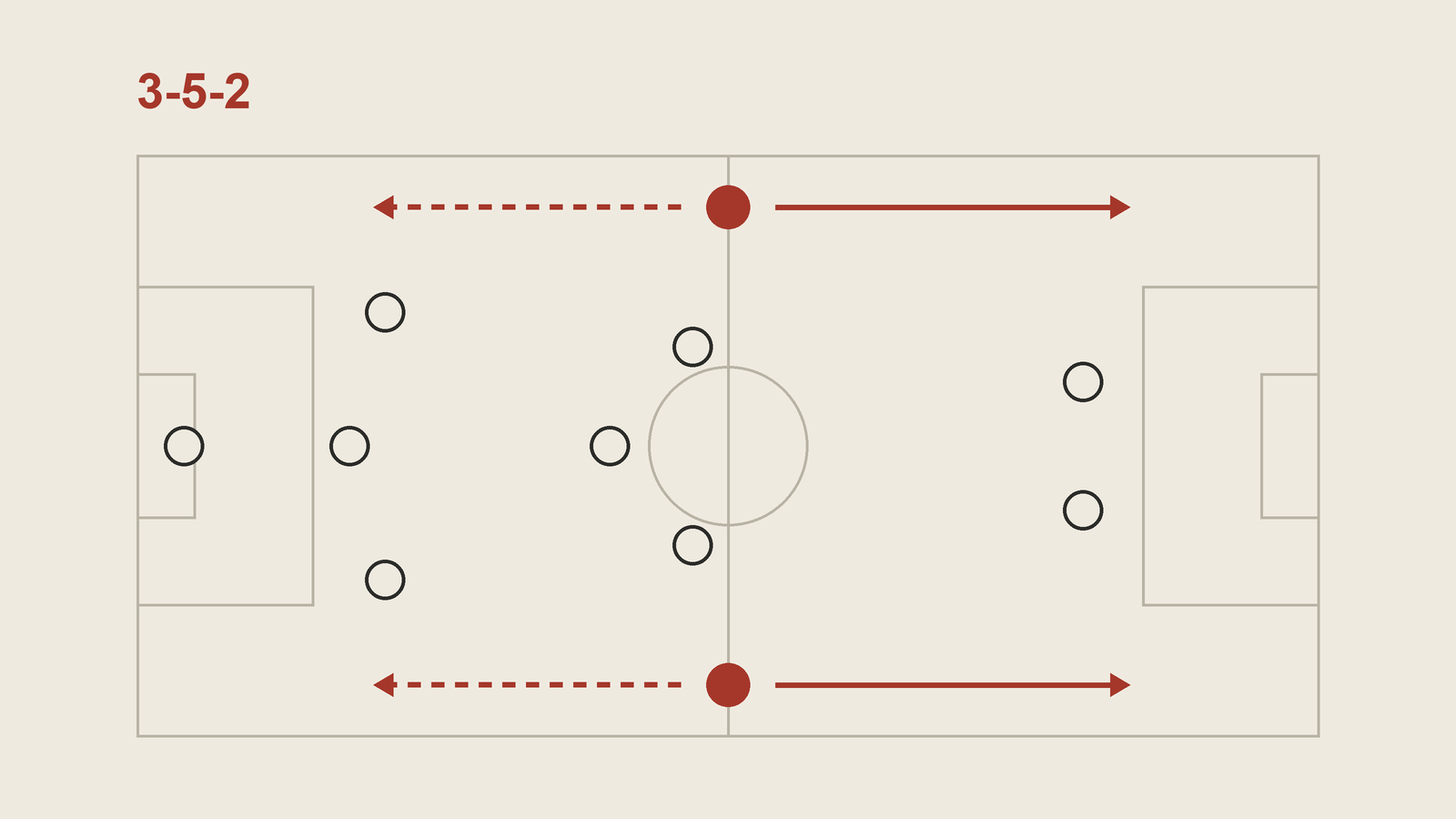
A wing-back almost always provides the width. In a back three there is usually nobody else on the touchline, so if he comes inside, the flank is empty. His job is to stand wide and high, stretch the opponent's back line and open the half-spaces for the players inside him.
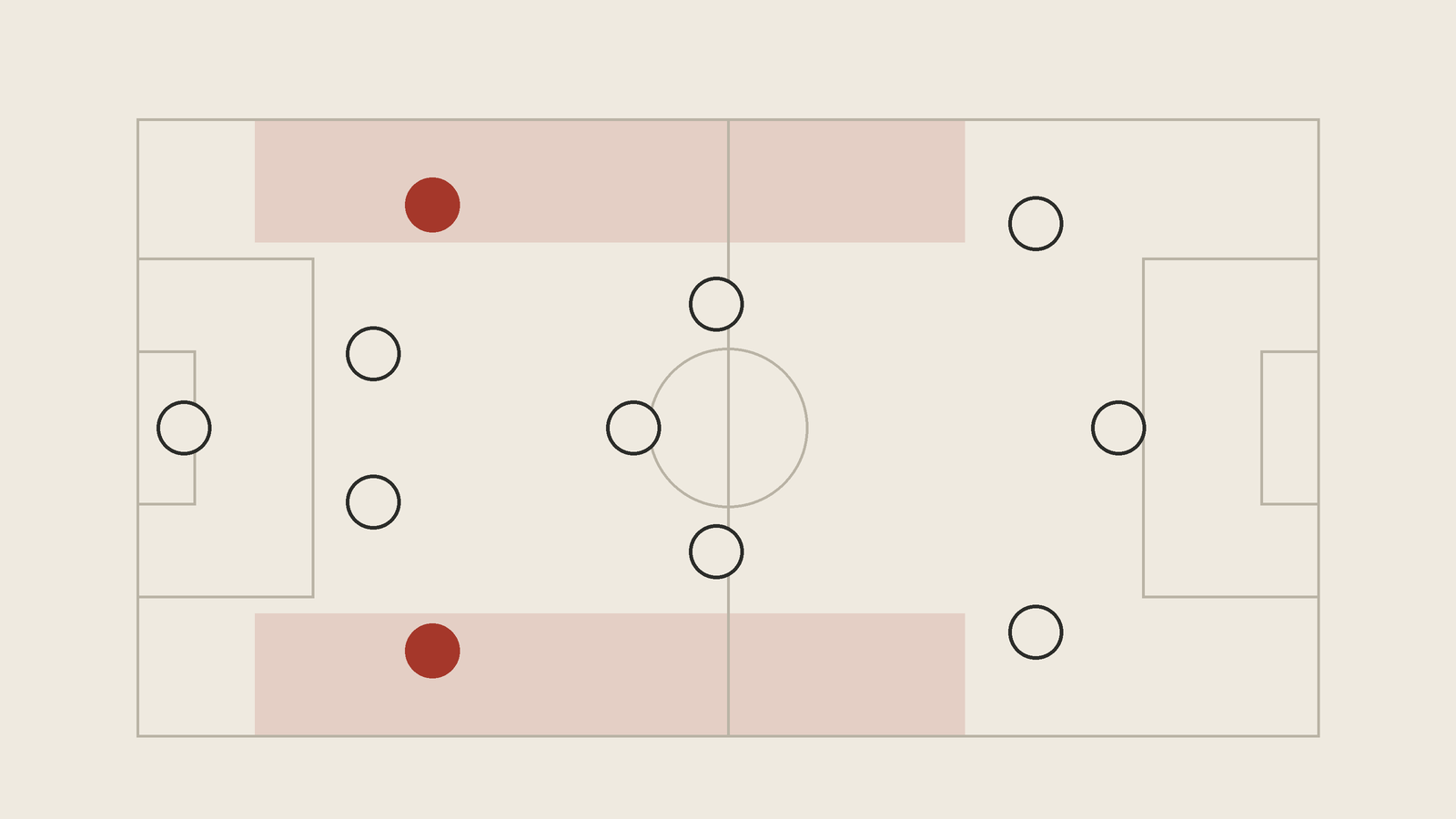
A full-back has more options because the winger can take the width. He can overlap outside the winger, underlap inside him or stay back. Coaches' Voice puts the contrast simply: in a back four the full-backs sometimes come inside while midfielders stay wide; in a back five the wing-backs are almost always the widest players.
That is why many wing-backs are converted wingers. Coaches' Voice lists Victor Moses, Ashley Young, Juan Cuadrado, Jesús Navas and Ivan Perišić among the wide attackers who moved back into the role.
Without the ball
A wing-back's defensive job is a long run back. When his team defends deep, both wing-backs drop either side of the three centre-backs and the shape becomes a back five, a 5-3-2 or a 5-4-1. That covers the width of the box but leaves fewer players to press.
A full-back's defending is closer to home. He faces the opposing winger, keeps the line with his centre-backs and tucks in at the far post. He also has help: in a 4-4-2 the wide midfielders are expected to get up the flank in attack and still protect the full-backs. A wing-back usually has no such cover ahead of him, so the attacking and defensive load sit on one player.
Which formations use each
Wing-backs belong to systems with three centre-backs:
- 3-5-2 (formation page): the wing-backs are the only width; Carlos Bilardo's Argentina won the 1986 World Cup with this shape.
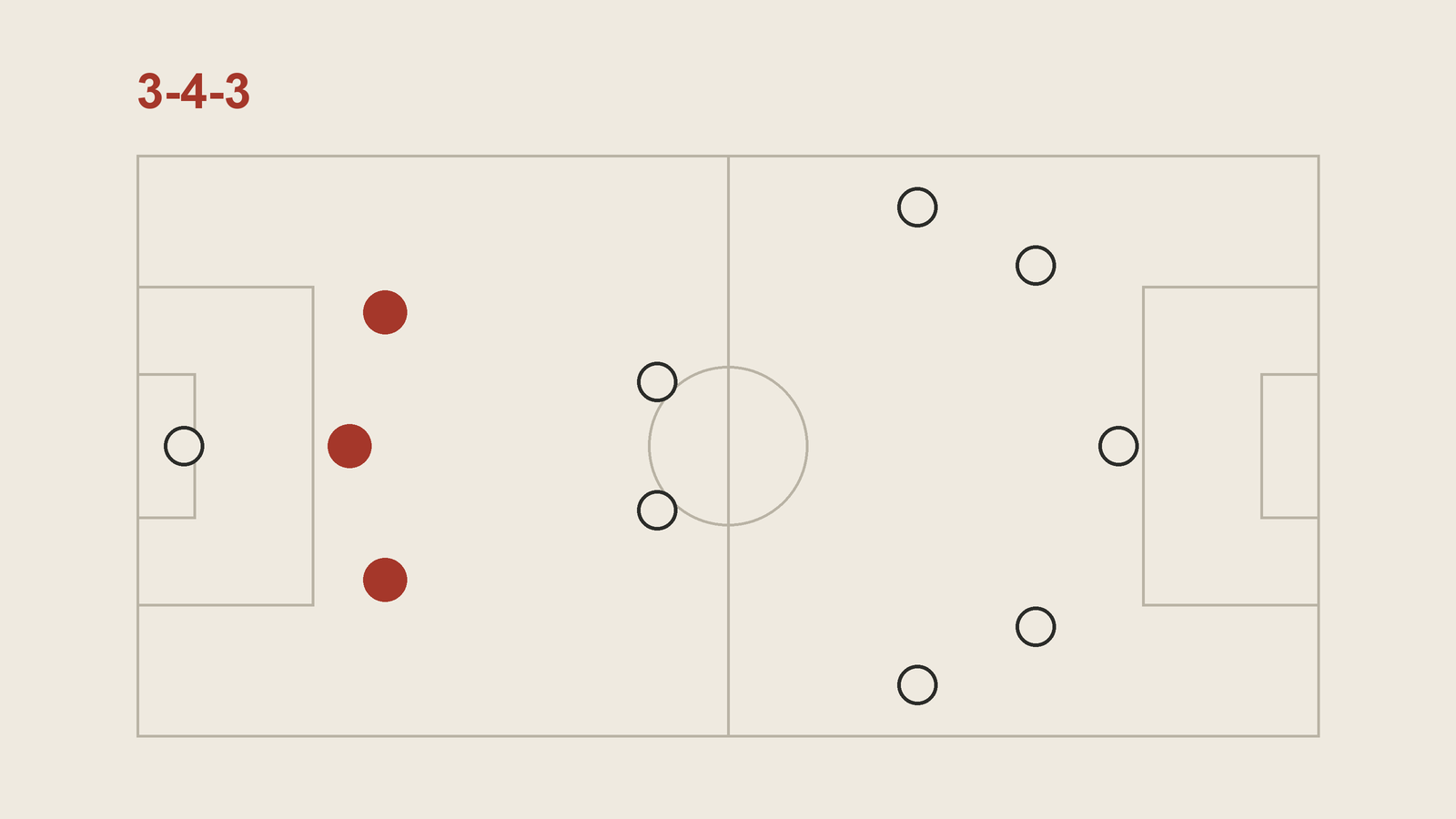
- 3-4-3 (formation page) and 3-4-2-1 (formation page): the wing-backs make up the outside of a midfield four.
- 5-3-2 (formation page) and 5-4-1 (formation page): the same players written as defenders, because they spend more time in the back line.
Full-backs belong to back fours:
- 4-3-3 (formation page): the wide forwards may be asked to mark the opposition full-backs rather than drop back to help their own, so the full-backs defend with less help.
- 4-2-3-1 (formation page): the wide players of the three are asked to track the opposition full-backs.
- 4-4-2 (formation page): a wide midfielder in front of each full-back.
Examples
Antonio Conte's Chelsea are a well-known wing-back case. After back-to-back league defeats, Conte switched to a 3-4-3 against Hull City on 1 October 2016 and won 2-0. The new shape had Marcos Alonso on the left and Victor Moses on the right as wing-backs, with Gary Cahill, David Luiz and César Azpilicueta behind them. Chelsea won the Premier League with 93 points and a record 30 wins. Brazil won the 2002 World Cup with Cafu and Roberto Carlos as wing-backs.
For the full-back, Wikipedia says Brazil in the 1950s are often regarded as pioneers of the attacking style, with Djalma Santos and Nílton Santos. Among modern full-backs who supply assists from the flank it names Trent Alexander-Arnold, who also played the inverted role at Liverpool.
The inverted full-back
The modern variant pulls the other way. An inverted full-back moves into central midfield when his team has the ball instead of going wide. Wikipedia traces the idea to Johan Cruyff's Barcelona and credits Pep Guardiola with making it popular at Bayern Munich, with Philipp Lahm and David Alaba, and at Manchester City. Mikel Arteta's Arsenal used Ben White and Oleksandr Zinchenko in a similar way.
So the two roles have split. A wing-back is as wide as anyone on the team. An inverted full-back may be the narrowest defender in possession, and the risk, as Wikipedia notes, is a lack of width that can leave the wingers isolated.
How to tell them apart in a match
Count the centre-backs when the goalkeeper has the ball. Three means the wide players are wing-backs; two means full-backs. Then look at the touchline in the opponent's half. If the only player there is the defender from your back line, he is a wing-back. If a winger holds the touchline and the defender arrives behind him, overlaps or comes inside, he is a full-back.
The defensive phase confirms it. Wing-backs drop level with three centre-backs to make five. Full-backs stay in a line of four with a midfielder in front.
When a coach picks one over the other
A coach chooses wing-backs when he wants a third centre-back and still needs width, and has wide players who can run the flank for ninety minutes. Coaches' Voice says wing-backs must be extremely fit and fast to contribute at both ends. A coach chooses full-backs when he has real wingers and wants an extra player in midfield or attack instead of a third centre-back. The full-back can then be told to overlap, stay home or invert, depending on the winger in front of him.
What is the difference between a wing-back and a full-back?
A full-back plays in a back four with a winger in front of him. A wing-back plays outside a back three, covers the whole flank alone and starts higher up the pitch. The wing-back carries more of the attack; the full-back shares the flank.
Is a wing-back a defender or a midfielder?
Both, depending on the phase. With the ball a wing-back plays in the midfield line or higher; without it he drops into a back five. That is why the same team can be written as a 3-5-2 or a 5-3-2.
Can a full-back play as a wing-back?
Yes, and many do, especially attacking full-backs with pace and stamina. Converted wingers also fill the role, because a wing-back has to provide the width a winger would.
Which formations use wing-backs?
Formations with three centre-backs: the 3-5-2, 3-4-3 and 3-4-2-1, and their deeper versions the 5-3-2 and 5-4-1. Back-four formations such as the 4-3-3, 4-2-3-1 and 4-4-2 use full-backs instead.
Sources and further reading
- Wing-backs: Football Tactics Explained — Coaches' Voice
- Defender (association football) — Wikipedia
- Formation (association football) — Wikipedia
- 2016–17 Chelsea F.C. season — Wikipedia
- Squad number (association football) — Wikipedia