Formations and roles · Analysis
Target Man: the striker the long ball is aimed at
A target man is a tall, strong striker who wins long balls, holds the ball up and brings team-mates in. Role table, diagram, examples and how to spot one.
By 01 Owen
· Updated 7 Oct 2026 · 7 min read
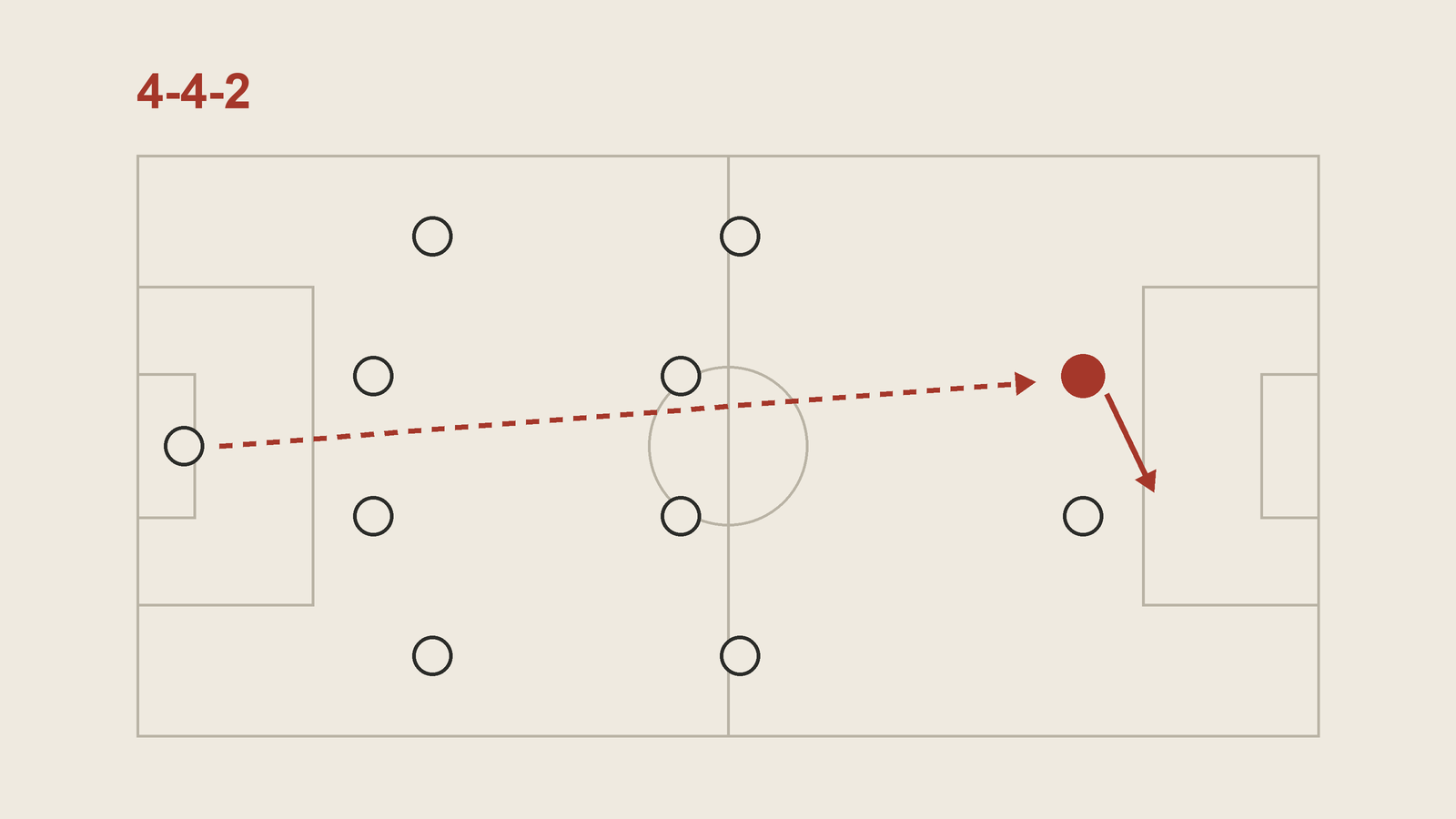
A target man is a centre-forward, usually tall and physically strong, whose main job is to win high and long balls, hold the ball up and bring team-mates into play. He is the reference point the team aims at when it plays forward quickly.
Wikipedia also lists the terms target forward and target striker. He is one of the named types of striker, the position covered in the guide to football positions. Much of his work is done for others: a header won, a flick-on, a lay-off to a midfielder running past him.
The target man at a glance
| Where he plays | Centre-forward, on the last line between or in front of the centre-backs |
| Main job | Win long and high balls, hold the ball up, lay it off or flick it on |
| Without the ball | Screens passes into midfield, presses centre-backs, defends set pieces |
| Typical formations | 4-4-2, 3-5-2, also as a lone 9 in a 4-2-3-1 |
| Shirt number | Traditionally 9, by convention rather than rule |
| Related roles | Striker, poacher, complete forward, false nine |
| Well-known examples | Didier Drogba, Olivier Giroud, Fernando Llorente; Jostein Flo as a wide target man |
What the target man does with the ball
Many of his touches arrive in the air, with his back to goal and a centre-back leaning on him. Wikipedia describes the typical pattern: the goalkeeper kicks long, or a defender plays a long ball forward, and the target man controls it, holds it and lets his team-mates move up the pitch. That makes him a central part of a direct style of build-up play, the route that skips midfield when pressing makes short passing risky.
From there he has three choices. He can lay the ball back to a midfielder facing play, flick it on into the path of his strike partner, or turn and shoot himself. Coaches' Voice, writing about strike partnerships, lists the tools: upper-body strength to pin or hold off centre-backs, and the touch to use flicks, knockdowns and headers to link with runners and a partner.
He is also the target for crosses. A team with a strong header of the ball in the box gets more from its wide players, which is why the classic winger and the target man are such a familiar pairing, as the winger article explains.
What he does without the ball
He is the first defender, like any striker. In a front two, Coaches' Voice describes the forwards screening passes into midfield and pressing the opposing centre-backs, with one pushing up and the other covering. A target man is rarely the quickest presser, so his work here is more about blocking angles than chasing.
He also gives the team somewhere to go under pressure. A side penned in its own half, or defending a low block, can clear the ball towards him instead of simply away, and if he wins it, the clearance becomes the start of a counter-attack.
Formations that use a target man
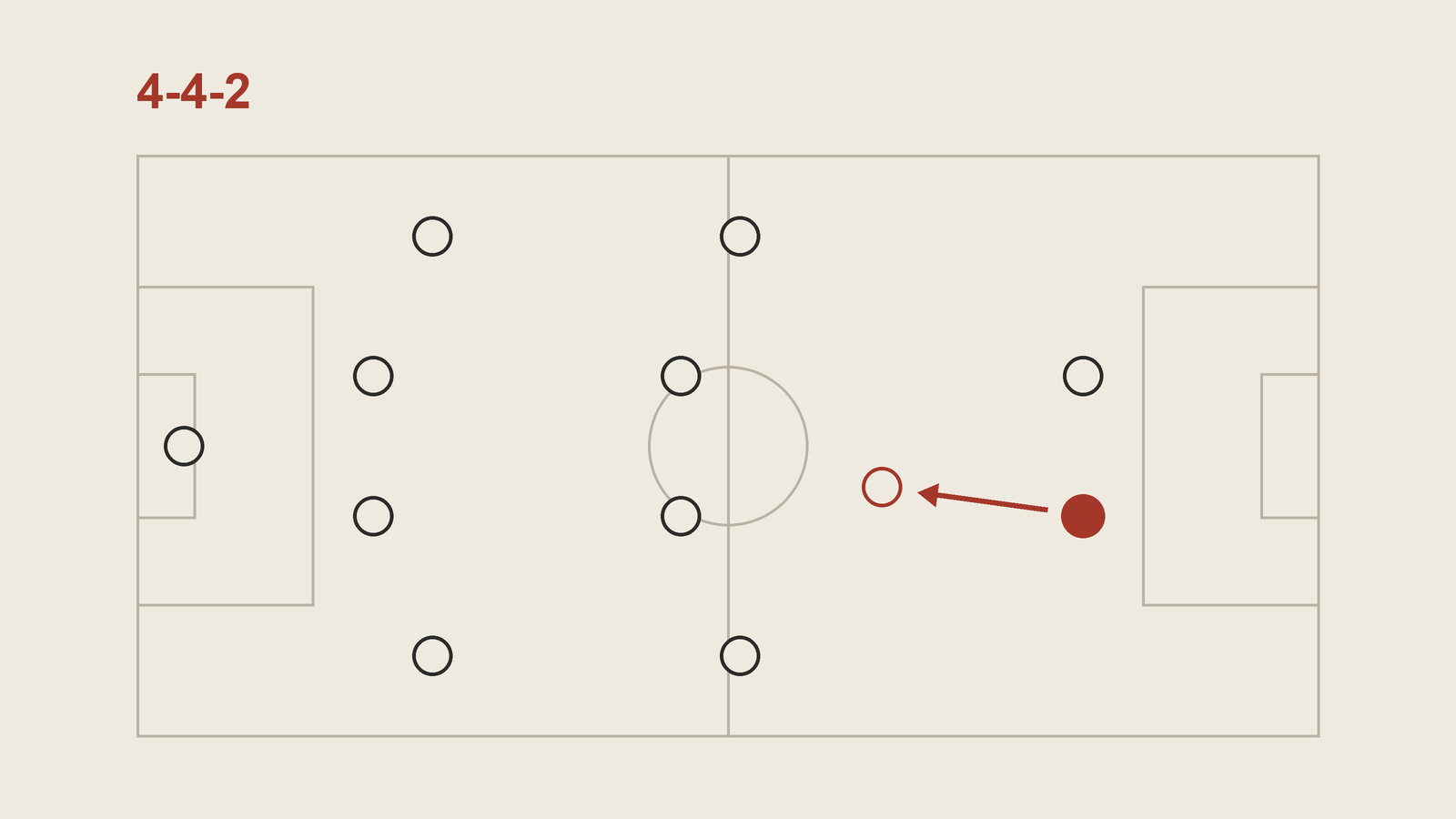
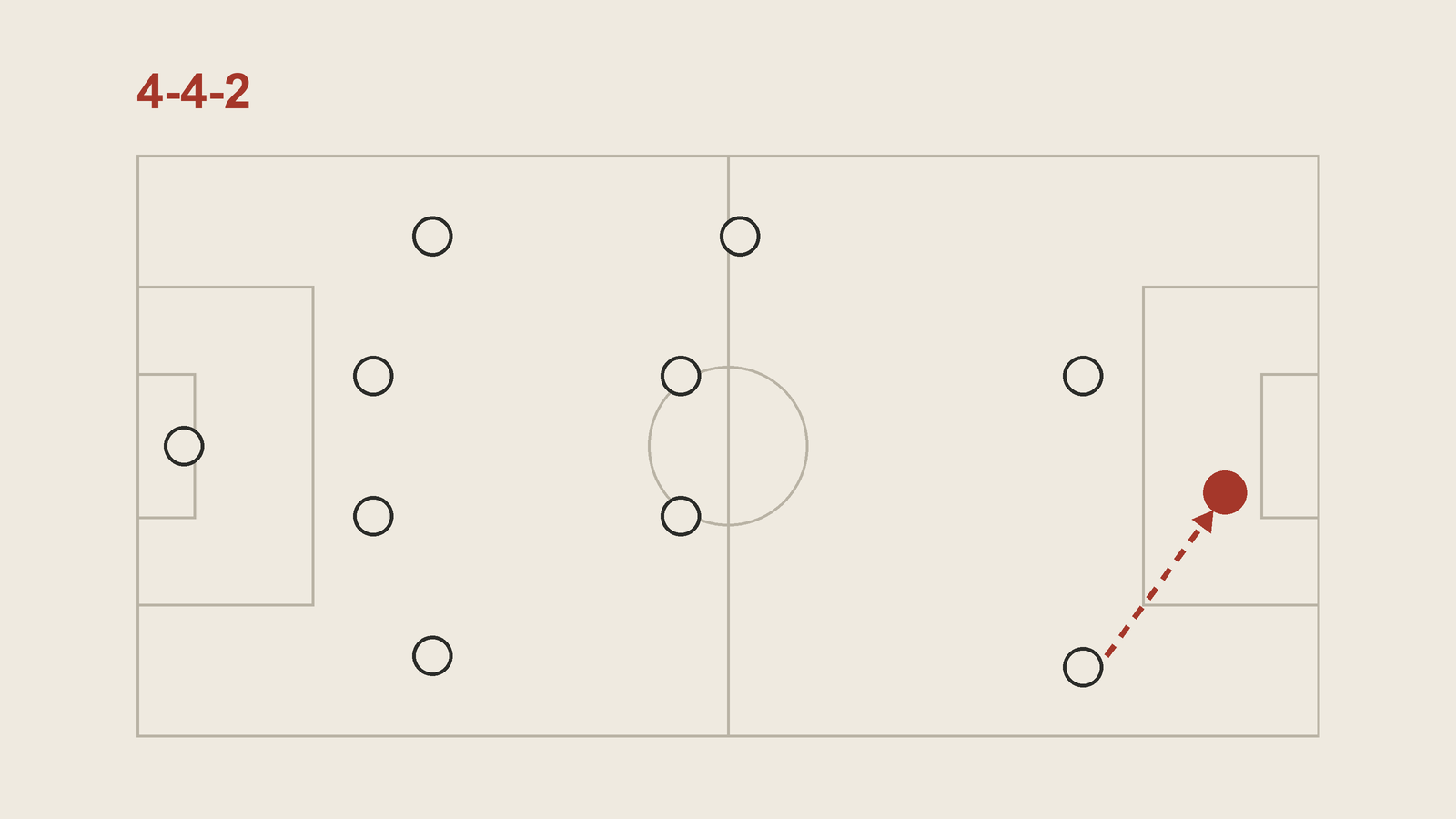
The natural home is the 4-4-2. The two strikers split the work: one stays high and wins the ball, the other plays off him, picking up flick-ons and knockdowns or running beyond. Wide midfielders hold their width and cross. Coaches' Voice says Sean Dyche's 4-4-2 at Burnley played a lot of long passes and connected with the front two quickly, with main strikers who were all strong in the air: Chris Wood, Ashley Barnes and, before them, Sam Vokes. Crosses from wide areas were delivered towards the two of them. You can open the 4-4-2 formation tool to see how the two lines of four sit behind the front pair.
The 3-5-2 also uses two strikers. At Juventus, Antonio Conte paired Fernando Llorente with Carlos Tevez. Coaches' Voice explains that Llorente stayed high as the main target for crosses from the wing-backs, and that direct passes from the back line or from Andrea Pirlo used his physical presence, while Tevez dropped short. Llorente secured the ball and laid it off to Tevez, the number eights or the wing-backs. The 3-5-2 formation tool shows the shape.
A lone target man in a 4-2-3-1 has a harder job: nobody is next to him to collect the flick-on, so the number 10 and the wide players must arrive quickly.
Examples
Wikipedia names Didier Drogba as a striker who played this role, noting his ability to hold up the ball, including in the 2012 Champions League final. It also names Olivier Giroud and Fernando Llorente, both World Cup winners.
Giroud at the 2018 World Cup is the clearest case of the role's value. Wikipedia records that he played in all seven of France's matches and did not register a shot on target from 13 shots, while Antoine Griezmann and Kylian Mbappé scored four goals each. The Guardian wrote during the tournament that Giroud had "selflessly played the role of target man", giving the two the freedom to flourish. France won the final 4–2 against Croatia.
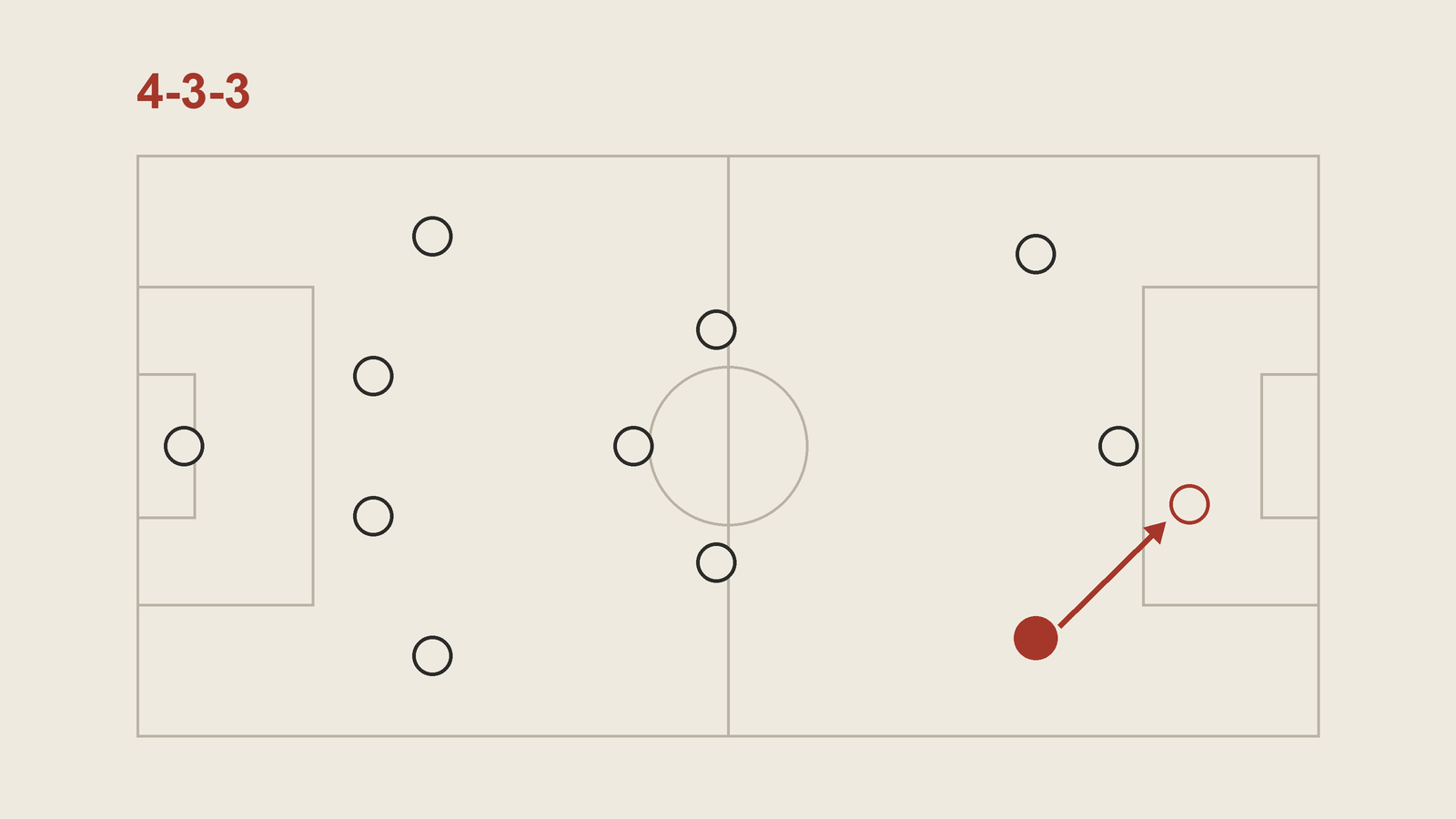
An unusual version is the wide target man. Egil Olsen's Norway in the 1990s used Jostein Flo, a 1.92m centre-forward, on the right flank. According to Wikipedia, the ball was hit long and cross-field to him because the full-back he faced was usually weaker in the air than a centre-back. The move became known as the Flo pass.
How he differs from neighbouring roles
A poacher also plays on the last line, but rarely touches the ball outside the box and does not hold it up. His value is in arriving at the right moment, not in winning the first ball.
A complete forward can do what a target man does, but also runs in behind and drops to link play. The target man is the more specialised version, and usually the less mobile one.
A false nine is almost the opposite. He leaves the last line to receive in midfield, while the target man stays on it and gives the centre-backs someone to mark. The false nine vs striker comparison sets out what changes when a team switches from one to the other, and the false nine article notes that a side without a centre-forward loses its target for crosses and long balls.
How to spot a target man in a match
Watch the goalkeeper's kicks and the long balls from defence. If they keep going to the same striker, and the centre-backs take turns to compete with him, he is the target. Then watch what happens to the ball after he wins it: a flick-on into space, a header down to a midfielder, or a lay-off with his back to goal. His partner usually stands a few yards away, ready to run onto the second ball. Wikipedia also points out that target men may be marked man-to-man and are often fouled, so a striker who wins many free kicks is another sign.
When a coach picks a target man
When the team wants to play forward quickly, or cannot play through a press. When it has good crossers on the flanks. When it is chasing a game and wants to put the ball in the box more often. And when the quickest players in the squad need someone to play off, as France's did in 2018. The cost: if he loses his duels, a team built on long balls gives the ball away again and again.
What is a target man in football?
A target man is a centre-forward, usually tall and strong, whose main job is to win long and high balls, hold the ball up and lay it off or flick it on to team-mates. He gives the team a reference point when it plays forward quickly.
Is a target man the same as a striker?
A target man is one type of striker. Every target man is a striker, but strikers also include poachers, complete forwards and false nines, who do the job in very different ways.
What formation uses a target man?
The 4-4-2 is the classic one, because the second striker can play off him and collect his flick-ons. The 3-5-2 also suits him, with wing-backs supplying crosses, and he can play alone in a 4-2-3-1 if the midfield arrives quickly in support.
What makes a good target man?
Strength to hold off centre-backs, good heading, a reliable first touch with his back to goal and the awareness to find a team-mate quickly. Scoring helps, but much of his value is in the goals he makes possible for others.
Sources and further reading
- Forward (association football): Target forward — Wikipedia
- Two up front: football tactics explained — Coaches' Voice
- No goals? No problem. Olivier Giroud's mission to supply France with glory — The Guardian
- Flo pass — Wikipedia
- Olivier Giroud — Wikipedia