Formations and roles · Analysis
False Nine vs Striker: One Drops Off the Centre-Backs, One Stays on Them
A false nine drops into midfield; a classic striker stays high on the centre-backs. A side-by-side table, a diagram, who scores and what each needs.
By 01 Owen
· Updated 7 Oct 2026 · 7 min read
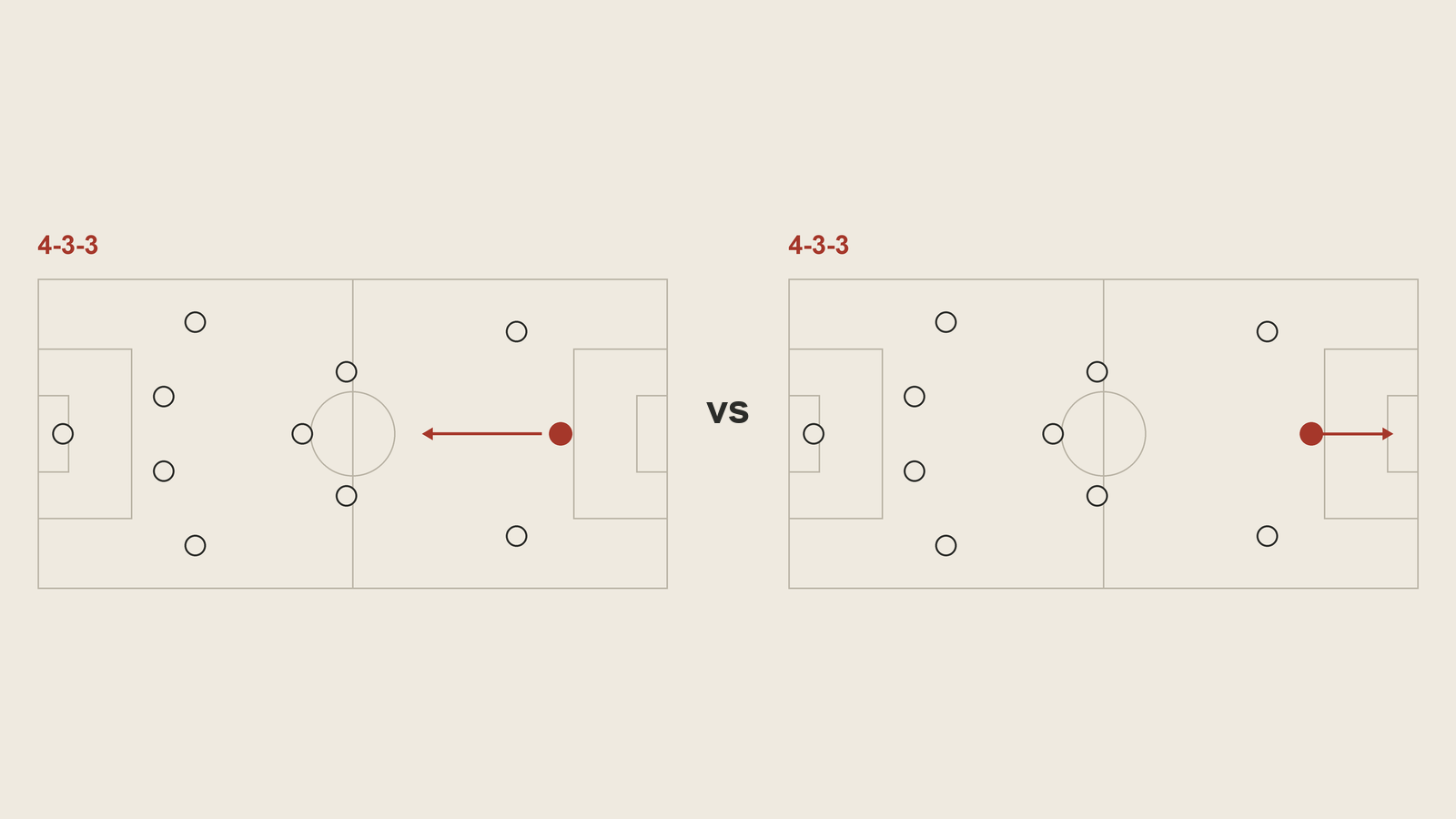
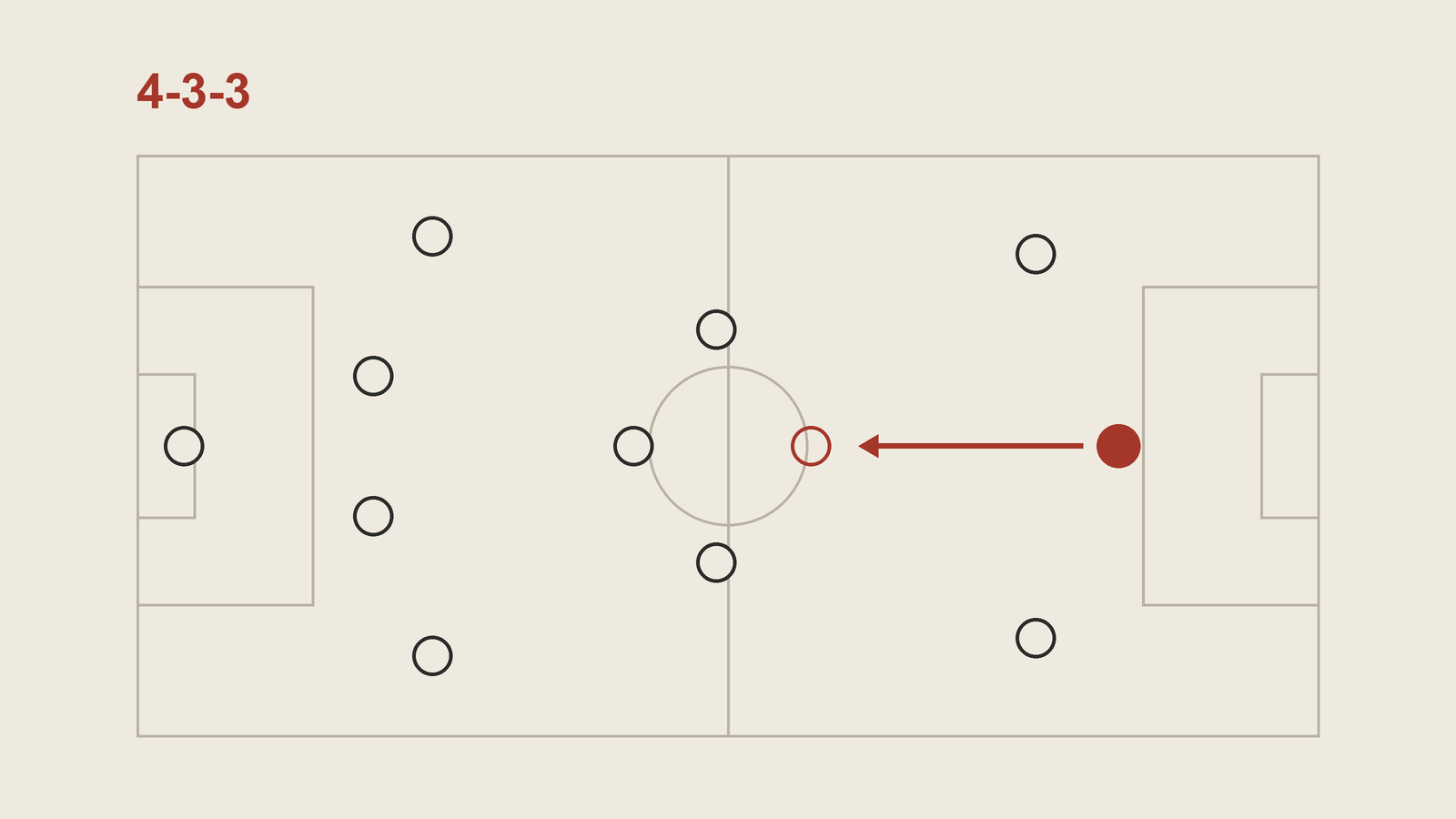
A false nine starts as the centre-forward and drops into midfield, pulling a centre-back out or leaving both with nobody to mark. A classic striker stays high between the centre-backs, pins them and runs in behind, and scores most of the team's goals himself.
Both stand in the same spot on the team sheet. What differs is direction: one comes towards the ball, the other goes away from it, towards goal. That choice changes who marks whom and who scores. The full background is in the articles on the false nine and the striker; this page puts them side by side.
| False nine | Classic striker (number 9) | |
|---|---|---|
| Where he stands | Starts up front, receives between the opponent's defence and midfield | On the last line, between or in front of the centre-backs |
| Main job | Link play, create a spare man in midfield, release runners | Score, run in behind, hold the ball up |
| Effect on the centre-backs | Gives them a dilemma: follow him and leave a gap, or let him turn | Keeps them busy and pushes the back line deeper |
| Who scores | Wide forwards and midfielders arriving in the box | Mostly the striker himself |
| Without the ball | Counter-presses and screens passes like any striker | Starts the press on the centre-backs |
| Typical shapes | Lone forward of a 4-3-3 | Lone forward of a 4-3-3 or 4-2-3-1, or one of two in a 4-4-2 or 3-5-2 |
| Well-known example | Lionel Messi at Barcelona under Pep Guardiola | Robert Lewandowski, Romelu Lukaku |
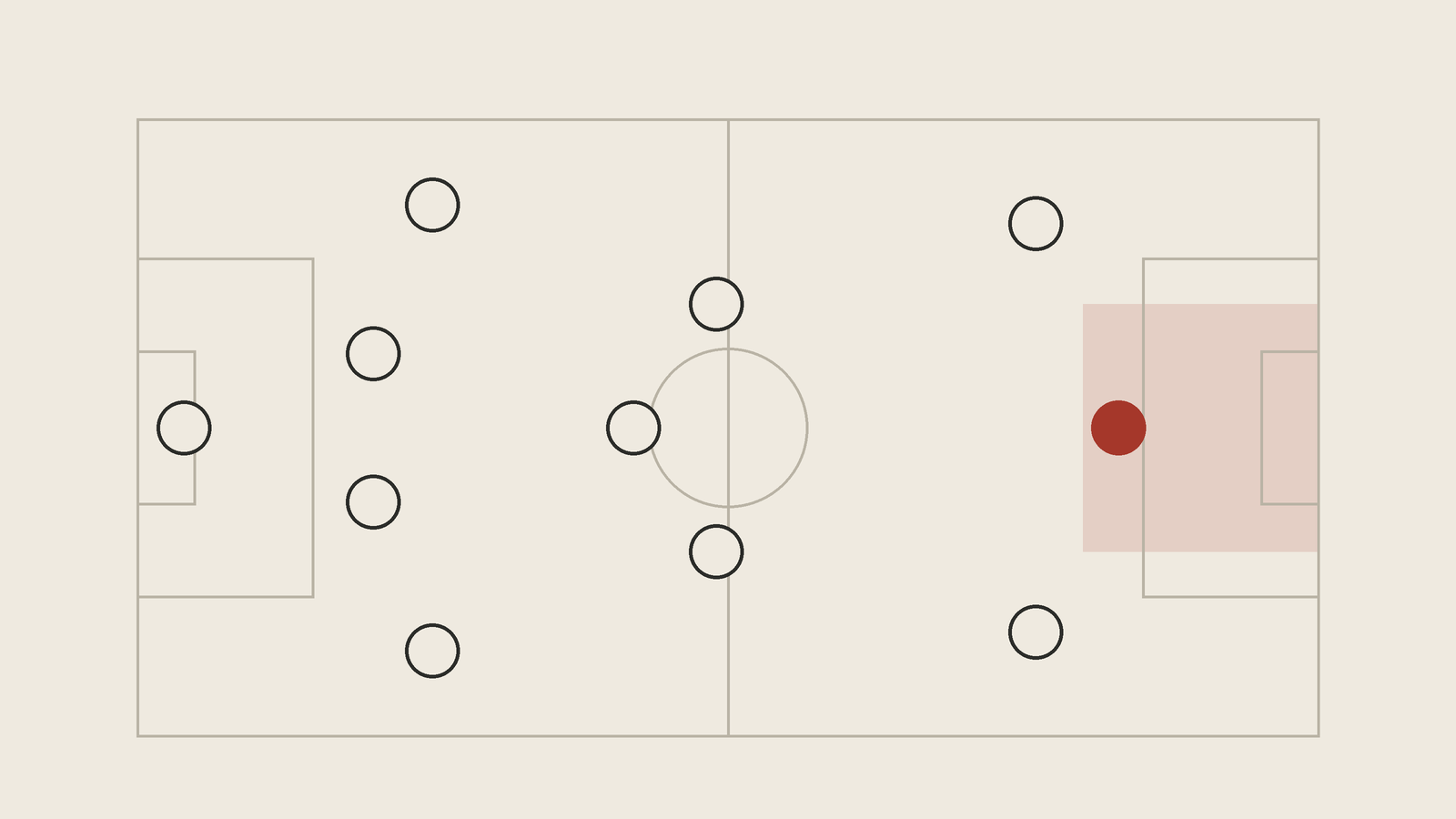
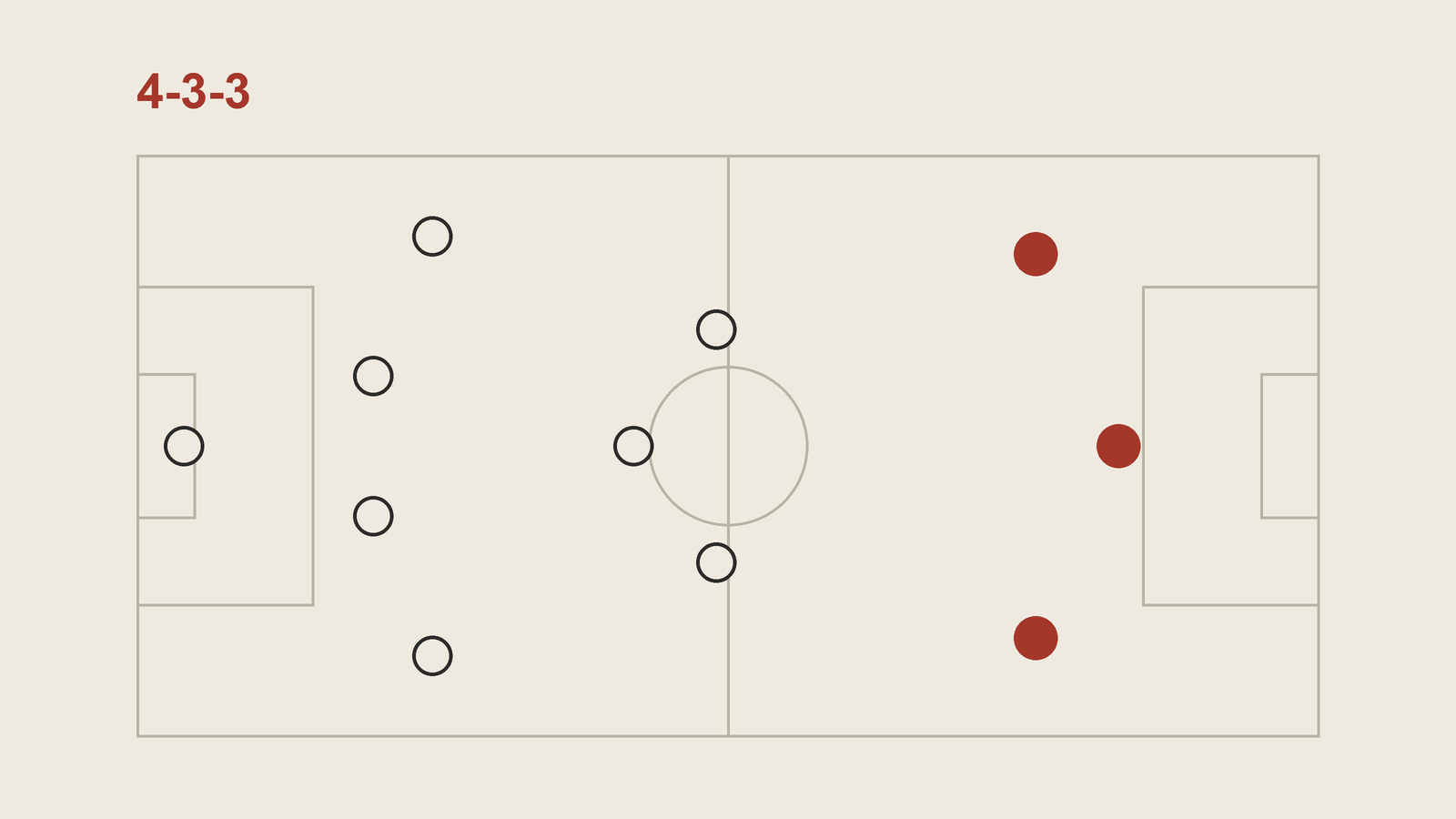
The numbered diagrams show where the 9 starts in each shape: the 4-3-3 and 4-2-3-1 have one, the 4-4-2 and 3-5-2 have two. A false nine is almost always the lone forward, because with a partner up front the centre-backs always have someone to mark.
What each does to the centre-backs
This is the heart of the difference. A classic striker plays against the centre-backs. He stays on their shoulder, attacks the space behind them and takes up set positions in the box, such as the front post. In 2021 UEFA's technical observers praised Timo Werner, a conventional number 9, for his movement "in behind to stretch opposition defences". Every time he threatens that run, the back line has to drop a few yards, and the space between defence and midfield grows for team-mates.
A false nine plays away from them. Wikipedia and Coaches' Voice describe the same dilemma: if a centre-back follows him into midfield, he leaves space behind for runners; if he stays, the false nine has time to turn and pass or dribble. Roberto Martínez, quoted by UEFA, put the second half of that simply: centre-halves are not going to follow all the way. So the false nine ends up free in the pocket in front of the defence, the area known as Zone 14, facing goal.
With the ball
The striker's work is concentrated near the goal. Wikipedia lists the tasks of the physical type: getting on the end of crosses, winning long balls and receiving with his back to goal while team-mates move up. Smaller, agile strikers rely on short bursts of speed, and Ronaldo, Thierry Henry and Andriy Shevchenko are cited for peeling off defenders on the blind side. He is the reference point the team plays towards.
The false nine needs a midfielder's skills in a forward's position. Wikipedia names dribbling to use the space between the lines, short passing to combine with midfield, and the vision to find team-mates running from deep. Because he goes towards the ball, he adds a player to the midfield and creates an overload there. The cost is that nobody is in the centre of the attack until someone else gets there.
Without the ball
Coaches' Voice notes that a false nine still does "the duties of a regular striker" out of possession: counter-pressing after a loss and screening passes into the opponent's midfield. The classic striker does the same, but from a higher starting point, usually pressing the centre-back with the ball.
Who scores, and who each one needs
With a classic striker, the ball goes to him in the box. The wingers can be crossers who stay wide and deliver, and the midfielders can be passers and ball-winners rather than goalscorers.
With a false nine, the goals have to come from elsewhere. Wikipedia notes that the space a following centre-back leaves is there for onrushing team-mates. Coaches' Voice adds that Messi's wingers were often inside forwards on their "wrong" flank, cutting in to take through balls. So a false nine needs wide forwards who score and midfielders who arrive in the box, such as a box-to-box midfielder or a mezzala. Without those runs, a false nine is just a team with no striker.
Examples
The reference match is Real Madrid 2-6 Barcelona on 2 May 2009. StatsBomb's analysis records that seven minutes in, Messi swapped places with Samuel Eto'o, moving from the right wing to the centre to drop off. Madrid's defence could not work out how to position itself; Messi scored twice and set up Thierry Henry for Barcelona's first goal.
Spain won the Euro 2012 final 4-0 against Italy in Kyiv on 1 July 2012 with Cesc Fàbregas, a midfielder, starting up front in a 4-3-3. The first two goals came from David Silva, heading in a Fàbregas cut-back, and the left-back Jordi Alba after a long forward run. Then the contrast: Fernando Torres, a real striker, replaced Fàbregas in the 75th minute, scored in the 84th and set up Juan Mata for the fourth.
Other false nines named by Coaches' Voice include Roberto Firmino under Jürgen Klopp at Liverpool, Harry Kane under José Mourinho and Gareth Southgate, and Karim Benzema at Real Madrid, whose movement and link play opened space for Cristiano Ronaldo's runs. An earlier version was Nándor Hidegkuti, Hungary's deep-lying centre-forward in the early 1950s. UEFA's 2021 report set Manchester City's use of Kevin De Bruyne and İlkay Gündoğan in the role against Timo Werner at Chelsea, a runner in behind.
How to tell them apart in a match
Watch the centre-forward when his team has the ball in its own half. If he comes back towards the centre circle and asks for it to feet, he is a false nine. If he stays on the shoulder of the last defender, he is a striker. Then watch the opposing centre-backs: against a false nine, one keeps stepping out or looking for someone to mark; against a striker, they hold their line. Finally, watch who arrives in the box when the ball goes wide: if wingers and midfielders get there first, the nine was false.
When a coach picks one over the other
A false nine suits a team that keeps the ball and has wide forwards who score. It is at its best against centre-backs who like to follow, because each step they take opens space behind. It struggles against a deep, compact low block, which leaves no room to drop into, and it removes the target for crosses and long balls.
A classic striker suits a team that wants a reference point: crosses, long balls, quick counter-attacks. Against a high defensive line, a striker running in behind is the most direct threat there is, which is why the UEFA observers linked the traditional nine to that situation. Many teams carry both and choose by opponent, or switch during a match, as Spain did with Torres in 2012.
What is the difference between a false nine and a striker?
A striker stays high between the centre-backs, runs in behind and scores most of the goals. A false nine starts in the same position but drops into midfield to receive, leaving the centre-backs to choose between following him and holding their line, while wide players and midfielders make the runs and score.
Is a false nine a striker?
On the team sheet, yes: he is the most advanced player and plays the number 9 position. In play he behaves more like an attacking midfielder, receiving between the lines and creating for others, though he still presses like a striker when the ball is lost.
Why do teams use a false nine?
To win the midfield and confuse the opposing centre-backs. Dropping off adds a spare man in midfield, and if a centre-back follows, there is space behind for wingers and midfielders to run into. It works best for possession teams with wide forwards who score.
Who is the best example of a false nine?
Lionel Messi under Pep Guardiola at Barcelona is the usual answer, starting with the 6-2 win at Real Madrid in May 2009. Cesc Fàbregas for Spain at Euro 2012 and Roberto Firmino at Liverpool are other well-known examples.
Sources and further reading
- False 9 — Wikipedia
- The false nine: explained — Coaches' Voice
- The No9s: Guardiola's double false nine, Messi the original, and the real nines — UEFA
- Messi Moments with Álex Delmás: Real Madrid 2-6 Barcelona, May 2009 — StatsBomb
- UEFA Euro 2012 final — Wikipedia