Formations and roles · Analysis
Mezzala vs Trequartista: The Wide Eight and the Classic Ten
A mezzala is a wide number 8 who runs into the half-space; a trequartista is a number 10 in the hole. Side-by-side table, formations and examples.
By 01 Owen
· Updated 7 Oct 2026 · 7 min read
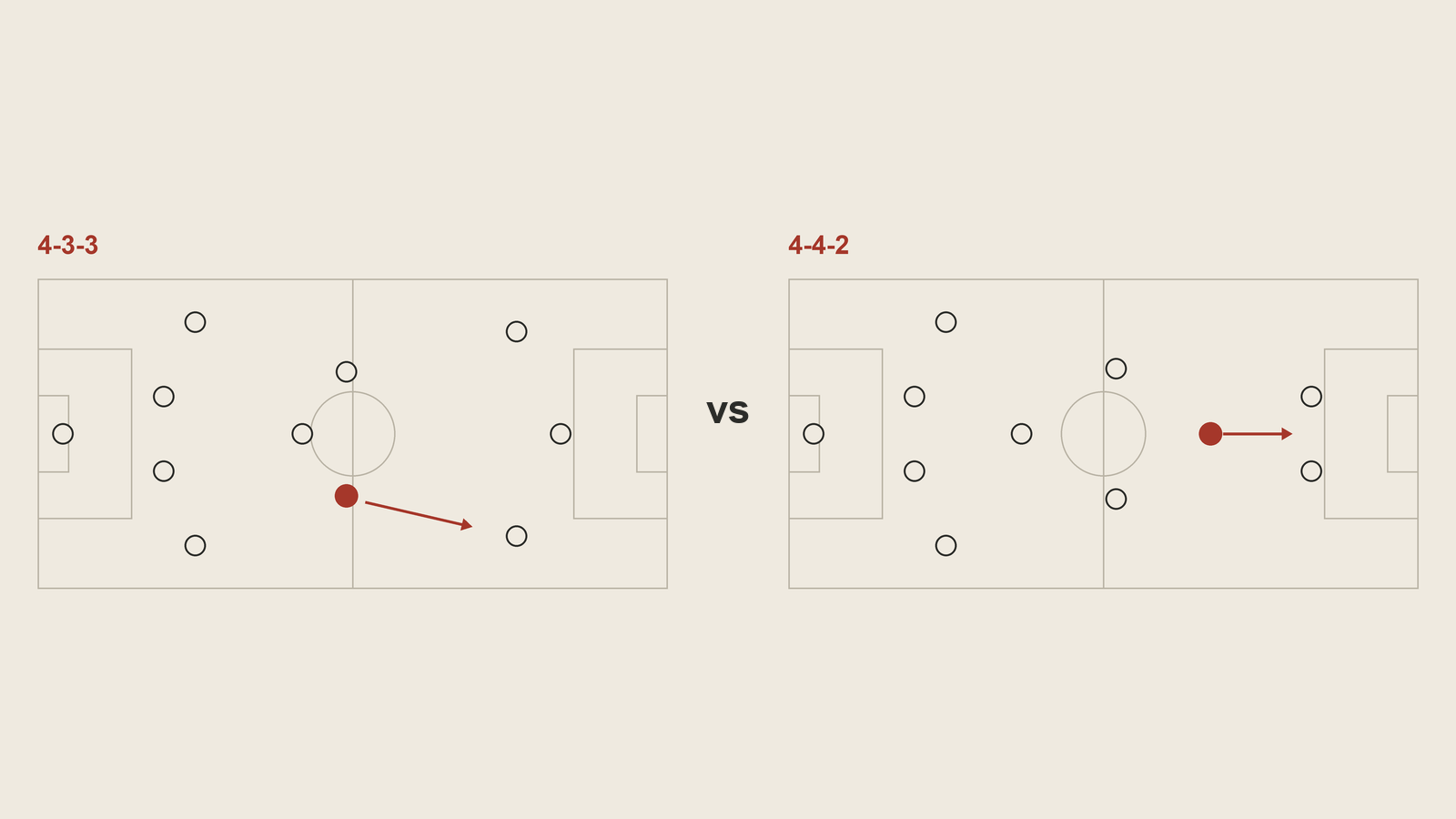
A mezzala is an outer midfielder in a three who starts in the midfield line and runs forward and wide into the half-space. A trequartista is a number 10 who starts behind the strikers, in the hole, and waits there for the ball to create the final pass.
Both words are Italian. That is why the question comes up so often: they sound like neighbours, and both describe a creative midfielder. But they start in different places, move in different directions and come with very different defensive jobs.
| Mezzala | Trequartista | |
|---|---|---|
| Where he starts | Wide in a midfield three, beside a holding midfielder | Centrally, between the midfield and the strikers |
| Main movement | Diagonal, forward and towards the flank | Little; he is already where the ball should arrive |
| Main job | Carry the ball and run into the half-space and the channel | Receive between the lines and play the final pass |
| Without the ball | Presses, then runs back into the midfield line | Classically little; the modern 10 presses or marks the opponent's holding midfielder |
| Typical formations | 4-3-3, 3-5-2 | 4-4-2 diamond (4-3-1-2), 3-4-1-2 |
| Typical number | 8 | 10 |
| Well-known example | Kevin De Bruyne under Pep Guardiola | Kaká in Carlo Ancelotti's Milan |
Where the two words come from
Mezzala means "half winger". In the Italian football of the 1930s, the Metodo and the WM, it was the name for the inside forward, the player between the winger and the centre-forward in a five-man attack (the old numbering is in our guide to football positions). Italian Wikipedia still describes him as a player who contributes to both interception and attacking push. When the five-man front line disappeared, the word moved back into midfield and attached itself to the wide central midfielder of a three. Our mezzala article covers that history and the modern role in more detail.
Trequartista means "three-quarter player". He plays in the last part of the pitch, behind the strikers, and Italian Wikipedia stresses both sides of his job, setting up team-mates and scoring himself, and adds that he is often the set-piece specialist. English Wikipedia notes that Italy also calls him the fantasista. The trequartista is one national name for what English calls the attacking midfielder or the 10; Argentina calls him the enganche and Spain the mediapunta.
So the two terms have different histories. Mezzala is a 1930s attacking position that became a midfield role. Trequartista has always named a place on the pitch: the space behind the strikers.
With the ball
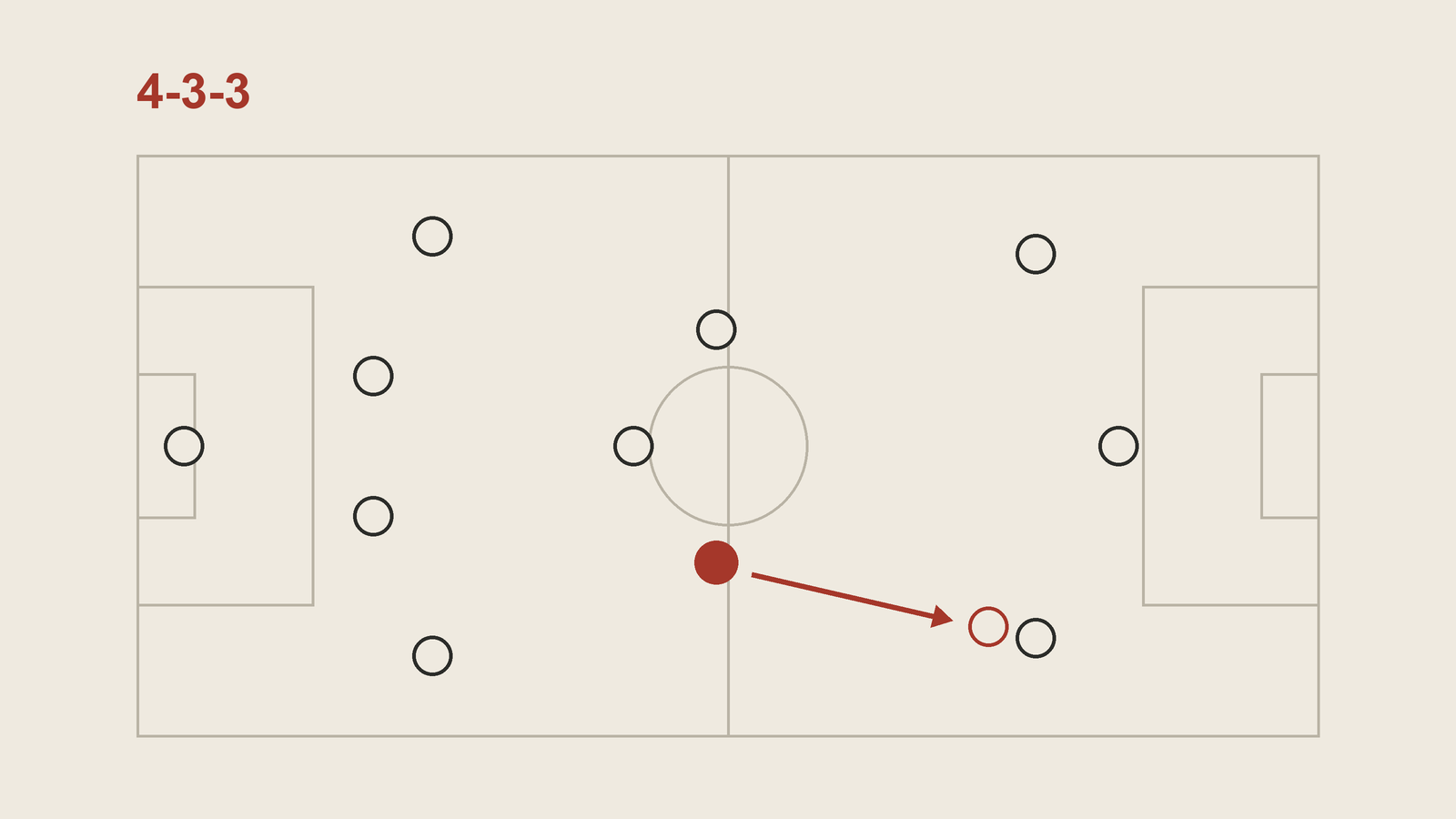
The mezzala's value is movement. Coaches' Voice describes vertical passing and through balls, penetrative runs into the gap between centre-back and full-back, and driving runs with the ball, with dangerous crosses as an added bonus. He receives on the half-turn in the half-space, combines with the winger or wing-back outside him, and arrives late in the area. Because he starts in midfield, the opponent's midfielder has to decide whether to follow him, and that hesitation is the point.
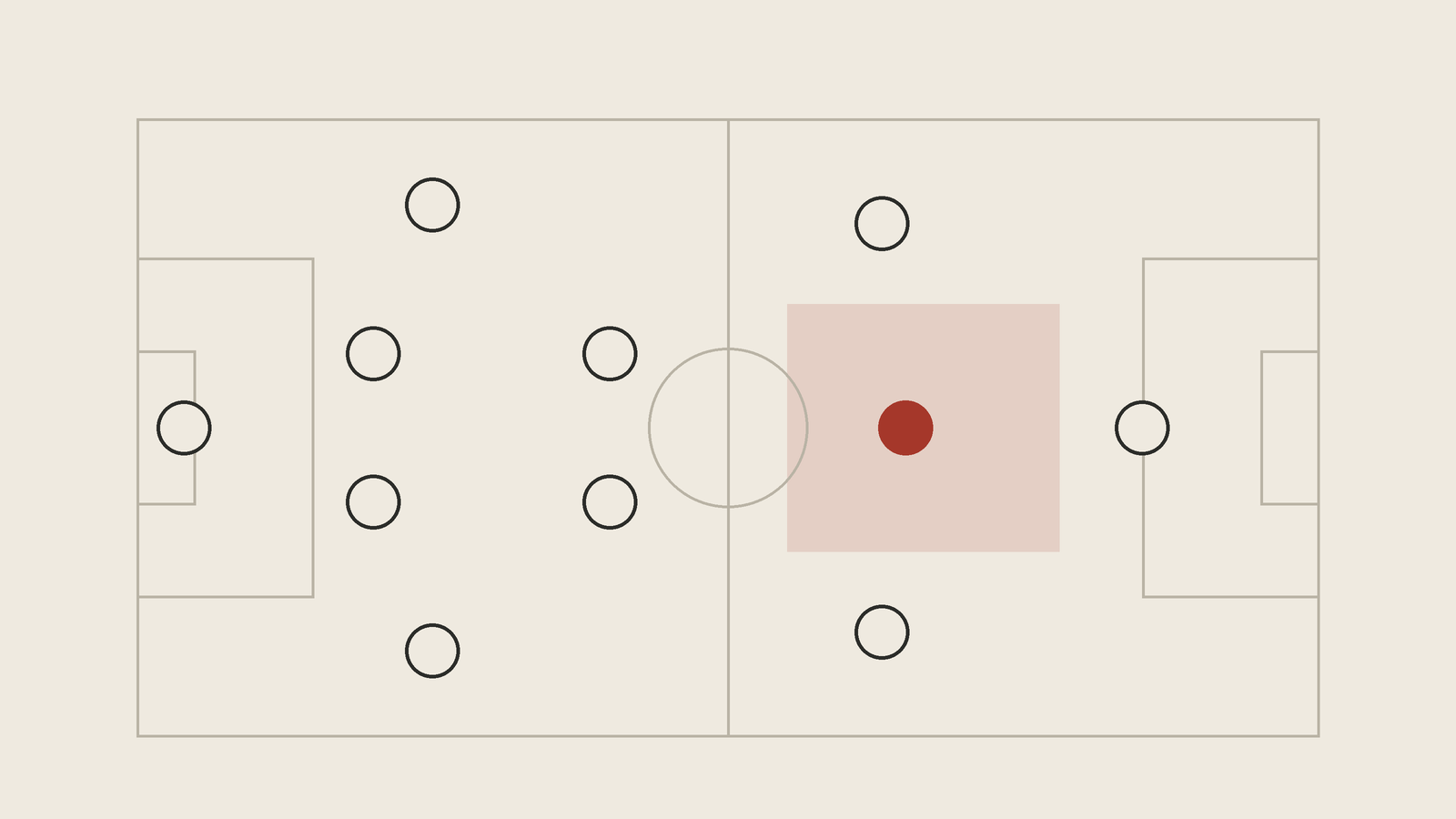
The trequartista's value is position. He is already in the space between the opponent's lines, often around zone 14, and the team tries to find him with one pass from the holding midfielder or the centre-backs. Wikipedia lists the qualities as touch, dribbling, vision, long-range shooting and passing. He turns, plays the through ball or the one-two with a striker, or shoots. His job is to be found, not to run past people.
Without the ball
This is where the two roles really separate. The mezzala is a midfielder first. Coaches' Voice explains that behind a lone striker he often presses alongside him onto the centre-backs, behind two strikers he screens central passing options, and when the opponent plays past him he makes a quick recovery run. Stamina and short, sharp shuttle runs are integral. When the team loses the ball he has to be back in a line of three, otherwise the holding midfielder is left alone.
The classic trequartista did far less of that work. Wikipedia notes that teams were often built to let their 10 roam free, and our attacking midfielder article explains why that became harder to afford. The modern 10 is usually given a specific job instead: push up next to the striker to press, or stay a little deeper and mark the opponent's holding midfielder. Most of the covering is done by the midfielders behind him.
Which formations use each
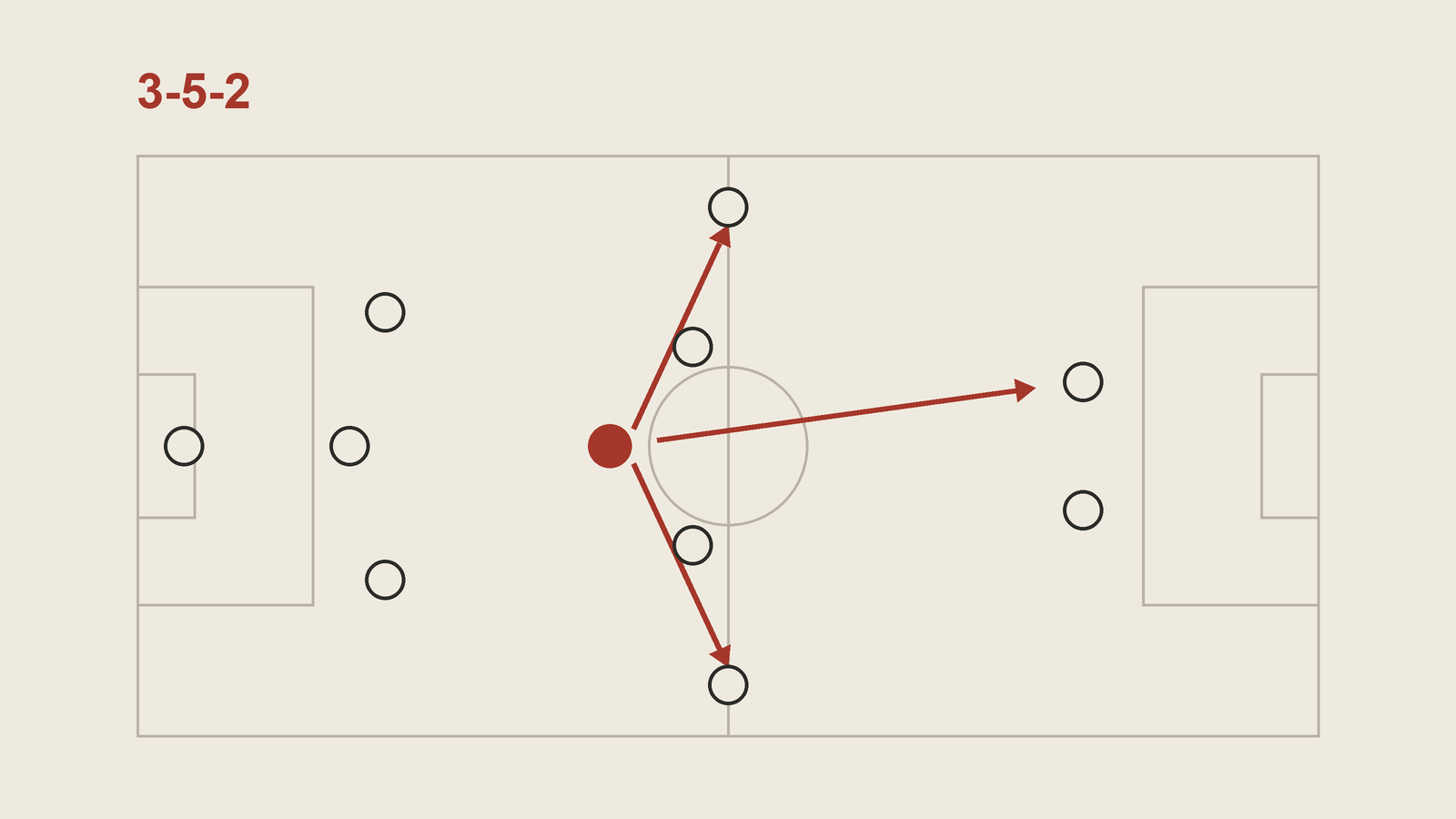
The mezzala needs a midfield three with one holder. In the 4-3-3 the two outer midfielders are the mezzali, with the winger outside and the full-back behind. In the 3-5-2 they sit either side of a regista and form a triangle with the wing-back and the wide centre-back. Coaches' Voice gives Sergej Milinković-Savić at Simone Inzaghi's Lazio as an example from a 3-5-2.
The trequartista needs two strikers in front of him and enough midfielders behind. The classic home is the 4-4-2 diamond, also written 4-3-1-2 or 4-1-2-1-2, a variant of the 4-4-2 with a holding player, two shuttlers and a 10 at the tip. In the 3-4-1-2, one central midfielder of a 3-5-2 is pushed up into the 10's position; Wikipedia notes Martin O'Neill used it at Celtic on the way to the 2003 UEFA Cup final. A 4-2-3-1 also keeps a central 10, though usually a harder-working one.
Notice the overlap. The diamond's two shuttlers are often mezzali in all but name, so one team can field both roles at once.
Examples
For the mezzala, Coaches' Voice names Kevin De Bruyne at Manchester City under Pep Guardiola, Ángel Di María at Real Madrid under Carlo Ancelotti and Milinković-Savić at Lazio, as well as Paul Pogba, Andrés Iniesta and Luka Modrić.
For the trequartista, the cleanest example is Ancelotti's Milan, who won the 2003 Champions League in a diamond. Wikipedia says the shape let Milan field Andrea Pirlo at the base of the midfield while Rui Costa, and later Kaká, played at the tip. Wikipedia's examples of advanced playmakers also include Francesco Totti, Zinedine Zidane and Juan Román Riquelme.
How to tell them apart in a match
Look at the kick-off shape first. If the player stands in a line of three midfielders, he is a candidate for the mezzala. If he stands alone between the midfield and two strikers, he is the trequartista.
Then watch where he receives. The mezzala gets the ball after a run, usually wide of the centre and moving towards the byline. The trequartista gets it standing between the lines, back to goal or half-turned, in the middle.
Finally, watch the moment the ball is lost. The mezzala turns and sprints back into the midfield line. The trequartista usually stays higher, presses with the strikers or picks up the opponent's holding midfielder, and the players behind him close the gap.
When a coach picks one over the other
A coach picks a mezzala when he wants a midfield three for control and pressing, wide players who need a runner inside them, and attacking threat from deep that is hard to mark. The price is the space behind him, which asks a lot of the holder and the team's rest defence.
A coach picks a trequartista when he has two strikers to supply and a player good enough to be found between the lines. The price is width: a diamond has no natural wide midfielders, so the full-backs must provide it. Some teams split the difference and let a mezzala drift infield into the 10's space, or use a false nine who drops into it from the front.
Is a mezzala the same as a trequartista?
No. A mezzala is a wide central midfielder in a three who runs forward into the half-space and has to get back into the midfield line. A trequartista is a number 10 who starts behind the strikers and has fewer defensive duties.
What does trequartista mean in Italian?
It means "three-quarter player". The word describes a creative player who operates behind the strikers, in the last part of the pitch, and both creates chances and scores. Italy also calls him the fantasista.
What formation uses a trequartista?
The classic formations are the 4-4-2 diamond, also written 4-3-1-2, and the 3-4-1-2. In both, two strikers play in front of him and a line of midfielders behind him covers the defensive work.
Can a player be both a mezzala and a trequartista?
Some players have done both jobs at different points, because the skills overlap: passing, carrying and arriving in the box. The difference lies in the starting position and the defensive work, so a coach normally asks a player to fill one role at a time.
Sources and further reading
- What is a mezzala? Explained: De Bruyne, Di María, Pogba — Coaches' Voice
- Midfielder — Wikipedia
- Formation (association football) — Wikipedia
- Centrocampista — Wikipedia (Italian)