Formations and roles · Analysis
3-4-2-1 Formation: One Striker, Two Tens and a Back Three That Becomes Five
The 3-4-2-1 uses three centre-backs, two wing-backs, a double pivot and two tens behind one striker. How it attacks, defends and differs from a 3-4-3.
By 01 Owen
· Updated 4 Oct 2026 · 8 min read
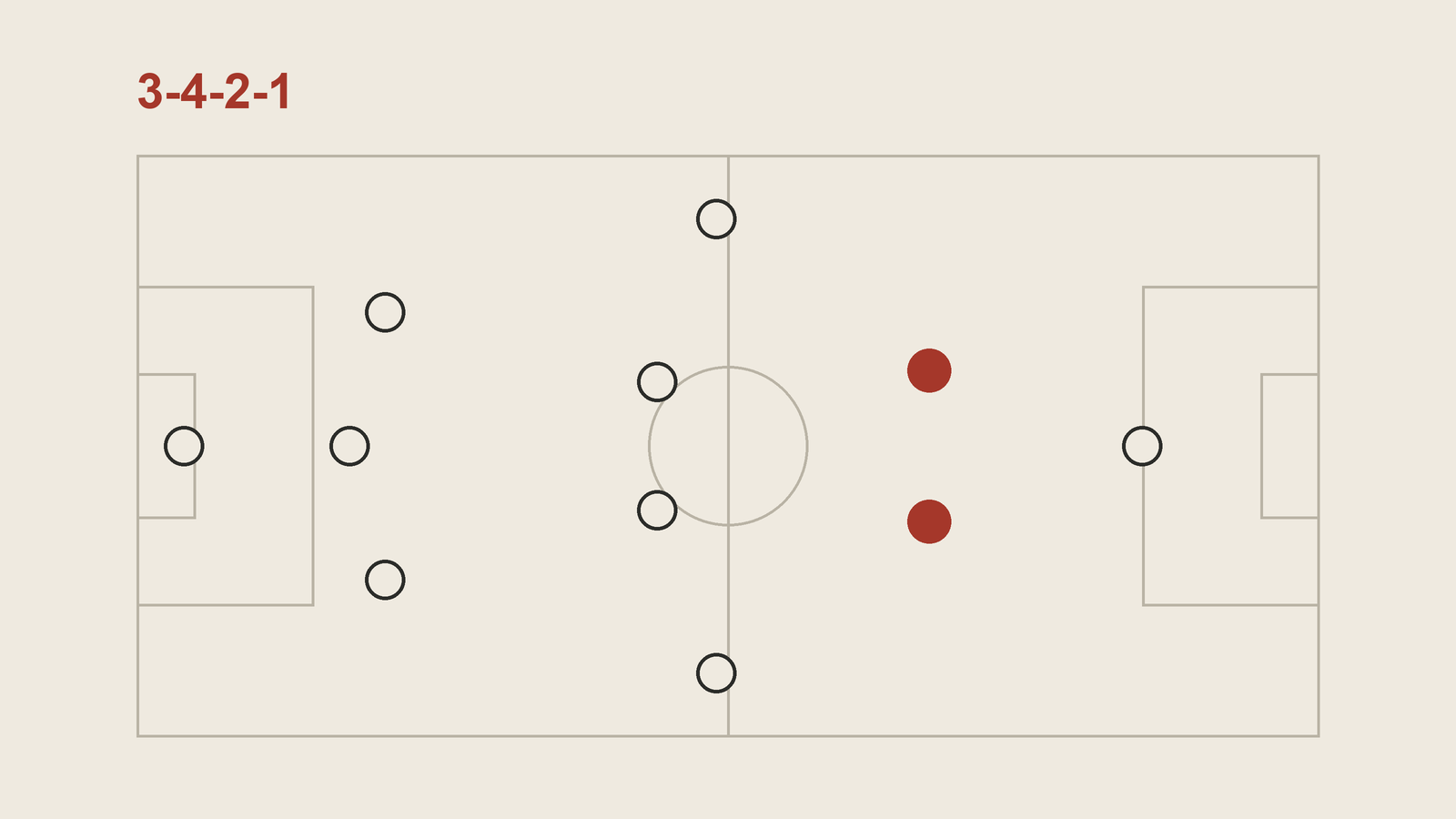
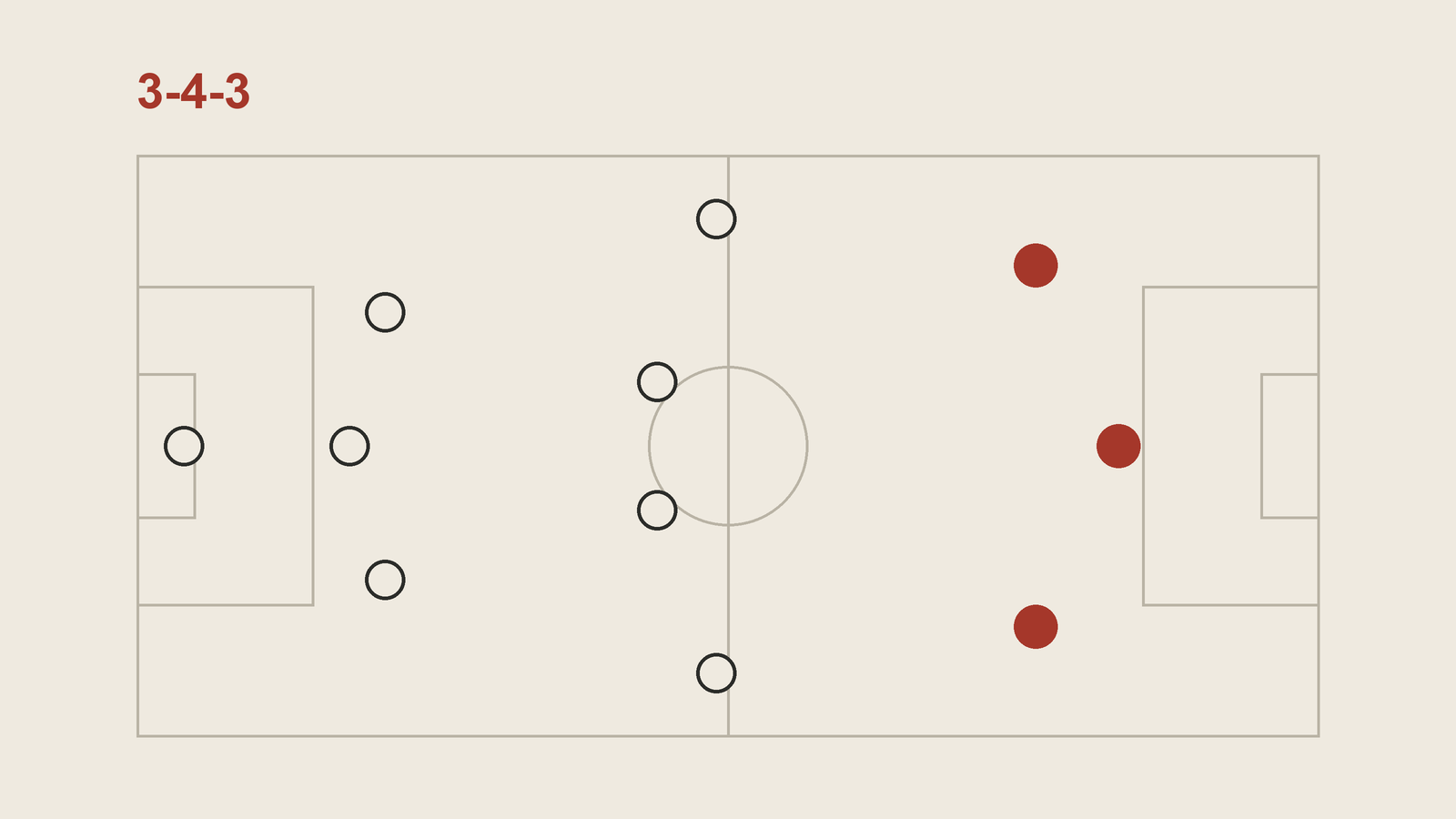
The 3-4-2-1 is a formation with three centre-backs, two wing-backs, two central midfielders, two attacking midfielders and a single striker. It is the narrow version of the 3-4-3: instead of two wingers beside the centre-forward, two number tens play just behind him, inside the pitch.
That one change moves the attacking weight from the touchlines into the middle. The wing-backs become the only natural width, and the striker has company close to him. Coaches' Voice treats it as a variant of the 3-4-3, and the two names are sometimes used for the same team. Xabi Alonso's Bayer Leverkusen, the first side to go through a Bundesliga season unbeaten, made it the most talked-about shape of 2023-24.
The shape, player by player
Every role below has a fuller explanation in our guide to football positions.
Three centre-backs. The middle one organises the line and covers; the two outside ones are expected to be comfortable on the ball. In possession they spread wide, carry it into midfield and pass into the front three. Because there are three of them, one can step out to engage a forward or join an attack while two stay behind. It is the centre-back role with more ground to cover sideways.
Two wing-backs. They own an entire flank each. In attack they hold the width that the tens give up, overlap around them, and arrive for crosses and cut-backs. In defence they drop level with the centre-backs to make a back five. No position runs more; a wing-back who cannot get back turns the formation into a back three with holes on both sides.
The double pivot. Two central midfielders sit in front of the defence. Coaches' Voice calls this pair the key to moving the ball through the thirds: they link the back three with the wing-backs and the front line, switch play from one flank to the other, and slip passes into the tens. Without the ball they stay close to the defenders so there is no gap between the lines. Usually one wins the ball and one passes it, as in any double pivot.
Two tens. This is what makes the 3-4-2-1 different. The two attacking midfielders start inside, roughly in the half-spaces, and receive between the opponent's midfield and defence. They combine with the wing-back on their side, rotate with the striker, and run into the box when the ball goes wide.
One striker. The striker has two attackers within passing range, so he can play with his back to goal and lay the ball off. Coaches' Voice also notes he can drop off as a false nine to pull a centre-back out and open space for the tens to run into.
How it attacks
With the wing-backs pushed on, the shape in possession is roughly a 3-2-5: three centre-backs and the double pivot behind, and a front line of five made up of two wing-backs, two tens and the striker. Five attackers across the width can stretch a back four to breaking point.
The second advantage is in the centre. Two tens plus a striker and the double pivot give the team numbers through the middle against an opposing midfield of two or three, which is where most overloads in this system are built.
Leverkusen showed how central this can be. In Alonso's first full season they had one of the lowest crossing rates in the Bundesliga, according to Coaches' Voice, and ranked among the league's leaders for dribbles and one-against-one situations. When the 3-4-3 became a 3-4-2-1 for 2023-24, quick direct runs from wide forwards gave way to more intricate combinations through the middle.
How it defends and presses
Without the ball the 3-4-2-1 becomes a 5-2-3 or a 5-4-1. The wing-backs drop into a line of five, the double pivot stays tight in front of it, and the front three either screen passes into midfield or press. The usual plan, as Coaches' Voice puts it, is to force the opponent wide and trap the ball against the touchline, where a wing-back can jump out because four defenders are still covering behind him.
How high it presses varies. Coaches' Voice notes that Alonso's Leverkusen were less aggressive in their counter-press than his Real Sociedad B side, delaying pressure so the wing-backs had time to recover, and defended in a 5-2-3 with the tens narrowed. When Leverkusen beat Bayern Munich 3-0 in February 2024, Bundesliga.com records that they had only 38% of the ball, their lowest of the season, and limited Bayern to 0.3 expected goals.
Three centre-backs and the double pivot also form a ready-made rest defence: five players behind the ball even when the wing-backs and tens are committed.
Who made it famous
Antonio Conte's Chelsea won the 2016-17 Premier League with a back three. Coaches' Voice describes Diego Costa supported by two inside forwards, N'Golo Kanté and Nemanja Matić in midfield, and Marcos Alonso and Victor Moses providing width as wing-backs. That team was usually called a 3-4-3, but the forwards beside Costa played inside, which is the 3-4-2-1 idea.
Thomas Tuchel's Chelsea won the 2021 Champions League with a back three. According to Coaches' Voice, his wing-backs, among them Reece James, Marcos Alonso and Ben Chilwell, pushed forward and rotated with two tens such as Mason Mount and Hakim Ziyech, who dropped or drifted wide to make room.
Xabi Alonso's Leverkusen took the shape furthest. Coaches' Voice lists Robert Andrich with Exequiel Palacios and later Granit Xhaka as the pivot, Florian Wirtz and Jonas Hofmann as the tens, Jeremie Frimpong and Álex Grimaldo as wing-backs, and Victor Boniface up front. In 2023-24 they won the Bundesliga with 28 wins, 6 draws and no defeats, added the DFB-Pokal, and went 51 matches unbeaten before losing the Europa League final 3-0 to Atalanta.
Gareth Southgate's England also used a back three, with Kyle Walker as the right-sided centre-back and wing-backs combining with two narrow tens.
Strengths and weaknesses
Strengths. Balance: five players behind the ball and five ahead of it. Numbers in the centre, which helps both in possession and in winning the ball back straight after losing it. A back five that is hard to break centrally.
Weaknesses. The flanks. With only three centre-backs covering the width, counter-attacks aimed at the space behind an advanced wing-back are the main danger; Wikipedia's formation article makes the same point about vulnerability to counters. The double pivot can be outnumbered in transition if the tens do not get back. And the physical load on the wing-backs is huge, because they are the width in attack and the outside of the back five in defence.
How it changes in and out of possession
The 3-4-2-1 rarely looks like its name for long. In possession it is a 3-2-5, or a 3-2-4-1 if one ten drops. Without the ball it is a 5-2-3 when pressing and a 5-4-1 when the tens drop beside the pivots into a low block. On the day Leverkusen beat Bayern, Bundesliga.com described their attacking shape as closer to a 4-2-3-1, with one wing-back tucking in.
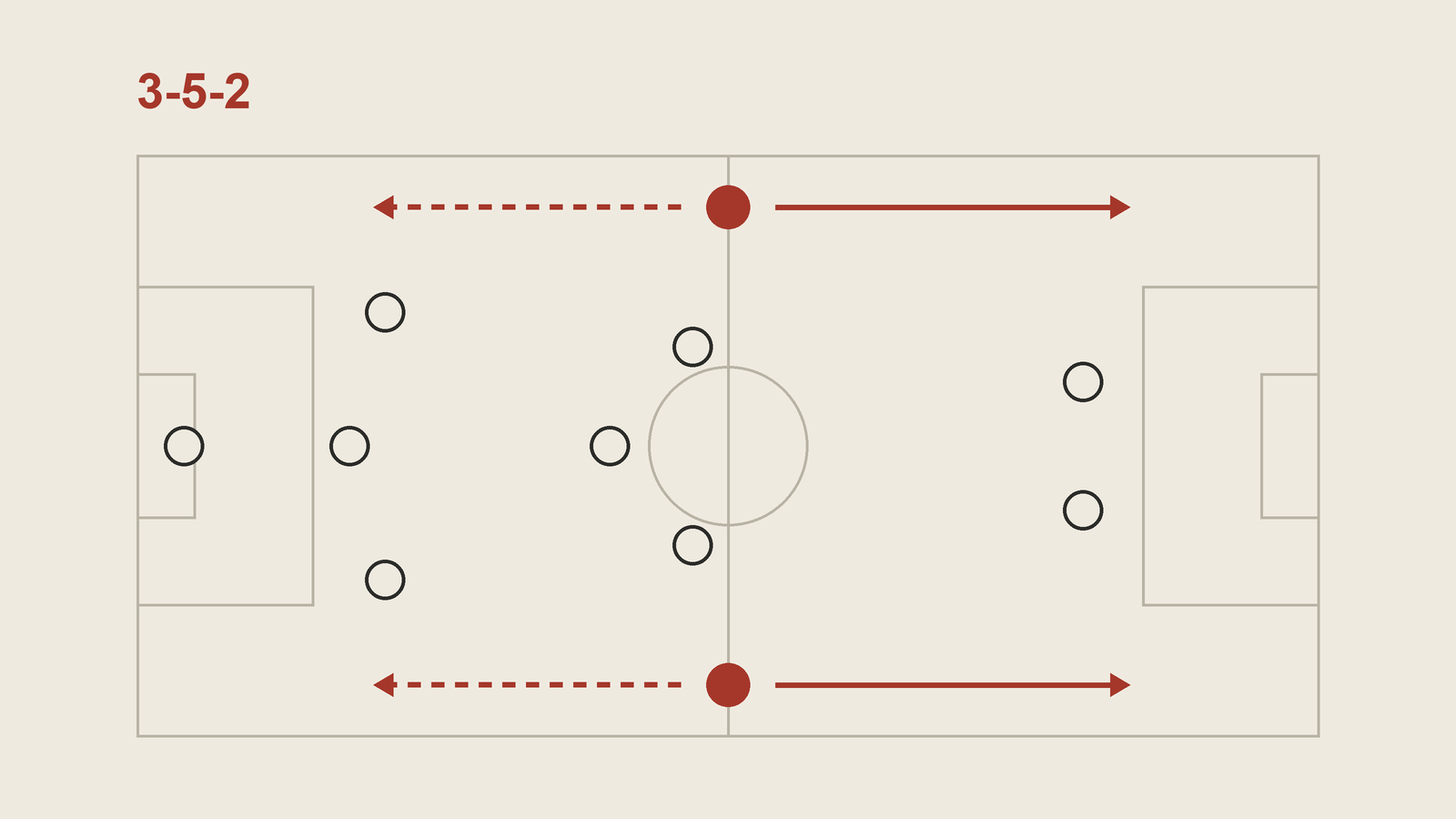
Its close relatives are the 3-4-3 with real wingers, the 3-5-2, which swaps one ten for a second striker and a third midfielder, and the 4-2-3-1, which shares the double pivot and the tens behind a lone forward. For the wider family of three-centre-back systems, see the back three.
How to beat it and how to spot it
To spot it, look at the front three. If the two players beside the striker stand inside the width of the penalty area rather than on the touchline, and the only players hugging the line are wing-backs, it is a 3-4-2-1 rather than a 3-4-3. Without the ball, count the defenders: a line of five with two midfielders just ahead is the giveaway.
To beat it, attack the space behind the wing-backs. Wingers who stay high and wide pin them back, and quick switches make the back three slide further than it would like. In midfield, a third central player can outnumber the double pivot if the tens are slow to drop. Closing the half-spaces where the tens want to receive takes away its best weapon.
FAQ
What is the difference between a 3-4-2-1 and a 3-4-3?
The positions of the two players beside the striker. In a 3-4-3 they are wingers who hold the width; in a 3-4-2-1 they are tens who play inside, behind the striker. Coaches' Voice treats the 3-4-2-1 as a variant of the 3-4-3, and many teams move between the two during a match.
Is the 3-4-2-1 a defensive formation?
Not by design. It has five defenders when the wing-backs drop, but in possession it attacks with five players across the front. How defensive it looks depends on how deep the wing-backs sit and whether the tens press or drop into a 5-4-1.
Which players are most important in a 3-4-2-1?
The wing-backs and the two tens. The wing-backs supply all the width and must cover the whole flank. The tens decide whether the team can play through the middle, because they receive between the lines and link the midfield to the striker.
What formation did Xabi Alonso use at Leverkusen?
Coaches' Voice describes a 3-4-3 in his first season, 2022-23, and a more permanent 3-4-2-1 in 2023-24, with Florian Wirtz and Jonas Hofmann as the tens. That season Leverkusen won the Bundesliga without losing a league match.
Sources and further reading
- The 3-4-3: football tactics explained — Coaches' Voice
- Xabi Alonso: Bayer Leverkusen tactics — Coaches' Voice
- Tactics Corner: How Xabi Alonso's Bayer Leverkusen neutralised Thomas Tuchel's Bayern Munich — Bundesliga.com
- Formation (association football) — Wikipedia
- 2023-24 Bayer 04 Leverkusen season — Wikipedia