Formations and roles · Analysis
5-3-2 Formation: Five at the Back, Two Up Front, and a Plan for Winning the Ball Deep
The 5-3-2 plays three centre-backs, two deep wing-backs, three central midfielders and two strikers. How it defends, counters, and how to break it down.
By 01 Owen
· Updated 4 Oct 2026 · 8 min read
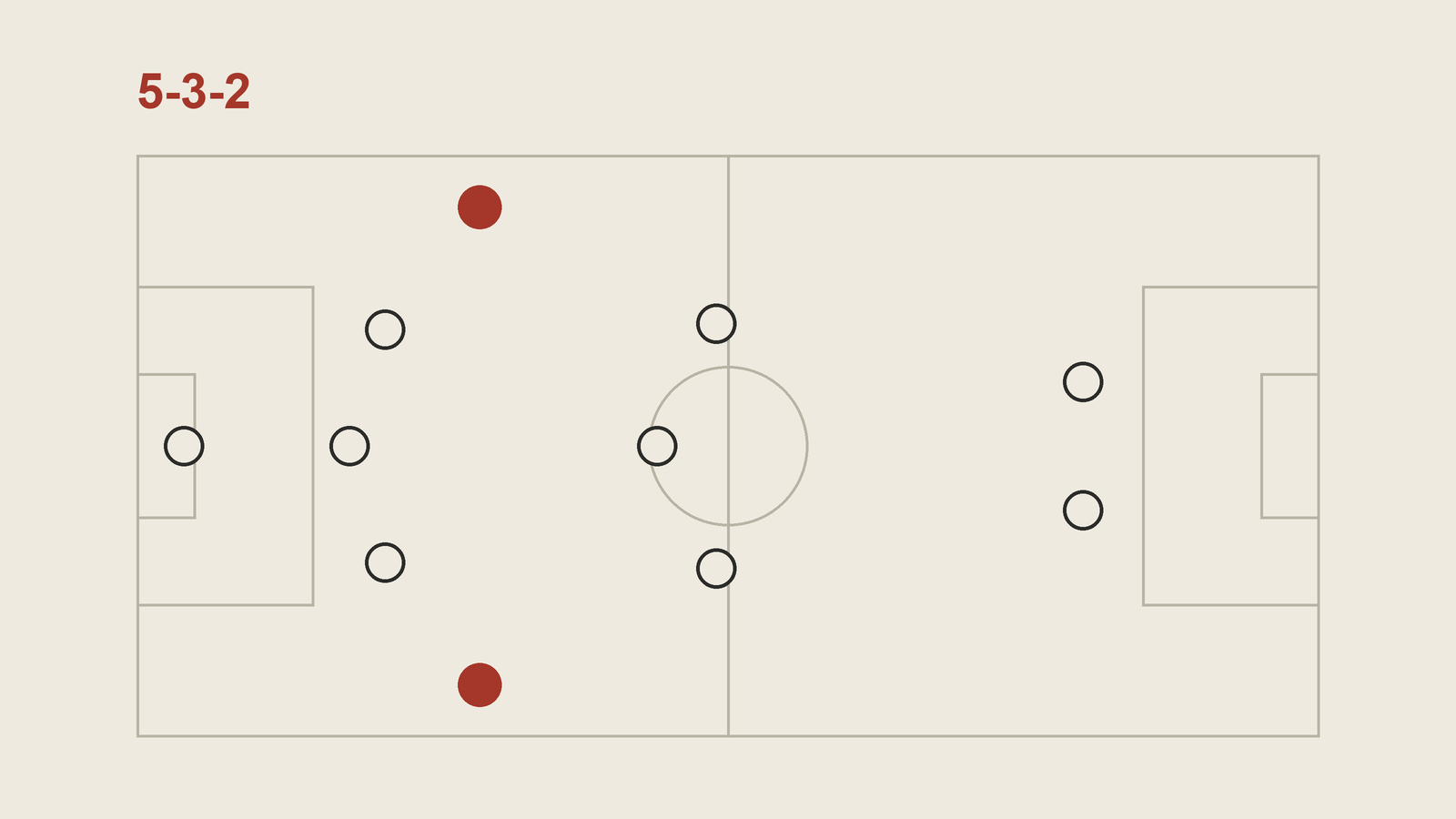
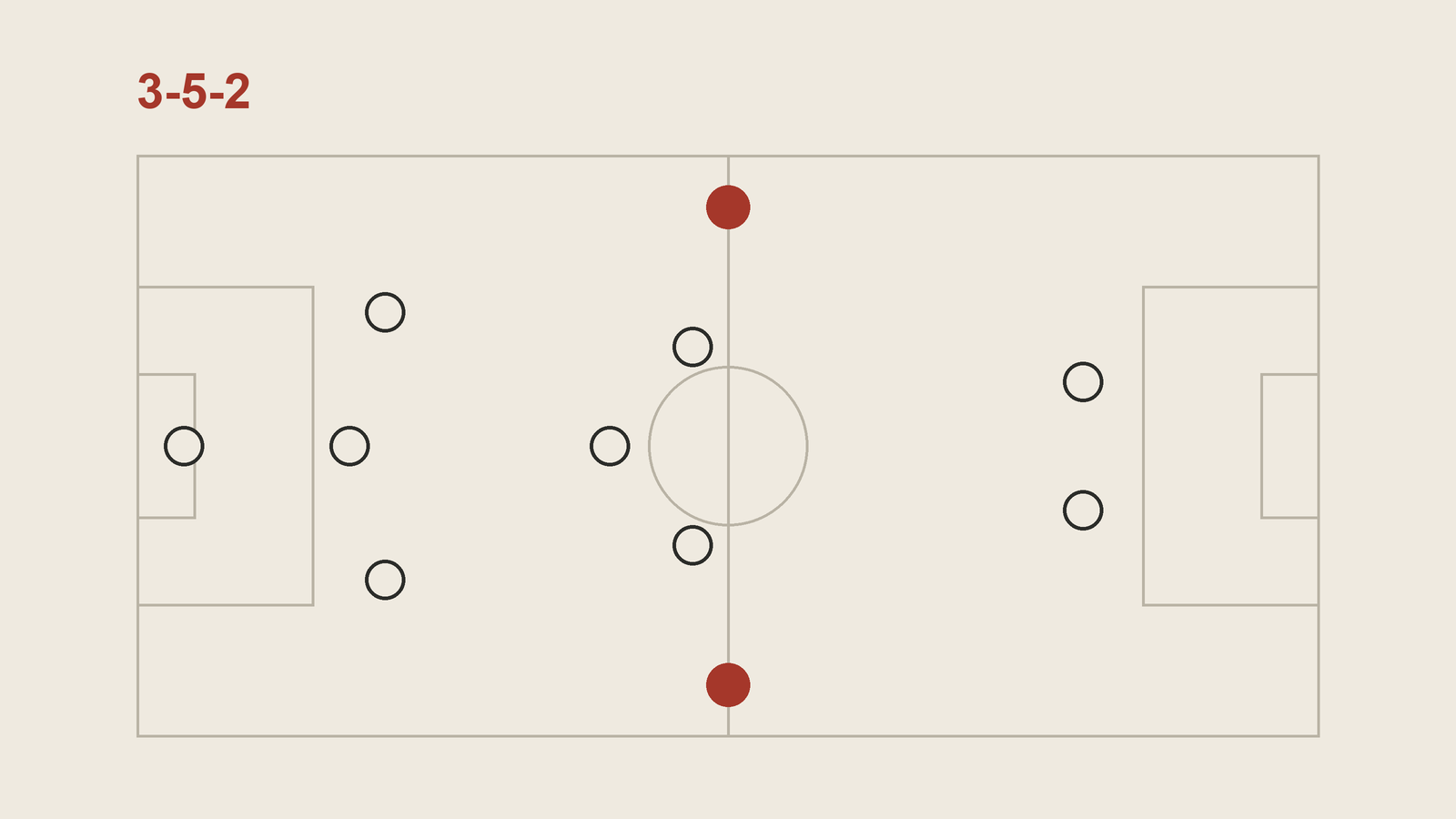
The 5-3-2 is a formation with five defenders, three central midfielders and two strikers. The five are three centre-backs and two wing-backs who start level with them, which makes it the defensive reading of the same eleven positions a 3-5-2 uses.
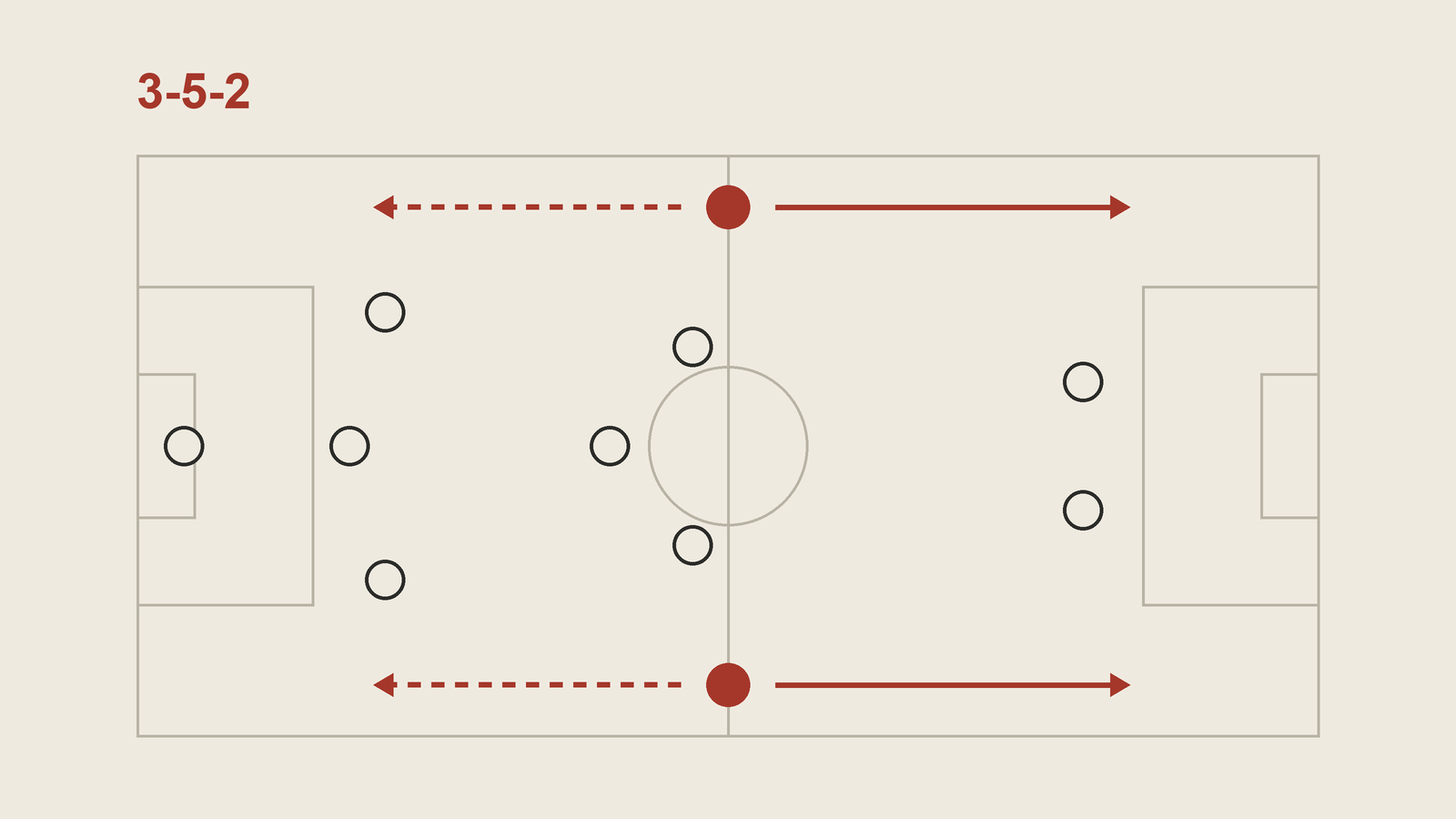
On paper, the 5-3-2 and the 3-5-2 contain the same players in the same slots. What separates them is where the two wide players stand when the opponent has the ball, and what the coach asks of them when his own team has it. A 3-5-2 treats its wing-backs as midfielders who sometimes defend. A 5-3-2 treats them as defenders who sometimes attack. The Wikipedia entry on formations draws the line in a similar place: the 3-5-2 usually has three classic centre-backs and wing-backs oriented towards attack, while the 5-3-2 may use one of the three as a sweeper.
The shape, player by player
Three centre-backs. The middle one is the organiser. Historically he was often a libero, a free defender covering behind two markers; in modern versions he is more likely to be level with the others and to step out with the ball. The two outside centre-backs are the players who make the shape work without the ball. Because there is a spare central defender, they can follow a striker or a winger out of the line, confident that the gap behind them is covered.
Two wing-backs. They are the only wide players in the team. In a 5-3-2 they start deep and are judged first on defending: holding the touchline, stopping crosses, tracking runners to the far post. When the ball is won they are also the team's main source of width, which is why the wing-back role combines the work of a full-back and a winger and covers more ground than any other position.
Three central midfielders. Usually one defensive midfielder screens the back five, with two box-to-box midfielders either side of him. Their job without the ball is to stay narrow and close to the defence, so that the space between the lines is too small to receive in.
Two strikers. The pair gives the formation its point. One usually works as a target, receiving long passes with his back to goal and holding the ball up. The other runs into the channels and beyond. Together they keep the opponent's centre-backs busy even when the rest of the team is camped deep. Both are striker jobs, split between two players.
How it attacks
The 5-3-2 is not built to keep the ball for long spells. Its natural attacking move is the counter-attack: win the ball deep, find a striker quickly, and get runners forward before the opponent's shape recovers. Coaches' Voice's explanation of the low block makes the logic plain. Once a deep team wins possession, there is space in behind the opponent, especially down the flanks if their full-backs have pushed on. The catch is distance. The goal is a long way off, so counters need quick, incisive forward play and a forward who can hold the ball up while support arrives.
Two strikers help: one lays the ball off while the other runs, and the opponent's centre-backs cannot both step up without leaving a runner free.
The other attacking route is the wing-backs. When the team settles into possession they move up, the shape becomes a 3-5-2, and the three centre-backs give a solid base to build from. The outside centre-backs can carry the ball into the space the wing-back has left, and one central midfielder can drift into the half-space to connect with a wing-back on the outside.
How it defends
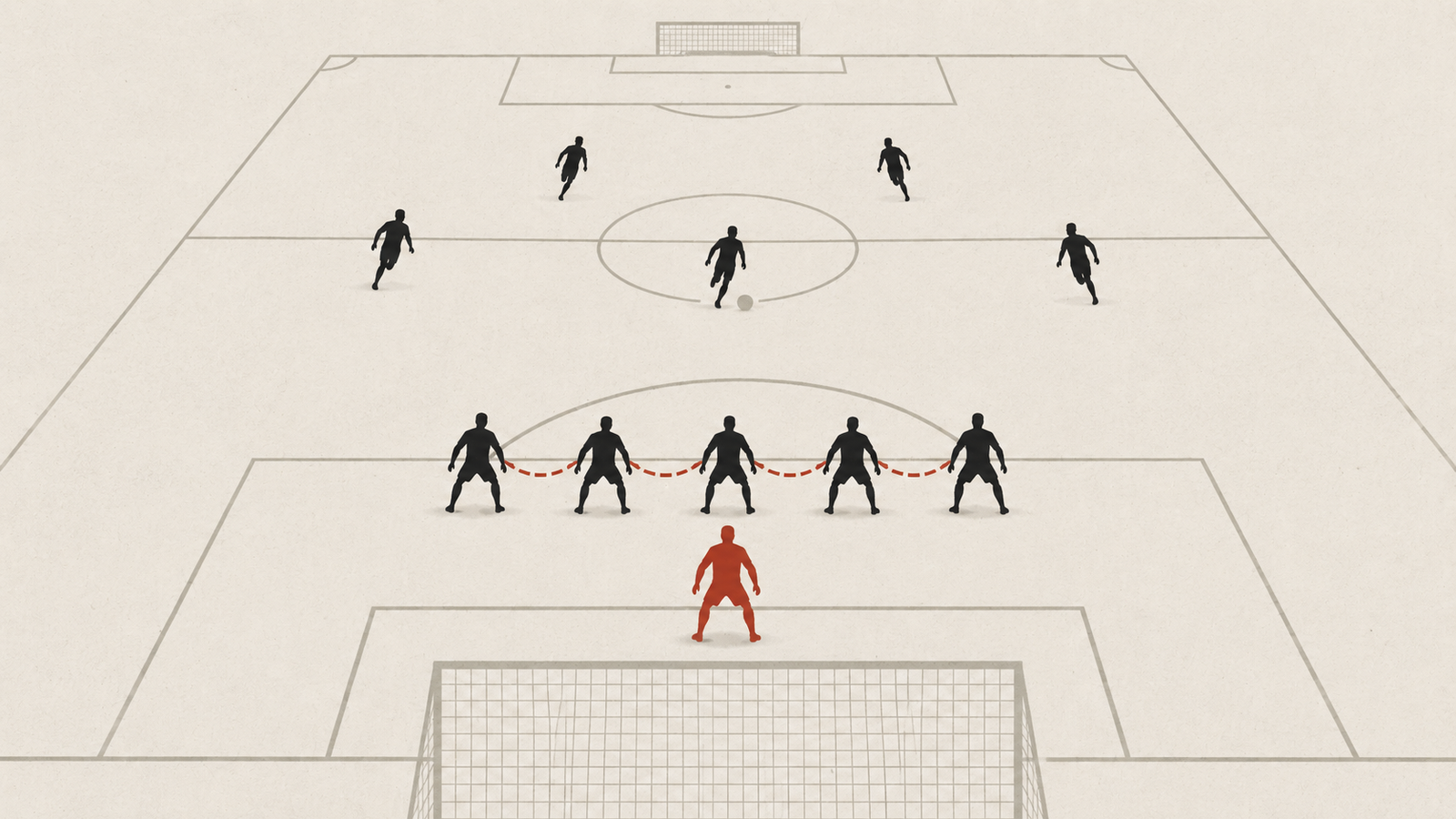
This is what the formation is for. Without the ball it becomes a low block: a line of five across the width of the penalty area, a line of three just in front, and two strikers screening passes into the opponent's holding midfielder. Coaches' Voice describes the same picture for back-five teams: when they drop into a low or mid-block, the wing-backs recover into the line to make a unit of five.
Five defenders solve problems a back four struggles with. Each wing-back can stay with an opposing winger without a centre-back having to slide across. A striker who drops off can be followed by an outside centre-back, because two remain. Crosses face three central defenders rather than two.
Low-block teams depend on players refusing to be drawn out of position to win the ball, because one defender stepping out at the wrong moment creates the gap the attack is looking for. The pressure point is the midfield three. They cannot cover the full width alone, so they have to choose between protecting the centre and closing down a player on the flank.
Who made it famous
The history runs through Italian defensive football. Karl Rappan's verrou, which he proposed in 1932 while coaching Servette, put a spare defender behind the defence. Italian coaches developed that idea after the war into catenaccio, and Helenio Herrera's 5-3-2 at Inter in the 1960s is the version people remember. According to Wikipedia's catenaccio article, Herrera's side won three Serie A titles, two European Cups and two Intercontinental Cups. The method was a sweeper behind man-markers and quick counters with long balls.
The formation did not stay purely defensive. Brazil won the 2002 World Cup with a 5-3-2 whose wing-backs, Cafu and Roberto Carlos, are among the best-known players ever to fill the role. They show the shape's other face: two of the five defenders spent much of the game in the opponent's half.
Back-three systems in general returned to fashion through coaches who used the 3-5-2 and let it drop into five. Coaches' Voice credits Antonio Conte with bringing the 3-5-2 back into vogue at Juventus, Italy and Inter. It also notes José Mourinho reaching a Europa League final with Roma in the shape, and Diego Simeone moving Atlético Madrid to back-five structures from 2020-21 after years of a classic 4-4-2. Their teams often dropped into a five-man back line without the ball.
Strengths and weaknesses
The strengths are clear. Width and depth are covered at once, so it is hard to find space in behind or a free player on the flank. The spare centre-back lets the others defend aggressively. Two strikers keep a counter-attack threat alive even when the team is pinned back. And the whole spine, three centre-backs, a holding midfielder and two forwards, is strong down the middle.
The weaknesses come from the same choices. With five defenders and two strikers, only three players are left in midfield, and they can be outnumbered by a team with four or five central players. The wing-backs have an enormous amount of running to do, and if they tire, the team loses its width. Most of all, a 5-3-2 that defends deep for long periods gives the opponent the ball and the territory. It may concede few clear chances but many long shots and crosses.
How it changes in and out of possession
In possession the wing-backs push up and the shape becomes a 3-5-2, or a 3-3-4 when both wing-backs reach the front line. Out of possession it is the 5-3-2. If one striker drops into midfield to help, it becomes a 5-4-1, the even more defensive variant. Wikipedia lists Greece's 2004 European Championship winners as a 5-4-1 side that won every knockout game 1-0, and its catenaccio article notes Traianos Dellas operating as their sweeper.
The 5-3-2 also sits inside the wider family of back three systems, and it is a natural shape for building rest defence: even with both wing-backs high, three centre-backs and a holding midfielder remain behind the ball.
How to beat it and how to spot it
To spot it, watch the wide players when the ball is lost. If they sprint back to stand level with three central defenders, the team is in a 5-3-2. If they stay in midfield, it is closer to a 3-5-2 or a 3-4-3. Two strikers staying high while everyone else drops is the other giveaway.
To beat it, attack the midfield three. Overload them centrally with an extra midfielder, then switch the play quickly, because three players cannot slide across the pitch as fast as the ball travels. Pin the wing-backs with high, wide wingers so they cannot join the attack. When the ball is lost, defend the space in behind your own full-backs first, because that is exactly where the 5-3-2 wants to counter. For an overview of every role mentioned here, see football positions.
Is a 5-3-2 the same as a 3-5-2?
They use the same eleven positions. The difference is where the wing-backs stand and what they prioritise. In a 3-5-2 they play as midfielders and push high; in a 5-3-2 they start level with the centre-backs and defend first. Most teams move between the two shapes many times in a match.
Is the 5-3-2 a defensive formation?
Usually, yes. With five defenders and the wing-backs starting deep, it is built to protect the penalty area and counter-attack. Teams with attacking wing-backs can still play it boldly, as Brazil did at the 2002 World Cup with Cafu and Roberto Carlos.
Does the 5-3-2 use a sweeper?
It can. Historically the middle centre-back was often a libero playing behind two man-markers, as in Helenio Herrera's Inter. Modern versions usually keep all three centre-backs on one line and use zonal marking, so the middle player organises rather than sweeps.
Sources and further reading
- Formation (association football) — Wikipedia
- Catenaccio — Wikipedia
- Wing-backs: football tactics explained — Coaches' Voice
- The 3-5-2 formation: five key points — Coaches' Voice
- The low block: football tactics explained — Coaches' Voice